II.ϟϟ-Panzerkorps; Fire Brigades at River Mius Front

SS-Sturmbannführer Christian Tychsen
SS-Untersturmführer Joachim-Günther Schöntaube


It took SS-Panzergrenadier-Division Das Reich and Totenkopf only a few days to disengage from the Prokhorovka region (Russia) after the end of Operation Citadel, II.SS-Panzerkorps was loaded onto trains and sent off into a bloody frontal assault on the River Mius Front (southeastern Ukraine). The Waffen-SS were used as fire-brigades to plug gaps in the German line wherever they occurred. The SS panzers may have been masters of the battlefield at Prokhorovka but the “Fire Brigades” bled white on the Mius Front between July and August 1943. They lost irreplaceable men and equipment at a crucial time when the fate of the Eastern Front hung in the balance. The SS-Panzer Corps eventually drove the Soviets from their bridgehead across the Mius. Only a few tanks escaped after the SS corps finally broke the back of Soviet resistance on the western bank of the river. Credit: author Tim Ripley. Left image: SS-Stubaf. Christian Tychsen of SS-Panzer-Regiment 2 Das Reich was awarded the Oakleaves to his Knight's Cross after the many bloody battles fought in the southern sector during the summer and fall of 1943. Photo probably taken in connection with the award of the Oakleaves on Dec. 10 1943. After being wounded more than nine times in total, Tychsen was killed during the Battle of Normandy on July 28 1944. He died, aged 33, of his wounds in American captivity. Credit: Bekors. c. Bundesarchiv. Right image: SS-Ustuf. Joachim-Günther Schöntaube, Tiger commander of SS-Panzer-Regiment 2 Das Reich. The Tank Destruction Badge is from his time in the Recon Bn. Schöntaube made SS-Ostuf. before the end of World War II. Credit: Vitaly Lopatin. c. Bundesarchiv.

Soviet Belgorod-Bogodukhov Operation

Panzerjäger Tiger Ferdinand n°232 of s.Pz.Jg.Reg. 656
Panzerkampfwagen Tiger n°211 of 2.s.Pz.Abt. 503
Waffen-SS Panzergrenadiers on the Eastern Front
The Belgorod (Russia) - Bogodukhov (Ukraine) Offensive Operation in August 1943 was another Soviet operation that followed the Battle of Kursk. In the fighting that took place on both sides of the Merla and Merchik rivers, the superiority of the Waffen-SS was clearly evident, in spite of being involved in combat operations continuously since July 5 1943. Whilst SS-Panzergrenadier-Division Wiking and 3.Panzer-Division of the Wehrmacht conducted primarily defensive operations, SS-Panzergrenadier-Division Das Reich and Totenkopf repeatedly blunted attacks of Soviet elements south of the rivers and Bohodukhiv. As at Prokhorovka, the Soviets enjoyed tremendous numerical superiority in tanks. Both 1st Tank Army and 5th Guards Tank Army began the operations with over 500 tanks each, while the SS Divisions never had more than about 30-50 tanks each at any time during this offensive, in spite of this, all Soviet attempts to penetrate to the railroad line were repulsed with bloody losses in men and tremendous loss in tanks. Belgorod was finally retaken on August 6 1943 and the way was now clear for the concentration of Soviet forces for the final battle of Kharkov. Credit: Wikipedia inter alia. Top image: Panzerjäger Ferdinand n°232 from schwere Panzerjäger-Regiment 656, named after SS-Oberführer Ferdinand Porsche, founder of Volkswagen and Porsche. The schwere Panzerjäger-Abteilung 653 fought at the Battle of Kursk in July 1943 and the subsequent Soviet counterattacks. In July 1943, the 653rd claimed 320 Soviet tanks and self-propelled guns and a large number of anti-tank guns and motor vehicles for 24 killed in action, 126 wounded and 13 vehicles destroyed. In August 1943, it fought around the Dnieper as the 1st battalion of s.Pz.Jg.Reg. 656. The Ferdinand heavy tank destroyer were later renamed Elefant. Credit: Rui Manuel Candeias. FU. Middle image: PzKpfw. Tiger n°211 of 2.s.Pz.Abt. 503 in the Belgorod area in August 1943. Credit: Ghermán Mihály. c. Bundesarchiv. Bottom image: battle-hardened SS-Panzergrenadiers in the summer of 1943, prepared to take down any Soviet armour which might come their way. Photo by SS-Kriegsberichter Max Büschel. U.S. National Archives.

Soviet Operation Polkovodets Rumyantsev: Casualties and losses

Pz.Kpfw. Tiger n°122 of s.Pz.Abt. 503
Wiking volunteer with fellow Wehrmacht conscripts
Wehrmacht infantry riding on a StuG III Assault Gun 
The Soviet Belgorod-Kharkov Offensive Operation, codenamed Op. Polkovodets Rumyantsev,
 on August 1943 was to break along an axis from Belgorod to Kharkov to drive the German Army Group South back to the River Dnieper in Ukraine. To ensure the success Soviet dictator Joseph Stalin massed 1,144,000 men and 2,418 tanks according to Russian military historian Grigoriy Fedotovich Krivosheyev and G. A. Koltunov. They faced the 4.Panzer-Armee and Armee-Abteilung Kempf, which had received no respite since the end of Operation Citadel. They mustered only around 200,000 men and less than 250 tanks and assault guns between them. The vicious fighting during the withdrawal from Kharkov cost SS-Panzergrenadier-Division Das Reich, Totenkopf and Wiking dearly and by this time they were approaching breaking points. Soviet casualties during the autumn offensives were horrendous, but the Soviet High Command was prepared to accept the losses. To prevent his soldiers deserting the front line, Stalin ordered special 'blocking detachments' to shoot all deserters, in other documented cases, the Soviet Red Army marched their own men at gunpoint through German minefields to detonate the mines. As a result, the communist forces suffered heavy casualties in the Belgorod-Kharkov offensive: according to official Soviet sources an estimated 255,566, including 71,611 killed and missing. According to German historian Karl-Heinz Frieser, Wehrmacht and Waffen-SS units suffered 25,068 casualties, including 8,933 killed and missing. Top clip: Tiger n°122 of schwere Panzerabteilung 503 in Ukraine in 1943. Credit: Gabriel Bîrsanu. Die Deutsche Wochenschau. Middle image: an SS-Scharführer of the Wiking division in conversation with regular Wehrmacht troops. The Wehrmacht regarded the Waffen-SS as thoroughly reliable comrades. Respect born of shared frontline experiences. c. Bundesarchiv. Bottom image: Wehrmacht infantry from unknown unit riding on a Sturmgeschütz III Assault Gun somewhere on the Eastern Front in 1943. Credit: Ryan N81. c. Bundesarchiv.

Soviet Lower Dnieper Offensive and Scorched-Earth Policy

German infantry in the Ukrainian steppe
Scorched earth-policy in Ukraine
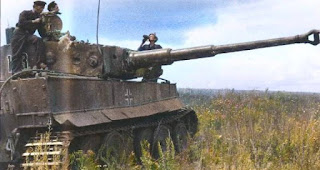
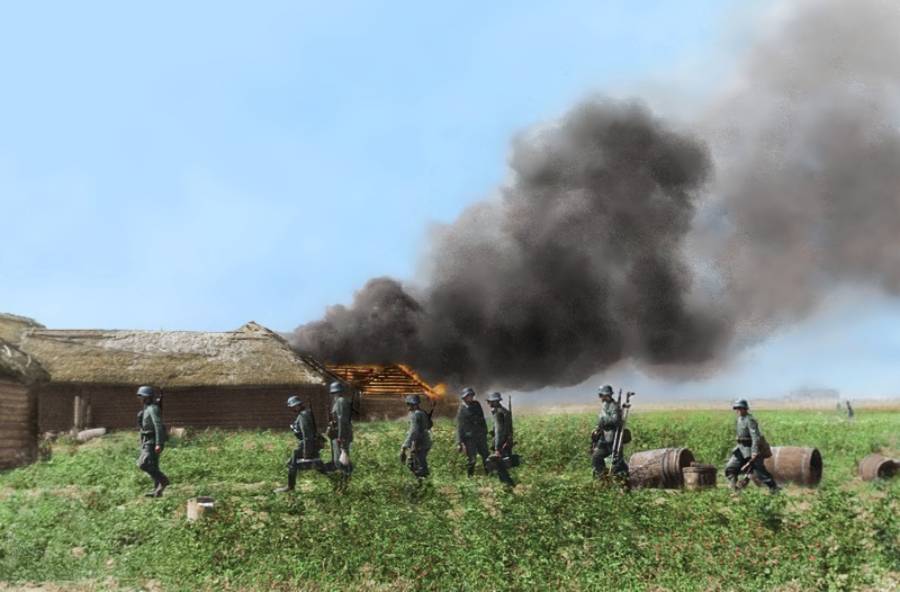
Nazi dictator Adolf Hitler reluctantly agreed on Sept. 15 1943 to allow Gen.Feldm. Erich von Manstein to pull his troops back behind the Dnieper. The Das Reich, Totenkopf and Wiking Divisions were now operating under the command of the German 8th Army during the withdrawal back to the Dnieper at Kremenchug. The three once-proud SS-Panzergrenadier divisions were now badly weakened by almost three month of constant combat. Fortifications were erected along the length of the Dnieper. However, there was no hope of completing an extensive defensive line in the short time available. Instead, they were concentrated in areas where a Soviet assault-crossing were most likely to be attempted. Additionally, on Sept. 7 1943, the Wehrmacht and the Waffen-SS received orders to implement a scorched-earth policy, by stripping the areas they had to abandon of anything that could be used by the Soviet war effort. Whilst the scorched-earth policy ordered by Hitler in 1943 is widely-known, less known is that the Soviet dictator Josef Stalin announced a scorched-earth policy from the initial days of the Barbarossa in 1941. This policy adopted by the retreating Soviets resulted in untold misery and death for a large but unknown numbers of Soviet civilians. Notable historic examples of scorched-earth tactics include the Russian army's strategy during the Swedish invasion of Russia in 1708, the Napoleonic invasion of Russia in 1812 and the initial Soviet retreat during the German invasion of the Soviet Union in 1941. Top image: a Tiger tank crew taking a break while the tanker in the top turret stares straight ahead on the exposed eastern steppe. c. Bundesarchiv. Middle image: German infantry crossing a Ukrainian village in flames. Photo by the well-known Kriegsberichter Feldwebel Arthur Grimm. Credit: Facundo Filipe. Originally published in the Nazi-era propaganda magazine Signal. It was published fortnightly in as many as 25 editions and 30 languages. Bottom clip: Eastern Front's southern section in the fall of 1943. Die Deutsche Wochenschau.

8.ϟϟ-Kavallerie-Division (Florian Geyer)

8.SS-Kavalleriedivision
The controversial SS-Kavallerie-Division was formed in 1942 and had a substantial proportion of its manpower involved in internal security operations and anti-partisan warfare in the rear behind the German front line. More than 40 percent of the division were Volksdeutsche from Romania and Serbia. It became caught up in an unusually cruel and merciless cycle of warfare characteristic of partisan activities. The results are often disturbing and sometimes inexcusable, but not unique to World War II or the German Military Forces. Previous to Operation Citadel a large campaign had been conducted by these forces to secure the supply lines to the front with the 8.SS-Kavallerie-Division as the major formation. Others were small East-European foreign volunteer units that were attached to Army Group Center. In September 1943 the division was moved to the Southern front where it took part in the German retreat to the Dnieper river, now having a military rather than police characterAfter having proved itself it was retitled 8.SS-Kavallerie-Division Florian Geyer in March 1944. Only about 800 men of the Florian Geyer and only some 170 conscripts of the Hungarian Volksdeutsche 22.SS-Freiwilligen Kavallerie-Division (Maria Theresia) which was formed from the cadre of Florian Geyer escaped the Siege of Budapest in February 1945. Credit: Waffen-SS EncyclopediaRight image: according to German military historians Wolfgang Fleischer and Richard Eiermann, the pictured soldiers were ethnic Germans from Romania belonging to the 8.SS-Kavallerie-Division. Credit: Karl Mensburg. Commons: Bundesarchiv. Right image: cavalrymen of the 8.SS-Kavallerie-Division using anti-tank Teller mines against Soviet T-34s near the Ukrainian Dnieper in late September 1943. Credit: Lex. Commons: Bundesarchiv.

Battle of the Lower Dnieper: Casualties and losses

SS-Obersturmführer Karl-Heinz Boska
Defeated and broken German Prisoner of War
The Soviet Lower Dnieper Offensive (August 24 1943 – December 23 1943) was one of the costliest operations of World War II. The Soviets mustered about 2,633,000 men according to historian Karl-Heinz Frieser: the Germans about 1,250,000 men (600,000 Romanian and 350,000 German Reinforcements). Casualties during the Battle of Dnieper are still a subject of a heavy debate. The Soviet casualties are estimated at being from 1,300,000 to 1,800,000 including 300,000 to 550,000 killed. The Russian historian Nikolaï Shefov (Russian fights) puts the figure of 1,500,000 total Soviet casualties including 373,000 killed. During this four-month operation, the eastern bank of the Dnieper was recovered from German forces. Subsequently, Kiev was liberated in a separate offensive. German losses, however, are more difficult to evaluate. The simple rule of 3:1 losses during an offensive operation against a heavily defended enemy would lead to a 500,000 total casualties. Credit: Wikipedia inter alia. Left image: a photo of Das Reich officer Karl-Heinz Boska, probably taken in connection with his promotion to SS-Obersturmführer on December 16 1943. On the morning of September 13 1943 near Bolschaja Grab, Soviet infantry mounted a large and dangerous surprise attack on Das Reich's II.Panzer-Abteilung Headquarters. the then SS-Untersturmführer Karl-Heinz Boska, rallied and led five Panzers in a ferocious counterattack that destroyed 12 anti-tank guns, two field guns and killed over 300 Soviet troops, earning him an immediate recommendation for the Knight's Cross of the Iron Cross by the Divisional commander, SS-Gruppenführer und Generalleutnant Walter Krüger. Knight's Cross holder Karl-Heinz Boska died aged 84 on October 22 2004 in Raisdorf near Kiel. Credit: Matthias Ruf. Commons Bundesarchiv. Right image: screenshot from a Russian USSR film showing a defeated Wehrmacht soldier during the Soviet offensives in Ukraine in 1943, possibly staged shoot for Soviet propaganda purposes to glorify the victories of the Red Army. PD.

Battleground Kiev-Zhytomyr and Casualties in the Second Battle of Kiev

SS-Panzergrenadier-Regiment 4 Der Führer of Das Reich
Leibstandarte SS Kradschützen in the Zhytomyr area
Leibstandarte SS Tigers in the Zhytomyr area
Leibstandarte SS Panzergrenadiers during the Rasputitsa
The Soviets launched a massive offensive to seize Kiev in Ukraine on early November 1943. Soviet tank tactics continued to be unimaginative, allowing small groups of 1.SS-Panzer-Division Leibstandarte SS and SS-Kampfgruppe Das Reich of the 2.SS-Panzer-Division Das Reich panzers to defeat numerically superior forces. The Soviets captured Kiev on November 6 1943. The second phase of the Soviet offensive now began. Zhytomyr was taken by the Soviet 38th Army on November 12 1943 but the Soviet advance came to a halt as the I Guards Cavalry Corps troopers looted the German 4th Army's alcohol stocks. When the Soviet Red Army finally at a high cost in casualties broke through southwest of Kiev during December 1943 it pushed the 4.Panzer-Armee back over 160 km, leaving the 8th Army's right flank dangerously exposed, it was the only German formation with a foothold on the southern banks of River Dnieper. Though the Soviets had failed to break the rail link with Army Group Center or envelop Army Group South, they had broken the Dnieper line, and inflicted massive casualties on the 4.Panzer-Armee. The Germans, for their part, had destroyed several sizable Soviet formations and kept the vital rail link open. According to historian Karl-Heinz Frieser Soviet casualties in the Second Battle of Kiev are estimated at around 118,042 men, including 28,141 killed and missing, the German casualties were 16,992 men, including 2,628 killed and 1,281 missing. Top image: with Tiger S22 in the background Austrian volunteer the then SS-Oberscharführer Adolf Peichl congratulates SS-Hauptsturmführer Hans Soretz on the destruction of the Das Reich divisions 2000th enemy tank. The photo was taken near the Dnieper River in early November 1943. The tank's Chinese good luck character Fu written upside down can clearly be seen in this photograph. SS-Untersturmführer Adolf Peichl was one of the 98 out of the millions who fought for the Greater German Reich in World War II who received both the Knight's Cross and the Close-Combat Clasp in Gold. He wears, among others, the German Cross in Gold and no less than five Single-Handed Tank Destruction Badges on his right arm. Peichl destroyed another five tanks in close combat and finished the war with the Wound Badge in Gold. He died aged 51 on June 4 1969 in his home town of Vienna. Photo by SS-Kriegsberichter Willi Merz. Credit: Dominik Štrok. Commons: Bundesarchiv. Second image: motorcycle troops of the Leibstandarte SS during a short break in 1943. Photo by SS-Kriegsberichter Max Büschel. Credit: Karl Mensburg. U.S. National Archives. Third image: Tigers of 13.schwere Kompanie of SS-Panzer-Regiment 1 of the Leibstandarte SS in November 1943. Credit: Doug Banks. Commons: Bundesarchiv. Bottom image: soldiers of the Leibstandarte SS struggle with the mud in the Zhytomyr Oblast during the Rasputitsa – the season without roads – in November 1943. Credit: Jean M. Gillet. Commons: Bundesarchiv.

5.ϟϟ-Panzerdivision „Wiking“ (XI.Armeekorps)

5.SS-Panzer-Division Wiking
Battle-hardened Volunteers of the Waffen-SS
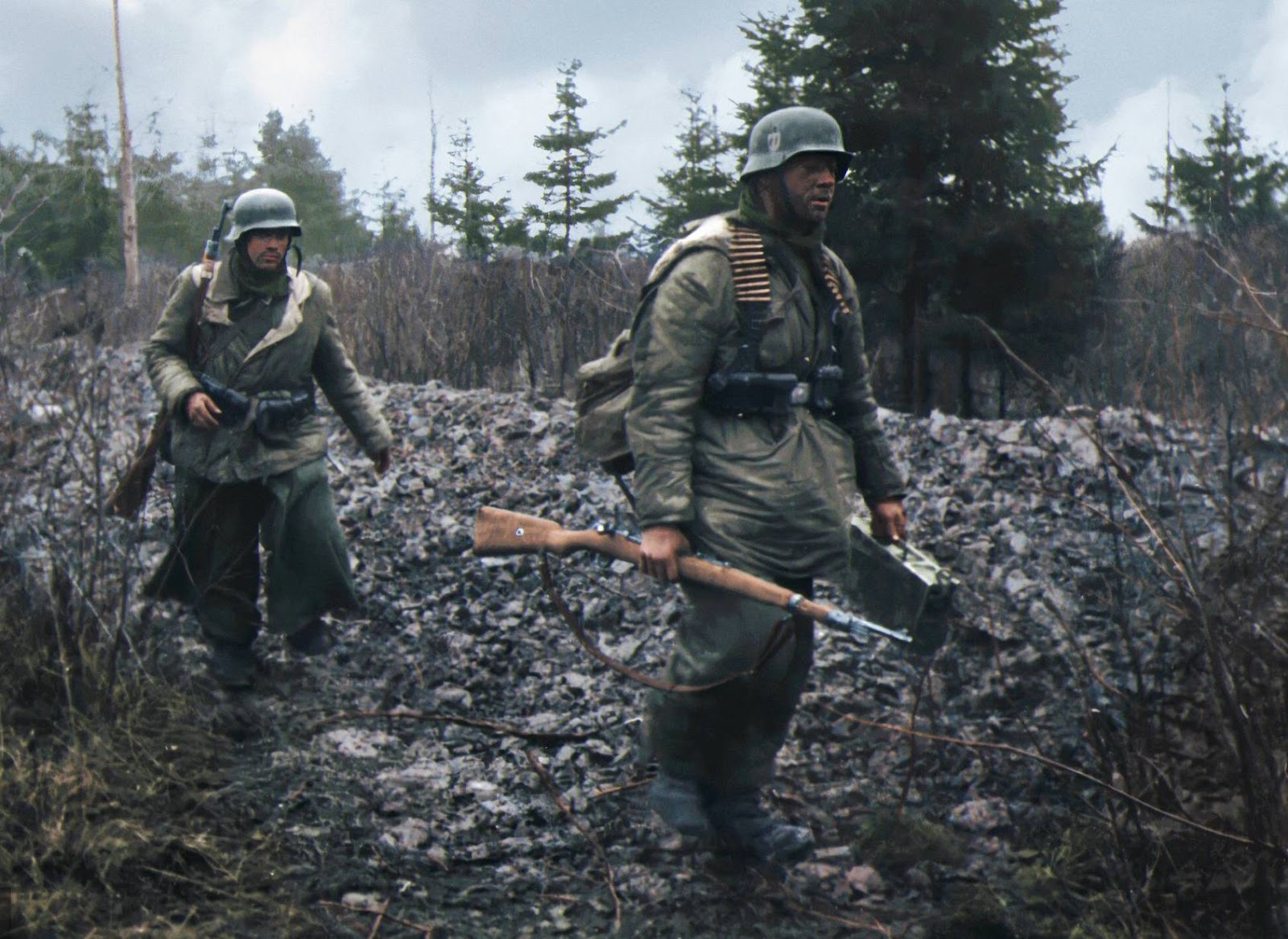
SS-Panzer-Grenadier-Division Wiking was redesignated as the 5.SS-Panzer-Division Wiking on October 22 1943 even though it had not been converted into one. Essential elements were still missing, which had not yet been sent to the division from Germany. In front of the division's sector on the Dnieper Front, the Soviets had dug in on the large island in the Dnieper River, the so-called Foxtail Island and was reinforcing his forces there. In the meantime the operational situation along the Dnieper was worsening day-by-day. On November 13 1943 the enemy was able to create a bridgehead at Cherkassy and on November 24 1943, a new and deeper penetration occurred near Kremenchug. A Soviet offensive appeared imminent. And it came. However, it did not emanate from Cherkassy. Instead, it came with powerful forces from deep behind the front. Top image: volunteers of the Wiking relaxing with Russian volunteers enlisted into the Wehrmacht. The photo was taken in November 1943 by the New York–born SS-Kriegsberichter Cornelius Kok who was awarded the Infantry Assault Badge in Bronze before being captured by the Soviets. U.S. National Archives. Bottom image: during a brief lull in the fighting, a Waffen-SS unit sitting down in weary, battle-tired poses. Right knee raised with his right arm resting on it, makes you wonder what happened next. The Panzergrenadiers bore the weight of the fighting in all divisions often carrying on to complete exhaustion. Their faces tell you more about them than any report. Cutline: Battle-weary troops are seen here taking a much-appreciated rest during a lull in the fighting. Their faces are a study in stoicism and determination, characteristics that came to define the men of the Waffen-SS as the campaign in Russia dragged on. PD.

5.ϟϟ-Freiwilligen-Sturmbrigade „Wallonien“ subordinated to „Wiking“

5.SS-Freiwilligen-Sturm-Brigade Wallonien
SS Assault Brigade Wallonien trapped in the Cherkassy pocket
At the conclusion of the fighting in the West Caucasus in the winter of 1942-43, the Légion Wallonie was returned to Belgium to be reconstituted as a mechanized formation and to recruit new members. 5.SS-Freiwilligen-Sturm-Brigade Wallonien was declared combat-ready in Nov. 1943 and was rushed to the middle Dnieper River sector 
on the Eastern Front. Its commander, SS-Sturmbannführer d.R. Lucien Lippert, was a career officer and Lieutenant Colonel in the Belgian Army, who had graduated from the Military School in Brussels at the top of his class. It was placed under the command of the 5.SS-Panzer-Division Wiking near Cherkassy by Nov. 19 1943. The day before the Wiking's commander SS-Gruppenführer Herbert Otto Gille ordered Wallonien into action, skeptical Wiking veterans posted signs around the assembly area: The Wallonia Circus. Free Shows tomorrow from 06:00 to 08:00. These Walloon volunteers proved their worth and fitted well into the division. The last act of the Battle of Cherkasy would soon begin. From Dec. 1943 to Feb. 1944 most of brigade Wallonien and Wiking, along with a number of Wehrmacht divisions, were surrounded in what has become known as the Korsun-Cherkassy pocket. The Wiking's manpower strength was 14,647 officers and men in Dec. 1943. Credit: Peter Straßner: European Volunteers. Top image: SS-Uscharf. Desire Lecocq of the 
Wallonien, he made SS-Ustuf. in 1945 while serving in SS-Panzergrenadier-Regiment 70. Bottom image: Belgian Léon Degrelle, promoted SS-Hstuf. on Jan. 1 1944, with some Walloons in the Cherkassy Pocket. After Lippert was killed by a sniper on Feb. 13 1944, Degrelle took command of the Brigade. FU.

Soviet Zhitomir–Berdichev Offensive

Commander of Soviet 2nd Ukrainian Front Russian Col.Gen. Ivan Konev
Tiger n°S33 of SS-KG Lammerding covered with German Paras
Waffen-SS troops on Eastern Front in late 1943
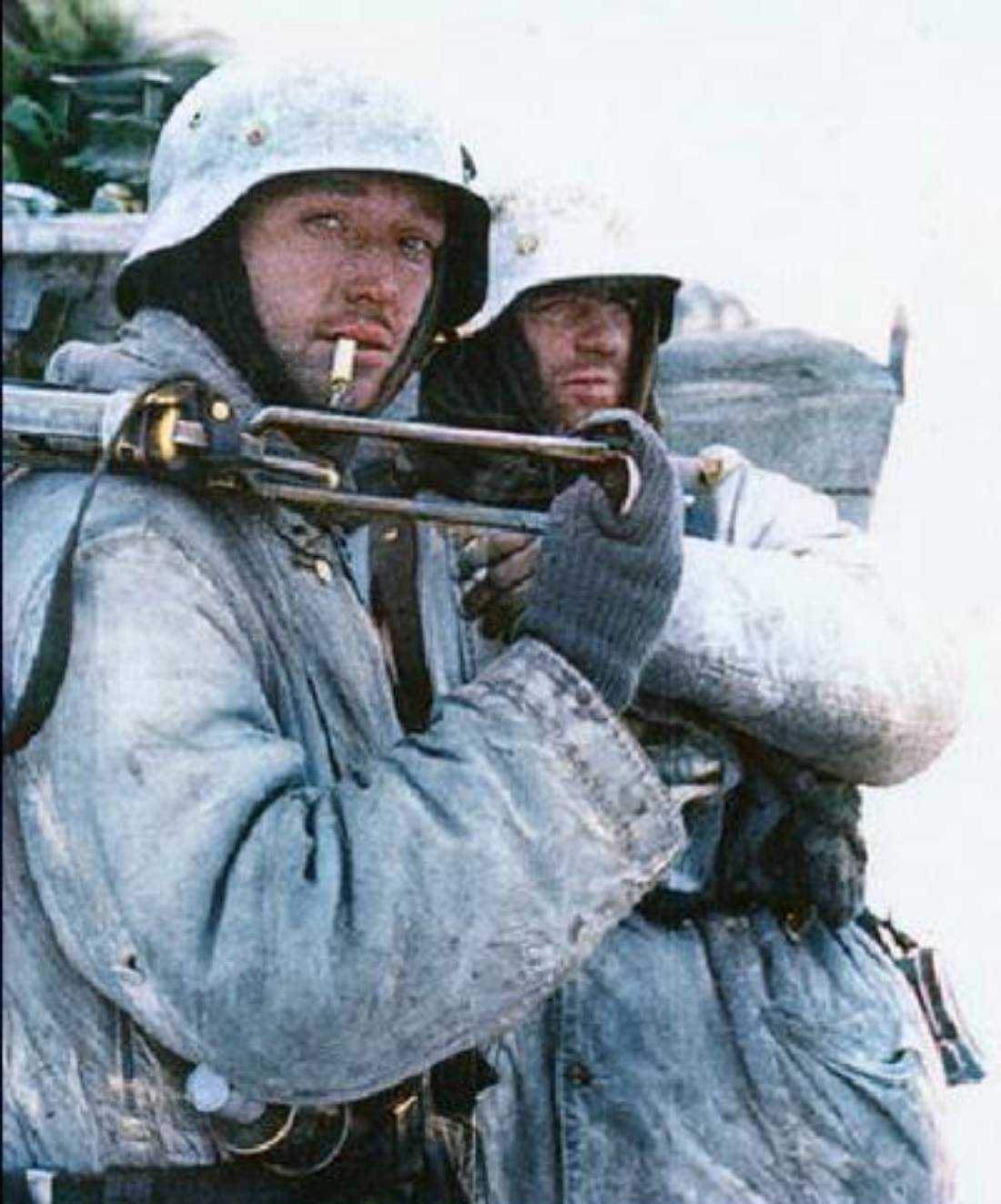
There was no rest on the Eastern front and the bulk of 2.SS-Panzer-Division Das Reich's surviving men were transferred to France on December 17 1943. The division was withdrawn to refit as a fully fledged Panzer Division after constant fighting since Operation Citadel in July. Steady attrition had reduced Das Reich to just six Panzer IVs, four Panthers, and five Tigers left for SS-Kampfgruppe Lammerding of SS-Kampfgruppe Das Reich that remained in action on the south-eastern Front as part of 4.Panzerarmee’s LIX Korps. The Soviets launched the Zhytomyr–Berdychiv Offensive on Christmas eve in 1943, as part of the massive operation known as the Dnieper–Carpathian Offensive, that shattered the Ukrainian Front and threatened to cut off German forces. Generaloberst Hans-Valentin Hube successfully extricated his 200,000 soldiers and inflicted heavy losses on the Red Army, but at a high cost in armor. Except for two Tigers evacuated for factory maintenance, all Das Reich's vehicles were destroyed by April 1944, when SS-Oberführer Heinz Lammerding handed SS-Kampfgruppe Das Reich over to SS-Sturmbannführer Otto Weidinger. After heavy losses, the survivors were now removed from the Eastern Front and rested at Köln-Wahn by May 1944. For his conduct during these battles Heinz Lammerding was awarded the prestigious Knight's Cross and promoted to SS-Brigadeführer in April 1944. He later gained notoriety for his involvement in the Tulle massacre. Top image: Russian commander Colonel general Ivan Konev's armies retook Belgorod, Kharkov and Kiev, which led to the bloody battle of the Korsun–Cherkassy Pocket. Konev openly boasted of his killing of thousands of German prisoners of war during the Red Army's offensive. He was made a Marshal of the Soviet Union in February 1944. Credit: Konstantin Fiev. Soviet Union stock photo. Middle image: German elite paras of the 2.Fallschirmjäger-Division riding on Tiger n°S33 of SS-Kampfgruppe Lammerding in the north-Ukrainian Zhytomyr Oblast in December 1943. Credit: Doug Banks. Commons: Bundesarchiv. Bottom image: Waffen-SS soldiers during the fierce battles fought on the eastern front in Ukraine. The picture is thought to have been taken on December 17 1943. Credit: Julius Backman. FU.

Password: Freiheit, Objective: Lysianka, February 16 1944 at 23:00 – 5.ϟϟ-Panzerdivision „Wiking“ and Battle in Korsun Cherkassy Pocket (I)

Wehrmacht troops on the Eastern Front
Whitewashed Panzerkampfwagen Tiger
Die Deutsche Wochenschau 1944
Trapped in the Korsun-Cherkassy pocket, a defensive position along the Dnieper river in Ukraine in January 1944, were 60,000 men, at approximately 55 percent of their authorized strength. Among the trapped German forces were the multinational 5.SS-Panzer-Division Wiking under command of SS-Gruppenführer 
Herbert Otto Gille and the Belgian 5.SS-Freiwilligen-Sturmbrigade Wallonien under command of SS-Hauptsturmführer Léon Degrelle and 6,000 Russian auxiliaries. 
Despite repeated warnings from Feldmarschall Erich von Manstein and others, Nazi dictator Adolf Hitler refused to allow the exposed units to be pulled back. Soviet dictator Joseph Stalin expected and was promised a second Stalingrad. The Soviets was already triumphantly proclaiming in their news broadcasts the destruction of the Cherkassy pocket and with it, division Wiking. Yet very few German soldiers and no Waffen-SS men in the cauldron had surrendered despite heavy Soviet propaganda inducements to do so. With great hardship, the front held. General Wilhelm Stemmermanns answer would be in the form of continued, bitter resistance. Erich von Manstein ordered III Panzerkorps to attempt 
to relieve the beleaguered forces. Led by the 1.SS-Panzer-Division Leibstandarte SS and the 16.Panzer-Division the attack soon encountered heavy resistance from four Soviet Tank Corps. After heavy fighting, the exhausted force reached the Gniloy Tikich stream and established a small bridgehead on the eastern bank. The III Panzerkorps could advance no further, Group Stemmermann would have to fight its way out. 
Under shellfire and pursued by Soviet tanks, the surrounded German troops fought their way across the Gniloy Tikich to safety, although at the cost of 19,000 dead, captured or missing and all their equipment. Stabswache de Euros: Battle in Korsun Cherkassy Pocket (II)Credit: Peter Straßner, European Volunteers and Douglas E. Nash, Hell's Gate. Bottom clips: according to some unconfirmed accounts, a Tiger of 13./SS-Panzer-Regiment 1 of the Leibstandarte SS between Petrivka and Korsun during the break-out from the Cherkassy cauldron. Die Deutsche Wochenschau - the official Nazi German war newsreel from 1940 until March 1945.

Password: Freiheit, Objective: Lysianka, February 16 1944 at 23:00 – 5.ϟϟ-Panzerdivision Wiking and Battle in Korsun Cherkassy Pocket (II)

5.SS-Panzerdivision Wiking at Korsun-Cherkassy
SS-Unterscharführer Gerhard Fischer


The trapped troops began to assemble into assault columns with the 72.Infantry Division and the 5.SS-Panzer-Division Wiking leading, moving ahead, silently and with bayonets fixed. Several hundred Soviet prisoners of war and Ukrainian civilians who feared reprisals by the Red Army also followed. Forming up in two columns they flocked into two parallel ravines in the surrounding countryside, and where the two ravines met, the troops emerged into open country and headed out towards Lysianka. The force broke through the first and soon thereafter the second Soviet defense line. General Wilhelm Stemmermann and his rear guard held fast and thus assured the success of the initial breakout. The Soviets ordered total annihilation of the escaping units using all available armor and artillery to attack and cut them into isolated groups and then destroy them piecemeal. Disaster struck at Lysianka as the Soviet troops, under General Konev, were waiting. The two blocking Soviet infantry divisions, 206th Rifle and 5th Guards Airborne, had already been smashed by the men of the 72nd and the Wiking. Soon after 06:00 the slaughter began. Soviet tanks drove into the German columns crushing hundreds under their tracks. Fleeing troops were confronted by units of Cossack cavalry and hands were lopped off of those who approached with their arms raised in surrender. There was no time to take prisoners in the frozen wastelands of the Korsun-Cherkassy pocket and the carnage continued till it was all over. In the short space of three hours, over 19,000 German soldiers lay dead or taken prisoner. Credit: European Volunteers, The 5. SS-Panzer-Division Wiking and HELL'S GATE: The Battle of the Cherkassy Pocket January to February 1944Left image: unidentified SS-Panzergrenadiers of the Wiking in Korsun-Cherkassy in February 1944. Commons: Bundesarchiv. Right image: SS-Unterscharführer Gerhard Fischer, Zugführer of SS-Panzerjäger-Abteilung 5 of the Wiking, was awarded the Knight's Cross of the Iron Cross for his actions at Cherkassy when Wiking's remaining panzers and assault guns established the escape corridor. Having succeeded in smashing a hole through the Soviets, they then turned round and headed back into the Pocket to cover the withdrawal. Not a single panzer made it back to German lines. Gerhard Fischer is born on November 12 1922 in Zwickau and is still alive in 2011. Private collection.