Showing posts with label B3: Dnieper-Carpathian Offensive: Korsun-Cherkassy Pocket and 2nd Battle of Târgu Frumos Jan-May 1944. Show all posts

Soviet Dnieper-Carpathian Offensive: Casualties and losses

Tigers of Das Reich's 8.Panzer-Kompanie
Fallen Red Armists in the woods
Jäger infantry armed with Sturmgewehr 44 selective-fire rifles
The massive Dnieper–Carpathian Offensive fought from December 24 1943 – April 17 1944, was a strategic offensive executed by the 1st, 2nd, 3rd, and 4th Ukrainian Fronts, along with the 1st Belorussian Front, against the German Army Group South. The initial phase of the offensive was the Zhitomir–Berdichev Offensive. According to the military historians Karl-Heinz Frieser and David M. Glantz the Soviet forces were made up of 2,406,100 men, 2,015 tanks and assault guns and 2,600 combat aircraft. In the course of the operation, 20 Wehrmacht divisions were destroyed, while another 68 divisions were reduced to below 50 percent of their establishment strength according to the military historian Hedley Paul Willmott. Equally huge were equipment losses, with hundreds of precious tanks, assault guns and trucks being lost, principally through their abandonment in the spring mud. In order to save its southern sector from complete collapse, the German high command was forced to transfer 26 German divisions as reinforcements from across France, Germany, Denmark, Poland, Balkans and Army Group Centre to Ukraine, which amounted to approximately 350,000 men according to the military historian Gregory Liedtke. As a result, the Soviet Dnieper-Carpathian Offensive played a key role in influencing the future successes of Allied D-Day landings and Soviet Operation Bagration. The Soviet forces suffered heavy casualties in the Dnieper–Carpathian Offensive: according to Karl-Heinz Frieser and David M. Glantz an estimated 1,192,000, including 270,198 killed and missing. According to Karl-Heinz Frieser Wehrmacht and Waffen-SS units suffered 250,956 overall casualties, including 41,907 killed and missing. After the end of World War II, some of the Soviet commanders involved were disgraced, and Stalin widely eliminated most references of the operation. Credit: Wikipedia i.a. Top image: Tigers of SS-Kampfgruppe Das Reich on the southern sector of the Eastern front. The last remnants of Kampfgruppe Das Reich or Kampfgruppe Weidinger was finally withdrawn from the east in April 1944. According to some accounts, Tigers S33 and S13. Note the unique company symbol, the Springender Teufel that is stenciled on the turret of the closest tank. Photo by KB Hans Georg Schnitzer. c. Bundesarchiv. Middle image: Heer soldiers walking past dead Soviets lying in the woods. No additional info on the photo. Fair use. Bottom image: Skijäger elite troops north of the Dnieper near the Pripyat river in February 1944. Credit: Royston Leonard. c. Bundesarchiv.

Swift as greyhounds - tough as leather - hard as Krupp-steel

Michael Wittmann of SS-Pz.Reg.1 with his Tiger crew
Kdr. of SS-Pz.Reg.1 SS-Ostubaf. Joachim Peiper


Waffen-SS Panzer commander Michael Wittmann of SS-Panzer-Regiment 1 of the Leibstandarte SS possessed a very real hunting instinct - that would make him the great tank killer of World War II. Despite an impressive tally of destroyed enemy tanks, it took a breakthrough by Soviet armor and Wittmann's success in dealing with it to finally earn him recommendation for Germany's highest military award, the Ritterkreuz or Knight's Cross. At ceremonies held on a snowy overcast day on Jan. 14 1944, the Knight's Cross was presented to SS-Untersturmführer Michael Wittmann and his trusty gunner the crackshot Saarlander SS-Rottenführer Balthasar Bobby Woll by his division commander, SS-Oberführer Theodor Teddy Wisch, along with the hearty congratulations of the regiment commander, SS-Obersturmbannführer Joachim Peiper. On the previous day, on Jan. 13 1944, Wittmann had suffered broken teeth on the inside edge of his tank's turret while stopping yet another Soviet deep penetration. Displayed prominently in all photos taken of the occasion is his Tiger S04 displaying the total number of tank and tank destroyer kills on the barrel, which at the time stood at 88. The more Soviet tanks that poured into the domain of Wittmann's Tiger, the higher his victory total went. And Soviet armor continued to pour in. Before the month was out, Wittmann and his superb crew had destroyed over 100 Soviet tanks, and Wittmann was awarded the Oakleaves to the Knight's Cross on Jan. 30 1944. On Feb. 17 1944, after assuming temporary command of the entire heavy tank company, Wittmann's Tigers slogged through the mud of Ukraine to aid in cracking the Soviet ring around Cherkassy. Credit: Dr. Gregory T. Jones. Left image: Wittmann's tank crew posing for a photo during the Knight's Cross award ceremony at Vinnytsia. Sitting on Tiger S04 from left to right is radio operator SS-Oschütze Werner Irrgang, loader SS-Pz.Schütze Josef Rößner, gun layer SS-Rttf. Balthasar Woll and driver SS-Strm. Eugen Schmidt. Bobby Woll, Wittmanns gunner, had taken part in 80 of his commander's 88 kills. Like Wittmann, Woll also wears the Iron Cross First Class, Wound Badge and Panzer Badge. Both Wittmann and Woll had taken part in the battle of Kharkov and experienced the defeat at Kursk and participated in the desperate defensive fighting around Kiev in 1943. The three other members of this highly talented crew are all decorated with the EK1 and PKA. SS-Hstuf. Michael Wittmann was KIA aged 30 on Aug. 8 1944, and SS-Oscharf. Bobby Woll, died aged 73 on March 18 1996. Credit: Richard James Molloy. c. Bundesarchiv. Right image: SS-Ostubaf. Jochen Peiper after receiving the Oakleaves from Nazi dictator Adolf Hitler himself at the Wolfsschanze on Jan. 27 1944. Note that Peiper is still wearing the gorget patches for SS-Stubaf. even though promoted to SS-Ostubaf. on Nov. 11 1943. Fair use.

Panzergrenadiers der Waffen-SS – Facing Impossible Odds

SS-Untersturmführer Hans Bernhard
An unidentified SS-Panzergrenadier
Wounded or captured Waffen-SS men or other volunteers against the Soviet Union were usually summarily executed on sight. The SS-Panzergrenadiers had no illusions about their fate if taken prisoner. The Soviet atrocities carried out against surrendered elite troops were well known among the Waffen-SS. On several well-documented occasions their fallen comrades had been found bestially mutilated and murdered. The barbarization of warfare in the East made surrender not an option. The year 1944 was depressing, but the men of the Waffen-SS did not have any idea of the occurrences for which they would later be made liable. The volunteer of the Waffen-SS was often prepared to hold the line when reason and casualties might have suggested all was lost. They played a significant part in holding enemy attacks when all else had failed. Our will to fight, our moral will to fight, seemed bigger, and in general our success were bigger, the Leibstandarte officer Hans Bernhard recalled in a filmed interview for Zeitzeugenportal der Bundesstiftung zur Aufarbeitung der SED-Diktatur published in 2009. The soldiers of the [Waffen-SS] were to demonstrate – toughness, a determination to do one's duty no matter what the cost, a willingness to go to the limits of physical and mental endurance. Men like Bernhard and his comrades-in-arms made formidable opponents. He died aged 90 on October 2 2010. Left image: Ordonnanz-Offizier Hans Bernhard, pictured here as an SS-Untersturmführer in the SS-Artillerie-Regiment 1 Leibstandarte SS. He ended the war as an SS-Hauptsturmführer. Credit: Bekors. Private Collection. Right image: a photo of an unidentified SS-Panzergrenadier by SS-Kriegsberichter Max Büschel taken in Ukraine around new year 1944. Credit: Wehrmacht39. Commons: Bundesarchiv.

Password: Freiheit, Objective: Lysianka, February 16 1944 at 23:00 – 5.ϟϟ-Panzerdivision „Wiking“ and Battle in Korsun Cherkassy Pocket (I)

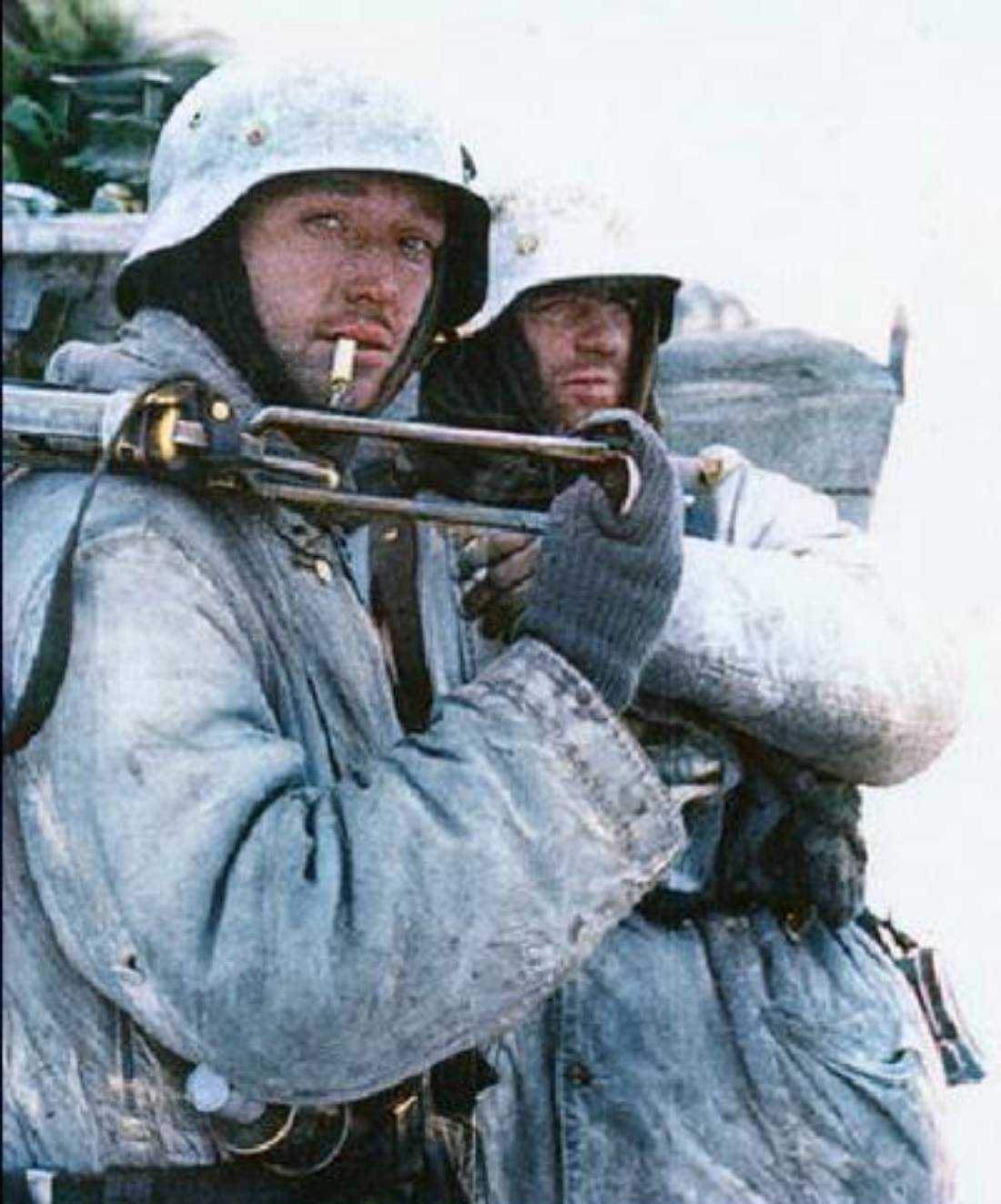
Wehrmacht troops on the Eastern Front
Whitewashed Panzerkampfwagen Tiger
Die Deutsche Wochenschau 1944
Trapped in the Korsun-Cherkassy pocket, a defensive position along the Dnieper river in Ukraine in January 1944, were 60,000 men, at approximately 55 percent of their authorized strength. Among the trapped German forces were the multinational 5.SS-Panzer-Division Wiking under command of SS-Gruppenführer 
Herbert Otto Gille and the Belgian 5.SS-Freiwilligen-Sturmbrigade Wallonien under command of SS-Hauptsturmführer Léon Degrelle and 6,000 Russian auxiliaries. 
Despite repeated warnings from Feldmarschall Erich von Manstein and others, Nazi dictator Adolf Hitler refused to allow the exposed units to be pulled back. Soviet dictator Joseph Stalin expected and was promised a second Stalingrad. The Soviets was already triumphantly proclaiming in their news broadcasts the destruction of the Cherkassy pocket and with it, division Wiking. Yet very few German soldiers and no Waffen-SS men in the cauldron had surrendered despite heavy Soviet propaganda inducements to do so. With great hardship, the front held. General Wilhelm Stemmermanns answer would be in the form of continued, bitter resistance. Erich von Manstein ordered III Panzerkorps to attempt 
to relieve the beleaguered forces. Led by the 1.SS-Panzer-Division Leibstandarte SS and the 16.Panzer-Division the attack soon encountered heavy resistance from four Soviet Tank Corps. After heavy fighting, the exhausted force reached the Gniloy Tikich stream and established a small bridgehead on the eastern bank. The III Panzerkorps could advance no further, Group Stemmermann would have to fight its way out. 
Under shellfire and pursued by Soviet tanks, the surrounded German troops fought their way across the Gniloy Tikich to safety, although at the cost of 19,000 dead, captured or missing and all their equipment. Stabswache de Euros: Battle in Korsun Cherkassy Pocket (II). Credit: Peter Straßner, European Volunteers and Douglas E. Nash, Hell's Gate. Bottom clips: according to some unconfirmed accounts, a Tiger of 13./SS-Panzer-Regiment 1 of the Leibstandarte SS between Petrivka and Korsun during the break-out from the Cherkassy cauldron. Die Deutsche Wochenschau - the official Nazi German war newsreel from 1940 until March 1945.

Password: Freiheit, Objective: Lysianka, February 16 1944 at 23:00 – 5.ϟϟ-Panzerdivision Wiking and Battle in Korsun Cherkassy Pocket (II)

5.SS-Panzerdivision Wiking at Korsun-Cherkassy
SS-Unterscharführer Gerhard Fischer


The trapped troops began to assemble into assault columns with the 72.Infantry Division and the 5.SS-Panzer-Division Wiking leading, moving ahead, silently and with bayonets fixed. Several hundred Soviet prisoners of war and Ukrainian civilians who feared reprisals by the Red Army also followed. Forming up in two columns they flocked into two parallel ravines in the surrounding countryside, and where the two ravines met, the troops emerged into open country and headed out towards Lysianka. The force broke through the first and soon thereafter the second Soviet defense line. General Wilhelm Stemmermann and his rear guard held fast and thus assured the success of the initial breakout. The Soviets ordered total annihilation of the escaping units using all available armor and artillery to attack and cut them into isolated groups and then destroy them piecemeal. Disaster struck at Lysianka as the Soviet troops, under General Konev, were waiting. The two blocking Soviet infantry divisions, 206th Rifle and 5th Guards Airborne, had already been smashed by the men of the 72nd and the Wiking. Soon after 06:00 the slaughter began. Soviet tanks drove into the German columns crushing hundreds under their tracks. Fleeing troops were confronted by units of Cossack cavalry and hands were lopped off of those who approached with their arms raised in surrender. There was no time to take prisoners in the frozen wastelands of the Korsun-Cherkassy pocket and the carnage continued till it was all over. In the short space of three hours, over 19,000 German soldiers lay dead or taken prisoner. Credit: European Volunteers, The 5. SS-Panzer-Division Wiking and HELL'S GATE: The Battle of the Cherkassy Pocket January to February 1944. Left image: unidentified SS-Panzergrenadiers of the Wiking in Korsun-Cherkassy in February 1944. Commons: Bundesarchiv. Right image: SS-Unterscharführer Gerhard Fischer, Zugführer of SS-Panzerjäger-Abteilung 5 of the Wiking, was awarded the Knight's Cross of the Iron Cross for his actions at Cherkassy when Wiking's remaining panzers and assault guns established the escape corridor. Having succeeded in smashing a hole through the Soviets, they then turned round and headed back into the Pocket to cover the withdrawal. Not a single panzer made it back to German lines. Gerhard Fischer is born on November 12 1922 in Zwickau and is still alive in 2011. Private collection.

Battle of Korsun–Cherkassy: Casualties and losses

Luftwaffe Field Division troops
Fallen SS-Panzergrenadiers


The Soviets greatly outnumbered the German forces but failed to cut off their retreat when the Wiking spearheaded the last desperate breakout from Korsun-Cherkassy on February 16 1944. Soviet sources tally losses of 80,188 casualties for the 1st and 2nd Ukrainian Fronts, with 24,286 killed and missing, and 55,902 wounded. These losses were incurred over the period of 24 January – 17 February 1944 during both the encirclements and the breakout attempts. German accounts state that the 60.000 men originally inside the cauldron had shrunk in heavy fighting to less than 50,000 by February 16 1944, that 45,000 took part in the breakout and that 35,000 got through, with a total of 19,000 dead, captured or missing. Only a handful survived Russian captivity. Russian Colonel general Ivan Konev, commander of 2nd Ukrainian Front, openly boasted of his killing of thousands of German POWs, during and after the Battle of Korsun–Cherkassy: The cavalry finally finished them off. 'We let the Cossacks cut up as long as they wished. They even hacked off the hands of those who raised them to surrender' he recounted. Konev was one of Soviet dictator Joseph Stalin's favorite generals. He was made a Marshal of the Soviet Union in February 1944. Wehrmacht General Wilhelm Stemmermann died fighting among his rear guard. The later SS-Obergruppenführer Herbert Otto Gille of the Wiking and the later SS-Standartenführer Léon Degrelle of the Wallonien both survived World War II. As the survivors from the Pocket streamed into Lysianka they were met by the welcoming arms of their comrades from the 1.Panzer-Division and the Leibstandarte SS. However, there was no immediate rest as they were sent plodding on farther westwards in their sodden uniforms, which were rapidly freezing to their starved bodies. Left image: the crews of the Luftwaffe's overworked transport fleet landed their Junker Ju-52 planes onto improvised airfields to bring in supplies and ferry out the injured. In the 19 days of the battle they would fly in almost 868 tons of ammunition and 82,949 gallons of fuel, while flying out 4,161 wounded soldiers. Commons: Bundesarchiv. Right image: Russian USSR photo showing dead Waffen-SS soldiers, possibly staged photo shoot for Soviet propaganda purposes. Most of the best-known Soviet images from the war were used as propaganda, to glorify the victories of the Red Army. Often they were staged. PD.

ϟϟ-Oberscharführer der Waffen-SS Olsson (Kamenets-Podolsky pocket)

Sven-Erik Olsson as SS-Unterscharführer
Tigers after the outbreak from Hube's Pocket


Sven-Erik Olsson was born in Pärnu in Estonia and belonged to the Swedish ethnic minority, the so-called Coastal Swedes. He volunteered for the SS as early as in November 1939, the first Swedish citizen to do so. He experienced his first battles in September 1940 in the Battle of the Netherlands. Olsson fought on the Eastern front in Galizien in March 1944 when Generaloberst Hans-Valentin Hube's 1.Panzer Army was to break out from the Kamenets-Podolsky toward Tarnopol, where relief forces led by SS-Obergruppenführer Paul Hausser's II.SS-Panzerkorps were to meet them. The Kamenets-Podolsky Pocket, also known as Hube's Pocket, is still studied in military academies today as an example of how to avoid annihilation when forces are trapped in a pocket. Olsson was promoted to SS-Oberscharführer in May 1944 and served as a personal signaler for SS-Gruppenführer Heinz Harmel, Commander of 10.SS-Panzer-Division Frundsberg. He took part in the fighting in Normandy where he was injured during the German breakout from the Falaise pocket in August 1944 but soon returned to his unit. He continued fighting in Pommern, Stettin-Altdamm, Stargard and Raum Cottbus before ending the war at Komotau where he destroyed his SPW after an attempt to reach Dresden failed. According to Division Commander Heinz Harmel, Olsson was awarded the German Cross in Gold on April 20 1945 while serving as commander of an communications tank of the Frundsberg division. At the time Olsson handled the communications for the divisional HQ which enabled the division to escape total destruction by the Soviets and eventually break out of the Spremberg pocket. He was taken POW by the Americans and relocated to Sweden in 1947. Sven-Erik Olsson died aged 62 on March 7 1985 of a heart attack during a skiing vacation in Arosa in Switzerland. Awards i.a.: German Cross in Gold, Iron Cross First Class, Close Combat Clasp in Bronze and Infantry Assault Badge in Silver. Credit: the authors Patrick Agte and Richard Landwehr. Left image: Swedish SS Volunteer Sven-Erik Olsson. PD. Right image: Panzer VI 'Tigers after the successful break-out from Hube's moving Pocket. Photo taken in the area of Tarnopol in Galizien on April 22 1944 by KB Valtingojer. c. Bundesarchiv.

5.ϟϟ-Panzerdivision „Wiking“ transferred out of Ukraine

Wikinger after the break-out from the Korsun–Cherkasy pocket
Pz.Kpfw. Panther n°823 of 5.SS-Pz.Div. Wiking
5.SS-Freiwilligen-Sturmbrigade Wallonien
After the 5.SS-Panzer-Division Wiking had escaped the Cherkassy pocket, its remaining forces were transferred out of Ukraine and assembled in Poland. On March 13 1944, the hopes of home leave after three years at the front were shattered. The entry on that date in the log read: Leave only for the Germanic volunteers and the wounded. Everything thus pointed toward commitment of the depleted division. According to the author Rupert Butler, only 632 Walloons survived out of the original 2,000 that began the siege of Korsun-Cherkassy under the command of Wiking. Their Belgian commander, SS-Hauptsturmführer Léon Degrelle returned to Brussels with the survivors to receive the largest mass welcome in Belgian history. Thousands of Belgians lined the streets and boulevards of the capital to cheer the returning volunteers of SS-Sturmbrigade Wallonien. On March 16 1944 the Soviets brought Wiking back into the battle again, although in the process of regrouping, the Wiking was sent to assist in the defence of Kovel in Eastern Poland. New weapons, above all heavy weapons, vehicles and manpower replacements had not yet arrived. SS-Gruppenführer Herbert Otto Gille led his men towards Kowel and began setting up a defensive perimeter, which was soon encircled by the Soviet Red Army. SS-Panzergrenadier-Regiment Germania's transport train were fired on by the Soviets and the train halted. Germania immedeiately attacked the enemy forces in order to reopen the rail line and enable the transport to continue. In the meantime, the transport train of Westland also closed up. On March 29 1944 the 4.Panzer-Armee was pressing for speed and ordered an immediate attack with the forces available at the time. The first unit to arrive Kowel was Wiking's SS-Panzer-Regiment 5. Top image: Knight's Cross winner and Wiking veteran SS-Hauptsturmführer Hans Drexel pose in front of a captured Soviet 76.2mm ZIS-3 gun after the break-out from Korsun-Cherkassy. He had participated in the invasion of Poland and been involved in the campaign in the East since day one. Hans Drexel died aged 42 on April 12 1962 in Stuttgart in Baden-Württemberg. Photo by SS-Kriegsberichter Alois Jarolim on March 9 1944. c. Bundesarchive. Middle image: Wiking Panther n°823 covers the progression of the panzergrenadiers in April 1944. c. Bundesarchive. Bottom image: Belgian SS-Hauptsturmführer Léon Degrelle with Leibstandarte SS commader Sepp Dietrich at a celebration parade held in Charleroi in Wallonia on April 1 1944 to mark the return of the Walloon volunteers after their break-out of the Soviet encirclement at Cherkassy in February of that year. Librairie Grandchamps-Fafouille. FU.

3.ϟϟ-Panzerdivision „Totenkopf“ after the Cherkassy debacle

Men of 3.SS-Panzer-Division Totenkopf and Sturmgeschütz-Brigade 228
Officers of Panzergrenadier-Division Großdeutschland
After the relief attempts towards Cherkassy were 3.SS-Panzer-Division Totenkopf and the 1.Panzer-Division attacked towards the city of Korsun, attempting to secure a crossing across the Gniloy-Tilkich river, the division fell back behind the Southern Bug River. Totenkopf immediately began taking up new defensive positions west of Ivanovka in the second week of March 1944. After another two weeks of fierce fighting in the forward defense lines, alongside Panzergrenadier-Division Großdeutschland, the Axis lines again fell back, withdrawing to the Dniester on the Romanian border near Iași. Top image: an SS-Untersturmführer of the Totenkopf and men of the Sturmgeschütz-Brigade 228 at rest next to a Soviet T-34 wreck in Bessarabia in April 1944. The Totenkopf men all wearing Platanenmuster camouflage smocks. Other pictures from the same occasion, shows the unidentified SS-Ustuf. reading a telegram with an Heer Oberleutnant of the StuG.Brigade 228. Wehrmacht soldiers regarded the Waffen-SS men as thoroughly reliable comrades. Respect born of shared frontline experiences. Photo by KB Vorpahl. Credit: Karl Mensburg. c. Bundesarchiv. Bottom image: Oberleutnant Dr. Bold of the Großdeutschland during the Battles of Târgu Frumos in Romania in April 1944. Note the cuff titles and the shoulder strap monogram. Visible behind Dr. Bold is the division's tactical sign: a white Stalhelm in outline. Photo by KB Theodor Scheerer. c. Bundesarchiv.

3.ϟϟ-Panzerdivision „Totenkopf“ and Second Battle of Târgu Frumos

Panzergrenadier-Division Großdeutschland
Totenkopf Reconnaissance Battalion
Leichter Panzerspähwagen of the Totenkopf
In the Second Battle of Târgu Frumos, elements of the 3.SS-Panzer-Division Totenkopf, together with elements of the elite Panzergrenadier-Division Großdeutschland and 24.Panzer-Division, managed to halt an armoured assault by the Soviet Red Army. The German-Romanian forces had successfully defended against limited attacks throughout the month of April 1944. Despite initial successes of the Soviet attack on May 2 1944, a series of counter-attacks managed to halt the Soviet offensive. The assault was carried out by approximately 500 Soviet tanks. The battle reduced Soviet tank strength to a point where a continued attack into Romania was not possible. In the three days of fighting, the Wehrmacht claimed the destruction of over 350 Soviet tanks. Despite German claims that the Soviet attack was a full-fledged offensive, it appears that the battle of Târgu Frumos was a relatively small-scale operation in the context of 1944's fighting on the Eastern Front. The battle of Târgu Frumos has been used as a case study in officer tactical education in the U.S. Army and other armies, teaching how a mobile defense can defeat an armoured spearhead. Credit: military historian David M. Glantz, Wikipedia i.a. Top image: Hauptmann Ernst-Günter Lehnhoff and Knight's Cross holder Oberst Willy Langkeit of the Panzer-Regiment-Großdeutschland alongside Panther n°01 during a rest-period after fighting near Târgu Frumos. The Großdeutschland fought alongside the Leibstandarte SS, Das Reich and Totenkopf on the eastern front between 1941 and 1944. By April 25 1945, the division ceased to exist, having been completely destroyed in the battles around former East Prussian Pillau. Many died of starvation, disease or exhaustion in Soviet labor camps. Photo by KB Theodor Scheerer. Credit: Ryan N81. c. Bundesarchiv. Bottom images: SS-Panzergrenadiers of a Totenkopf armoured recon battalion with their Sd.Kfz. 222, a light four-wheel drive armoured car. These soldiers have never been positively identified. Photos taken before the Battles of Târgu Frumos. Source: Priv.coll. of David Williams. FU.

ϟϟ-Pz.Gr.Rgt.6 „Theodore Eicke“ and Pz.Gr.Rgt. „Großdeutschland“

Unidentified SS-Hauptsturmführer of  the Theodor Eicke
Oberleutnant Hans-Karl Richter of the Großdeutschland


On May 2 1944 the Red Army began its offensive southwards to break through to Târgu Frumos. The 3.SS-Panzer-Division Totenkopf occupied a line running to the left of its Romanian allies and Panzergrenadier-Division Großdeutschland positions. The Soviets advanced in great waves, their tanks and infantry mixed together. Oberleutnant Hans-Karl Richter wrote: four T-34s were in among the SPWs when, as if by magic, tanks and assault guns of SS-Division Totenkopf appeared. Before a single T-34 could train its gun, all had received direct hits. Immediately thereafter Oberst Hans-Ulrich Rudel's Ju87 Stukas led off a counter thrust by Totenkopf's Panzerregiment, accompanied by Richter's four SPWs. At the end of the Battle of Târgu Frumos the frontline stabilised. However, it was from these positions that the Soviets launched their new offensive in late August 1944. Images: Oberleutnant and Kompanieführer Hans-Karl Richter of 2.(SPW)/Panzergrenadier-Regiment Großdeutschland, briefs his opposite number, an SS-Hauptsturmführer of SS-Panzergrenadier-Regiment 6 Theodor Eicke when the latter relieved Richter's exhausted command near Târgu Frumos on May 3 1944. Richter, awarded both the German Cross in Gold and the Close Combat Clasp in Silver, recalls that after a perfunctory conversation when maps and documents were turned over to the Waffen-SS, he and his men boarded their SPWs and went back to the rear to rest. Richter never learned the Hauptsturmführer's name and never saw him again. Photos by KB Theodor Scheerer. Commons: Bundesarchiv.