Showing posts with label A8: Southwestern Russia/Operation Zitadelle; Battle of Kursk July 1943. Show all posts

Operation Citadel or the Battle of Kursk July 5 – July (20) 1943

Gen.Oberst Hermann Hoth and Gen.Feldm. Erich v. Manstein
Unternehmen Zitadelle – Panzerschlacht um Kursk
Battle of Kursk in July 1943 remains both the largest series of armored clashes, including the Battle of Prokhorovka, and the costliest single day of aerial warfare. The Wehrmacht's goal during Operation Citadel was to pinch off a huge salient that bulged more than 80 km. A rapid panzer advance, punching inwards from either shoulder of the salient, would trap hundreds of thousands Soviet troops and, in turn, shorten the German front. In the build-up to the battle both sides massed their best troops. By early July 1943 the Wehrmacht had concentrated 43 divisions. Barring their way were 100 Soviet divisions and five tank armies. Soviet had a massive supply of men and hardware at this stage of the war and General and Marshal Georgy Zhukov wanted to trade their lives for German panzers. The Soviet strength in the Kursk salient was growing much faster than the Wehrmacht could muster forces to attack it. From reports and tactical intelligence, Georgy Zhukov knew almost the hour when the German assault would begin. The Soviets designed a system to slow and exhaust the powerful German panzer spearheads by forcing them to attack through a vast interconnected web of minefields, pre-sighted artillery fire zones, and concealed anti-tank strong-points comprising eight progressively spaced defense lines 250 km deep, it was by far the most extensive defensive works ever constructed. Behind the Soviet front were more than 3,000 tanks, the majority T-34/76s. Credit: Tim Ripley. Left image: Generaloberst Hermann Hoth and Generalfeldmarschall Erich von Manstein analyze a map of operations on June 21 1943. Von Manstein was one of the primary commanders at the Battle of Kursk. Note the Krimschild on his left arm. His ongoing disagreements with German dictator Adolf Hitler over the conduct of the war led to his dismissal in March 1944. Von Manstein died aged 85 on June 9 1973 in Bayern. Hoth commanded the 4.Panzer-Armee in the Battle of Kursk reinforced by the II.SS-Panzerkorps under SS-Obergruppenführer Paul Hausser. Hoth died aged 85 on January 25 1971 in Niedersachsen. Photo by KB Heinz Mittelstaedt. Credit: Facundo Filipe. c. Bundesarchiv. Op. map. PD.

ϟϟ-Ogruf. Paul Hausser's II.ϟϟ-Panzerkorps in the Battle of Kursk

Commander of the Leibstandarte SS-Oberf. Teddy Wisch
SS-Panzergrenadier-Division Das Reich
Pz.Kpfw. Tiger S13 of 8./SS-Panzer-Regiment 2 Das Reich
The advance would be executed from the Orel salient to the north of Kursk and from Belgorod to the south. The most powerful elements of the German attack force, however, were concentrated on the southern flank of the Kursk salient, where Generalfeldmarschall Erich von Manstein had command of SS-Obergruppenführer Paul Hausser's II.SS-Panzerkorps. It was to form the spearhead of Generaloberst Hermann Hoth's 4.Panzer-Armee when final orders were issued for the initial assault. The SS-Panzergrenadier-Divisions Leibstandarte SS, Das Reich and the Totenkopf were deployed next to each other. Each of the SS-Panzergrenadier-Regiments was given a Soviet strongpoint as an objective and were to attack simultaneously to batter through the Soviet defence lines. Top image: the 34-year-old SS commander Theodor ‘Teddy’ Wisch during the opening phases of Operation Citadel. Wisch succeeded Josef ‘Sepp’ Dietrich as commander of SS-Panzergrenadier-Divisions Leibstandarte SS in April 1943. In July of that year, at the time of the Kursk offensive, Wisch was further promoted to SS-Oberführer. He was later seriously wounded by a naval artillery barrage in the Falaise Pocket on Aug. 20 1944. Theodor Wisch ended the war as SS-Brigadeführer und Generalmajor der Waffen-SS having been awarded the Knight's Cross with Oakleaves and Swords. He died aged 87 on Jan. 11 1995 in Norderstedt in Schleswig-Holstein. c. Bundesarchiv. Middle image: Tiger S13 of the 8th Company of SS-Panzer-Regiment 2 Das Reich moves forward on the Russian steppe during Zitadelle as SS-Panzergrenadiers consolidate their positions. Tank S13 was commanded by the Austrian former Messerschmitt pilot of the Jagdgeschwader 27 Paul Egger. Photo taken by SS-Kriegsberichter Friedrich Zschäckel on July 5 1943 west of Yakhontov in the Belgorod Oblast. c. Bundesarchiv. Bottom image: here's another shot of the Tiger ace Paul Egger and S13. The then SS-Oberscharführer Paul Egger is seen coordinating actions with infantry. This photo was taken by SS-KB Hermann Grönert just moments after Zschäckel's more famous photo of the tank climbing the slope. Das Reich's 8th Company used a unique company symbol known as the Springender Teufel. According to veteran and Panzer ace SS-Standartenjunker Will Fey a member of SS-Panzer-Regiment 2 Das Reich found a strange metal figure in the streets of Kharkov after the battle in March 1943. He named it the Jumping Devil and the gnome was adopted by Das Reich's heavy Tiger company in the early summer of 1943 and stenciled onto the turrets for the Kursk offensive. The gnome is well visible on Grönert's photography. U.S. National Archives.

ϟϟ-Panzergrenadier-Division „Wiking“ – Reserve Force during Zitadelle

Commander of the Wiking Herbert Gille as SS-Gruf.
SS-Panzer-Regiment 5 Wiking
SS-Panzergrenadier-Division Wiking was moved to Izyum on the Donets River in Kharkov Oblast under command of SS-Brigadeführer Herbert Gille in late June 1943 where it, along with 17.Panzer-Division was to form the reserve force for Feldmarschall Erich von Manstein's Army Group South during the approaching Operation Citadel. Before the Wiking moved to the area of Izyum the Finnisches Freiwilligen-Bataillon der Waffen-SS had been replaced by Estnisches SS-Freiwilligen-Panzergrenadier-Bataillon Narwa. Von Manstein ordered the reserve force to move up to the vicinity of Kharkov so that this corps could exploit any major success. It began moving from the Donbas in the evening of July 10 1943 with orders to move to Belgorod. While the operation was in effect the Wiking was engaged against enemy forces near Kharkov, with the newly added Estonian battalion Narwa. The Estonians acquitted themselves well throughout the action, destroying around 100 Soviet tanks over several days. Because of the tardiness of von Manstein's decision, Army Group South's reserve would not be present on the battlefield when it was needed most; thus, the II.SS-Panzerkorps would be left to fight the critical Battle of Prokhorovka with only its own resources. When Citadel was cancelled, the Wiking was still involved in halting Soviet attacks. It remained fully capable of fighting and destroyed various enemy tank formations during the operation. Further to the south, on the Mius-Front, a major Soviet offensive, Operation Rumyantsev, threatened to break the German lines. The Wiking spent the rest of the year fighting in the slow retreat to the Dnieper River. Credit: Prof. at the USAWC Jonathan Klug. Top image: Wiking Commander Herbert Gille as SS-Gruppenführer. Photo taken by SS-KB Alois Jarolim during the Kowel encirclement in March 1944. U.S. NARA. Bottom image: an SS-Panzergrenadier of the Wiking speaking through Feldfernsprecher 33, while behind him the Panthers hit the dusts. The Panthers in the background numbered II011 and II014 belonged to the 2nd Battalion's recon platoon of SS-Panzer-Regiment 5 Wiking. The photo was most probably taken during the one day military Op. Ilse on April 27 1944 south of Kowel. According to the author Dennis Oliver, Panther II011 was commanded by SS-Untersturmführer and Zugführer Dr. Manfred Renz. Photo by SS-Unterscharführer Ernst Baumann, staff member of Germania. c. Bundesarchiv.

Operation Zitadelle – the Southern Sector was to be the Major Theatre

SS-Sturmbannführer Christian Tychsen with fellow officer
LSSAH part of Paul Hausser's II.SS-Panzerkorps


The first attacks went in on schedule, with small groups of infantry and grenadiers infiltrating through minefields and rushing the Soviet trenches. In two hours of hand-to-hand combat, the Soviet outposts were captured and the main attack was ready to roll at just after dawn – 04:05 hours – on July 5 1943. In the north, Generalfeldmarschall Walter Model's 9th Army blunted its spearhead against the Soviet minefields. The southern offensive, spearheaded by SS-Obergruppenführer Paul Hausser's II.SS-Panzerkorps and the Großdeutschland Division made more headway, unlike in Model's sector, it was not halted, and broke through. Left image: Knight's Cross holder SS-Sturmbannführer Christian Tychsen, commander of the 2nd battalion of Das Reich's SS-Panzer-Regiment 2, seen here in conversation with an SS-Untersturmführer, certainly one of his company commanders. Tychsen is wearing the tanker's camouflage non-reversible coverall worn by the Waffen-SS. The Panzerbefehlswagen III's name likely reads Karracho - schnelle Bewegung. Photo taken by SS-Kriegsberichter Hermann Grönert during the Kursk battles in July 1943. Credit: Ghermán Mihály. U.S. NARA. Right image: a Leibstandarte SS soldier raising the SS runes in their camp in the summer of 1943. Photo taken in the southern sector of the Kursk salient by SS-Kriegsberichter Waldbach just days before one of the largest series of armored clashes in all history. U.S. NARA.

Leibstandarte ϟϟ Knight's Cross Recipients during Operation Zitadelle

SS-Oberscharführer Kurt Sametreiter
SS-Unterscharführer Franz Staudegger


Left photo shows the Austrian platoon commander in SS-Panzerjäger-Abteilung 1 of the SS-Panzergrenadier-Division Leibstandarte SS SS-Oberscharführer Kurt Sametreiter during the award of the Knight's Cross on July 31 1943. Sametreiter knocked out 24 Soviet tanks in one engagement during the Battle of Kursk. He ended the war as an officer and SS-Obersturmführer. Kurt Sametreiter died aged 95 on Jan. 28 2017 in Bad Gastein in Austria. Photo by SS-KB Max Büschel. Right photo shows the very first Tiger tank commander to be awarded the Knight's Cross the Austrian SS-Unterscharführer Franz Staudegger. On July 7 1943, a single Tiger n°1325 of SS-Hauptsturmführer Heinz Kling's 13th (heavy) Company of SS-Panzer-Regiment 1 LSSAH engaged a Soviet group of some 50 T-34 tanks approaching from the northwest in the southern sector of the Kursk salient. The panzer crew commanded by the 20-year-old Staudegger consisted of the driver SS-Sturmmann Herbert Stellmacher, the gunner SS-Pz.Schütze Heinz Buchner, the loader SS-Pz.Schütze Walter Henke and the radio operator SS-Pz.Schütze Gerhard Waltersdorf. They arrived just in time to rescue elements of the SS Infantry battalion Deutschland of Das Reich from being overrun. Guided by the Waffen-SS infantry Staudegger knocked out astonishing 17 Soviet tanks before the enemy started retreating. He then ordered his crew to pursuit the retreating Soviets and knocked out another five tanks – a feat that would earn the young Austrian the coveted Knight's Cross. Staudegger ended the war in the schwere SS-Panzerabteilung 101 where he reached the rank of SS-Oberscharführer. This heavy tank battalion was present at the Battle of Normandy in 1944 under the command of SS-Oberführer Heinz von Westernhagen. Franz Staudegger died aged 68 on March 16 1991 in Frankfurt am Main. Photo taken after the award ceremony on July 10 1943. c. Bundesarchiv.

II.ϟϟ-Panzerkorps on the Southern Flank of the Kursk Salient

Pz.Kpfw. Tiger S23 of SS-Pz.Gren.Div. Das Reich
SS-Panzergrenadier-Division Das Reich
Reports and combat records of SS-Obergruppenführer Paul Hausser's II.SS-Panzerkorps show, first of all, that Hausser's corps began with far fewer tanks than previously believed and, more important, that they suffered only moderate losses. The number of Waffen-SS tanks actually involved in the battle has been variously reported as high as 600 by some authorities, however, on July 4 1943, the day before Operation Citadel was launched, Hausser's three SS divisions possessed a total of 327 tanks between them, plus a number of command tanks. The SS Corps used temporary divisional markings instituted for the Battle of Kursk. This was to confuse the Soviets with unit identification. SS-Panzergrenadier-Division Das Reich used two vertical bars with a footer in place of the Wolfsangel insignia (until the fall 1943). The Totenkopf used three bars without a footer in place of the Totenkopf insignia. The Leibstandarte SS were assigned a marking of two and a half bar with a footer in place of the Dietrich insignia but was never used. Credit: author George M. Nipe. Top image: Das Reich Tiger S23 moves forward followed by a column of Tigers in the vicinity of Yakhontov near Belgorod. The photo is most likely taken by SS-Kriegsberichter Hermann Grönert or possible by SS-Kriegsberichter Friedrich Zschäckel during the early phase of Zitadelle in July 1943. Note that this is not the same photograph as the more classic photo-shoot of Tiger S23 taken moments before by Zschäckel. The houses behind seem to suggest the photo is taken on slightly higher ground. Middle image: four SS Panzergrenadiers are visible in the background of this photo (mid-left) taken on the same slope as the previous photo. It appears to be Zschäckel standing to the left of the group taking the iconic photo of the Austrian SS-Oberscharführer Paul Egger's Tiger S13 climbing the slope. Photo taken by SS-Kriegsberichter Hermann Grönert. Bottom image: Tiger of the Das Reich passes Soviet prisoners of war while it moves forward at Kursk to consolidate the positions on the exposed Russian steppe. Footage from Die Deutsche Wochenschau.

Soviet POWs Captured by ϟϟ-Panzergrenadier-Division „Das Reich“

Wounded Soviet Sgt. captured by the Waffen-SS in the Battle of Kursk
Waffen-SS tankers giving first aid to wounded Soviets in the Kursk salient
Operation Citadel - the Battle of Kursk
SS-Panzergrenadier-Division Leibstandarte SS and Das Reich were the most successful units on the German southern wing on the first day of the Citadel offensive. The Leibstandarte SS were overrunning the first Soviet defensive belt in heavy fighting against Soviet Paratroops of 9th Guards Airborne Division. The Das Reich tore through the Soviet defences and pushed upwards of 65 kilometers into the southern sector of the bulge and captured numbers of Soviet troops, but the Wehrmacht got bogged down. The German High Command (OKW) hoped that large numbers of Soviet prisoners would be captured during Citadel to be used as slave labour in the German armaments industry. More than three million Soviet prisoners died in German prisoner-of-war camps during World War II, about 60 percent of all Soviet prisoners. Similar death rates prevailed among German soldiers in Soviet captivity. German Wehrmacht prisoners had of course much higher survival rate than volunteers and conscripts of the Waffen-SS and other elite units. It was actually more dangerous to be in a prisoner-of-war camp than to be on the Eastern front line as an infantryman. In fact, the poor conditions were not caused primarily by incompetence or lack of preparation: harsh treatment of prisoners was a matter of policy. The capturing government itself, not the Waffen-SS nor any other frontline organization, was responsible for what happened behind the front lines. The top photo shows a wounded sergeant of the Soviet Red Army lying on the ground. A Waffen-SS Panzergrenadier with a Soviet PPSh-41 submachine-gun slung across his back is apparently calling the medics to see his condition. The middle and bottom photos from the same occasion show Soviet prisoners captured by tankers of the Waffen-SS being treated on the battlefield by an SS-Scharführer of Das Reich. Photos by war correspondent SS-Kriegsberichter Hermann Grönert. Grönert served with Das Reich at Kharkov and Kursk. U.S. National Archives.

ϟϟ-Panzergrenadier-Division „Totenkopf“ in the Battle of Kursk

Knight's Cross holder SS-Oberführer Hermann Prieß
SS-Panzergrenadier-Division Totenkopf moments before attack
SS-Totenkopf Panzergrenadier inspect a knocked out T-34
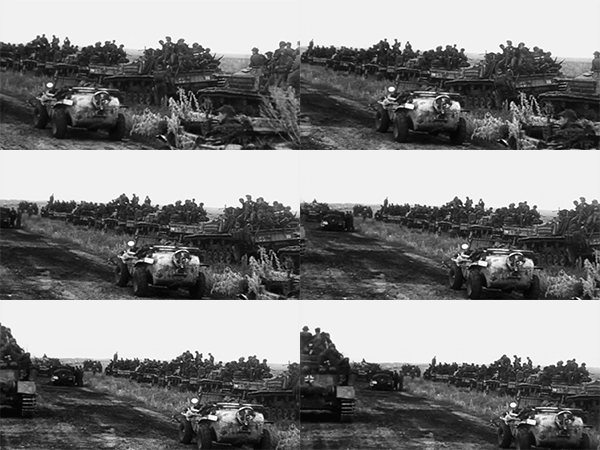
SS-Obergruppenführer Paul Hausser was determined to press forward the attack and ordered the II.SS-Panzerkorps to wheel northwestwards in a coordinated attack. Their objective was to seize the crossings over the River Psel and breach the Soviet third line. SS-Panzergrenadier-Regiment 6 Theodor Eicke of the SS-Panzergrenadier-Division Totenkopf led the advance on the western flank battling through the 52nd Guards Rifle Division pakfronts, while SS-Panzergrenadier-Division Leibstandarte SS was forming the spearhead. In the late morning the Totenkopf broke the back of the Soviet defence and was able to make big gains. However, in the afternoon large Soviet counterattacks by 2nd Guards Tank Corps battered the division's right flank. Wave after wave of Soviet tanks surged forward, with some attacks involving more than 300 tanks. They were picked off one-by-one by the SS-Panzers and Panzergrenadiers picked off those that came too close and shot any tank-ridding infantry on their hulls. Thousands of Soviet infantrymen were mown down by well aimed artillery fire that was called down within a few hundred meters of the Waffen-SS new frontline. Top clip: Commander of SS-Panzergrenadier-Division Totenkopf SS-Oberführer Hermann Prieß observe the battlefield at Kursk in early July 1943. He was promoted to SS-Brigadeführer und Generalmajor der Waffen-SS on July 15 1943. Prieß would go on to become one ​of Nazi Germany's most highly decorated soldiers. He was one of the elite few to be awarded the Knight’s Cross of the Iron Cross with Oakleaves and Swords – an honour that was awarded to only 159 men of the approximately 15 million who served in the German armed forces during World War II. Middle clip: the armoured fighting vehicles of the Totenkopf carrying SS-Panzergrenadiers in the run-up to a combined-arms attack during Zitadelle in July 1943. Bottom clip, taken on a later occasion, shows a SS-Panzergrenadier of the Totenkopf carefully inspect a knocked out Soviet T-34 on the Eastern front. Footages: Die Deutsche Wochenschau.

Luftwaffe Support Crucial for the Success of Operation Zitadelle

Formation of Junkers Ju 87 Stuka dive-bombers in flight
FlaK-Abteilung of the Leibstandarte SS at Kursk
Famous and feared 8.8 cm FlaK during Zitadelle
The advance was well supported by the Luftwaffe, which greatly aided in breaking Soviet strong points and artillery positions. At the start of the Citadel offensive, the Germans dominated the air, sweeping the skies clear of Soviet aircraft, attacking anti-aircraft guns and taking a terrible toll of Soviet armour. By the end of the first week, Luftwaffe sorties began to drop off sharply due to attrition and fuel shortages. Soviet sorties increased. By the end of July 1943, the Soviets had gained air supremacy. Germany recorded the loss of 194 aircraft. Soviets acknowledge losing 1,130 aircraft. The Soviets could replace their losses - Germany could not replace theirs. Top image: a formation of Junkers Ju 87 or Stuka dive bombers in flight. The Stuka was heavily involved in Citadel. The Ace Hauptmann Hans-Ulrich Rudel's cannon-equipped Ju 87 Gs had a devastating effect on Soviet armour at Orel and Belgorod. Rudel was the most decorated German serviceman of World War II, being the sole recipient of the Knight's Cross with Golden Oakleaves, Swords, and Diamonds in Jan. 1945. The Ju 87s participated in a huge aerial counter-offensive in July 1943 against a Soviet offensive at Khotynets and saved two German armies from encirclement. The Stuka arm lost eight of their Knight's Cross during the Kursk offensive. In the wake of the defeat at Kursk, Ju 87s played a vital defensive role on the southern wing of the Eastern Front. To combat the Luftwaffe, the Soviets could deploy 3,000 fighter aircraft. Commons: Bundesarchiv. Middle image: Anti-Aircraft gunners of the Leibstandarte SS alert the Luftwaffe Stuka dive bomber pilots operating over the Kursk battle area of their position to prevent friendly fire. Credit: Royston Leonard. Commons: Bundesarchiv. Bottom clip: the famous German 8,8 cm FlaK gun became one of the most feared anti-tank weapons of World War II. It performed well in its original role of an anti-aircraft gun and it proved to be a superb anti-tank artillery gun as well. Thousands of 88 mm guns were produced throughout the war in various models and mounts. Die Deutsche Wochenschau.

Operation Zitadelle and the Battle of Kursk

Waffen-SS and Heer officers during Zitadelle
Panzerkampfwagen VI Tiger
Waffen-SS Maschinengewehr 34 gunners
The advance continued with village after village having to be cleared of Soviet defenders. The Wehrmacht and the SS constantly fought offensive battles. Subsequently, they then defended themselves, then went on to counterattacks. Hand grenades and MG 42 machine guns were their weapons of choice for close-quarter combat with Soviet infantry. The II.SS-Panzerkorps zone of battle, contrary to the impression given in many accounts, was approximately 15 kilometers wide, with SS-Panzergrenadier-Division Totenkopf on the left flank, Leibstandarte SS in the center and Das Reich on the right flank. The South Tyrol-born war correspondent SS-Obersturmführer Friedrich Zschäckel's contact sheets from Operation Citadel reveal numerous groups of Soviet POWs awaiting transport to the rear and an uncertain fate in captivity. Many, however, died during the death marches from the front lines or under inhumane conditions in German prisoner-of-war camps and concentration camps. Top image: an SS-Untersturmführer of the Leibstandarte SS and veteran from the Battle of the Crimea with two Wehrmacht officers before their next assault on Soviet positions during Citadel. Photo taken by war correspondent SS-Unterscharführer Max Büschel. Credit: OTL Marwan. U.S. National Archives. Middle image: an early model of the Tiger tank accompanied by supporting panzergrenadiers entering a burning village and driving the enemy out. Credit: Rui Manuel Candeias. Commons: Bundesarchiv. Bottom image: Waffen-SS MG gunners in camo smocks stride through a burned-out Soviet village in the summer of 1943. Photo taken by SS-Kriegsberichter Obermüller who served with Wiking and bandit-fighting 8.SS-Kavallerie-Division. Note: some sources identify this image as being from Demyansk showing the Danish machine-gunner SS-Rottenführer Kaj Buchardt in the center. Waffen-SS volunteer Buchardt survived the war and died in 2009. Credit: Doug Banks. Commons: Bundesarchiv.

Operation Zitadelle and the Battle of Kursk

Kursk salient July 1943


The Combat medics were armed and did not wear the Red Cross armbands on the Eastern Front because of the fear of snipers. Both the Soviets and the Germans often intentionally aimed for medics working on the front lines. Many combatants in the 20th Century have not honored the immunity that should be accorded medical personnel in combat, and as a result many countries that previously did not arm combat medics now do so. Images: an SS-Panzergrenadier armed with a Maschinenpistole 40 gives a wounded Soviet tanker water from his field flask in early July 1943, while the remains of a T-34 Model 1943 blazes in the background. The final tally of the battle was gruesome. Tens of thousands lay wounded from both sides, scattered across the Kursk salient - abandoned and left for dead. There was none to give them medical aid when they were struggling between life and death. Both photos were taken by war correspondent SS-Unterscharführer Max Büschel who served with the SS-Panzergrenadier-Division Leibstandarte SS at Kursk and Zhitomir. Max Büschel survived World War II and managed to evade captivity when the 1.SS-Panzer-Division Leibstandarte SS surrendered to American forces in Austria in May 1945. He made his way back to his family in Berlin, but was apparently shot by Soviet Occupation Forces when they found out he had been a member of the much feared Waffen-SS units. U.S. National Archives. Fair use.

ϟϟ-Division „Totenkopf“ in the Battle of Psel Bridgehead

SS-Hauptsturmführer Erwin Meierdress
Unidentified SS-Panzergrenadier


By July 10 1943, the SS-Panzergrenadier-Division Totenkopf was in a position to cross the River Psel in force, then all three SS-Panzergrenadier-Divisions could strike towards Prokhorovka. Elements of the Totenkopf's SS-Panzergrenadier-Regiment 6 Theodor Eicke had finally forced a crossing of the Psel and established a weak bridgehead. By July 11 1943, SS-Hauptsturmführer Hubert-Erwin Meierdress led his SS-Panzer-Regiment 3 across the Psel on hastily constructed pontoon bridges and reinforcing the tenuous position. The forces in the bridgehead were subjected to several furious attacks from Soviet Marshal Katukov's 1st Guards Tank Army, reinforced with 33rd Rifle Corps and 10th Tank Corps, but Meierdress' Panzers held their ground and slowly expanded the Psel bridgehead west of Prokhorovka. Left image: the winner of the Knight's Cross with Oakleaves SS-Hauptsturmführer Erwin Meierdress during the Battle of Kursk. Erwin Meierdress had performed many fire brigade missions since the Demyansk Pocket in 1942 but was killed in action aged 28 on January 4 1945 as SS-Sturmbannführer when his Panther was hit in Hungary during Operation Konrad. Photo by SS-Kriegsberichter Tissen. Right image: an unidentified Waffen-SS volunteer moving forward across the hot and dusty Russian steppe in July 1943. His Karabiner 98 Kurz is equipped with a mounted Schießbecher (rifle grenade launcher). Commons: Bundesarchiv.

II.ϟϟ-Panzerkorps the day before the Prokhorovka Clash

SS-Sturmbannführer Joachim Peiper the day before Prokhorovka
II.SS-Panzerkorps during Operation Zitadelle
Exhausted SS-Panzergrenadier somewhere in the Kursk salient
During the evening of July 11 1943, SS-Obergruppenführer Paul Hausser readied his divisions for an assault on Prokhorovka. SS-Panzergrenadier-Division Totenkopf, commanded by SS-Oberführer Hermann Prieß, anchored the left flank of the II.SS-Panzerkorps, while SS-Panzergrenadier-Division Leibstandarte, commanded by SS-Oberführer Theodor Wisch, was in the center. SS-Panzergrenadier-Division Das Reich, commanded by SS-Gruppenführer Walter Krüger, moved into its attack zone on the corps' right flank. Generalfeldmarschall Erich von Manstein had prepared orders for his southern forces, with the SS-Panzergrenadier-Division Wiking in lead, to start moving towards Belgorod. While Hausser's Waffen-SS divisions prepared for battle, there was feverish activity on the Soviet side as well, the Red Army consisted of the 18th and 24th Tank Corps and the Soviet 5th Guards Tank Army who were reinforced by the 2nd Tank Corps, increasing its strength to about 850 tanks. On the morning of July 12 1943, a climactic engagement of the Battle of Kursk was about to take place. The last fortified elevation on the road leading to the key town of Prokhorovka had been taken by the Leibstandarte SS after ferocious fighting on the previous day. The Battle of Prokhorovka would become known as the greatest clash of armoured forces ever fought in history. Top image: SS-Sturmbannführer Joachim Peiper decorating a young soldier of the Leibstandarte SS with the Iron Cross Second Class on July 11 1943, the day before the Battle of Prokhorovka. Peiper is wearing a SS M40 Palmenmuster camouflage smock. The Waffen-SS was the first military organization in the world to use mottled camouflage clothing and made wide use of a perplexing variety of season patterns and colors. Clips: rhe soldiers endured the stress of battle around the clock during the offensive, attacking again and again in the face of overwhelming odds. Behind the frontline footage of the II.SS-Panzerkorps at Kursk in the summer of 1943. Die Deutsche Wochenschau.