Showing posts with label 1. Introduction: German SS-VT/Waffen-SS 1934-1945. Show all posts

The History of the Waffen-SS - Military Branch of the Schutzstaffel

Adolf Hitler inspects LAH Honor Guard – forerunner of the Waffen-SS
Heinrich Himmler – head of the SS and key architect of the Holocaust
Desert Fox Erwin Rommel and Paul Hausser – father of the Waffen-SS
Das Reich – elite Panzer division of the Waffen-SS
The topic of the Waffen-SS remains fresh; more remains to be said without simply rehashing what has come before. Many works exist which are rehashes. The result is that much misinformation has been spread, with the Waffen-SS order of battle suffering greatly in this regard. The Waffen-SS was a multinational European front line combat organization under the direct tactical control of the OKW, the German High Command of the Armed Forces, not to be confused with the notorious SS-Totenkopfverbände or the political Allgemeine-SS. For example, the Waffen-SS had its own recurring section and had nothing to do with the criminal activities of the Allgemeine-SS. Former Waffen-SS frontline soldiers routinely inveighed against Reichsführer-SS Heinrich Himmler personally. Undoubtedly, this hatred was seen all throughout the ranks of the Waffen-SS, even as high as SS-Oberstgruppenführer Paul Hausser, who had specifically been recruited in the mid 1930‘s to found the precursor of the Waffen-SS, the SS-Verfügungstruppe. Hausser proclaimed that Himmler had deceived the troops by grouping them with the concentration camp personnel. This combination chained the actual Waffen-SS to the fate of those SS men who are responsible for the incidents in the concentration camps. Wiking veteran SS-Unterscharführer Richard Fuchs asserted: The Waffen-SS had no love for Himmler. To us he was more or less a stranger. At best, his connection with the Waffen-SS was nominal. The testimony of SS-Obergruppenführers Richard Hildebrandt and Karl von Eberstein corroborated this claim regarding the relationship between Himmler and the Waffen-SS. They and several other high ranking officers reported that Himmler's opinions were not taken seriously by the Waffen-SS. The history of the Waffen-SS began to be recorded before and during World War II, and many accounts were understandable biased, as they were written by pro-Nazi sources or wartime enemies. The atrocities committed by certain units made investigators ready to believe the worst about the entire Waffen-SS. These factors contributed to many incorrect concepts being taken into historiography as accepted truths. Credit: Assoc. Prof. of History Dr. Amy Beth Carney and Waffen-SS historian Marc Rikmenspoel. Top image: Reichskanzler Adolf Hitler inspecting an assembly of his personal honour guard of the Leibstandarte SS on arrival at Nürnberg on Sept. 10 1935. Press photo probably taken by his official photographer Heinrich Hoffmann during the 7th Reich Party Congress called the Rally of Freedom. "Freedom" referred to the German liberation from the Treaty of Versailles. The Leibstandarte's role in these ceremonies was a symbol of the close bond between Hitler and his personal guard, reflecting their significance within the Nazi power structure. Credit: GPFI. FU. Second image: the feared and disliked Heinrich Himmler, Reichsführer of the SS and Chief of the German Police, during his visit to Warszawa in Feb. 1939, seven months before the German Reich and the Soviet Union invaded and partitioned Poland. He is accompanied by Hans von Moltke, German Ambassador to Poland and General Kordian Józef Zamorski, Chief of the Polish State Police. Credit: Olga Shirnina. c. Bundesarchiv. Third image: Feldmarschall Erwin Rommel and Waffen-SS General Paul Papa Hausser, two exceptional commanders of World War II. Hausser became the father of the Waffen-SS and was in charge of the troop's military and ideological training. Credit: Ghermán Mihály. c. Bundesarchiv. Bottom image: an original Nazi era postcard of the Unsere Waffen-SS series showing Panzer III's from the famous Waffen-SS Panzer elite division – Das Reich. Photo by SS-KB Dürr. Credit: Julius Backman. c. Bundesarchiv.

Leibstandarte ϟϟ - the Praetorian Guard - and ϟϟ-Verfügungstruppe

Führer und Reichskanzler Adolf Hitler at the Erntedankfest Bückeberge
Commander of Leibstandarte SS Sepp Dietrich during Op. Marita 
Leibstandarte SS at SS-Nachrichtenschule Metz after the Westfeldzug
On March 17 1933, SS-Gruppenführer Josef Sepp Dietrich was instructed to collect 117 reliable young SS men into a militarized SS bodyguard for the democratically elected Reichskanzler Adolf Hitler. This new unit was named the SS-Stabswache Berlin. It was the origin of what became the Leibstandarte SS. Eight of these 117 men went on to become regimental commanders in the Waffen-SS, and three attained division command. The Schutzstaffel, abbreviated SS or ϟϟ with stylized Armanen sig runes, now began to grow rapidly and were set up in major cities to act in the event of a Communist strike. The SS-Verfügungstruppe, abbreviated SS-VT, was formed on Sept. 24 1934. The unit consisted of military-trained men at the disposal of the Führer. It was made up of three regiments modeled on the infantry regiments of the German Army. In 1936, the Prussian officer SS-Brigadeführer Paul Hausser worked to transform the SS-VT into a credible military force that was a match for the regular army. The SS-VT received military – rather than political – training. They trained alongside Hitler's personal body guard the Leibstandarte SS. The Totenkopf formations were never part of the SS-VT. They belonged to the SS-Totenkopfverbändeanother branch of the SS. By 1940 the SS-VT had become the nucleus of the Waffen-SS. Its units would spearhead some of the most crucial battles of World War II while its men would shoulder some of the most difficult and daunting combat operations of all the units in the German military. According to their enemy's opinion and those of Wehrmacht's own commanders-in-chief the soldiers of the Waffen-SS ranged among the most effective and professional soldiers of all. Top image: Adolf Hitler at the Reich Harvest Thanksgiving Festival held on the Bückeberge south of Hamelin in 1937. The festival was part of a cycle of National-Socialist celebrations which included the annual party rally at Nürnberg, Hitler's birthday celebrations and other important events on the National-Socialist calendar. The photo was taken by Hitler's personal colour photographer Hugo Jäger. LIFE photo archive. Middle image: Commander of the Leibstandarte SS Sepp Dietrich here photographed by SS-KB Gunter d'Alquen. Dietrich is wearing the early style of gorget patches for SS-Obergruppenführer, which he was promoted to on July 1 1934. Dietrich loyalty to his elite Waffen-SS troops remained paramount throughout the war and beyond. He despised Reichsführer-SS Heinrich Himmler with every fibre of his being whom he frequently referred to with barely concealed contempt as the Reichsheini. Dietrich even banned Himmler from the Leibstandarte SS barracks. U.S. NARA. Bottom image: LSSAH guard at SS-Nachrichtenschule in ancient Metz in Elsaß–Lothringen. Commons: Bundesarchiv.

ϟϟ-Junkerschulen: Waffen-SS Officer Candidate Schools

The Runes of the Schutzstaffel represented all branches of the SS
Main Gate at SS-Junkerschule Bad Tölz
The SS-VT addressed the creation of an organic officer corps by creating two officer candidate schools. SS-Brigadeführer Paul Hausser's school system was designed to provide necessary education to men who demonstrated potential. The first facilities were established at Bad Tölz in 1934 and at Braunschweig in 1935. By 1936, the SS-VT was highly selective. For recruits, it only accepted young men who were healthy, in good physical shape, and who had clean police records. Additionally, recruits had to show proof of pure Germanic ancestry back to 1800, while those who became officers had to further demonstrate this to 1750. Officers and men exercised and trained together, breaking down social barriers and creating comrades, with each man prepared to take the place of his superior, should the latter become a casualty. Party membership was not required for joining the SS-VT. Additional SS leadership schools were founded at Klagenfurt and Posen-Treskau in 1943, and in Prague 1944. Credit: Marc Rikmenspoel. Top clip: according to German librarian Ulrich Hunger the Siegrune was designed in 1929 by graphic designer Walter Heck. Heck's simple but striking device consisted of two sig runes drawn side by side like lightning bolts, and was soon adopted by all branches of the SS, both by the Allgemeine-SS and the Waffen-SS. Heck himself was promoted to SS-Ostuf. on Nov. 9 1933. This iconic symbol is both ubiquitous and widely banned today. Die Deutsche Wochenschau. Bottom image: the main gate at SS first leadership school in Bavarian Bad Tölz 1942. The Waffen-SS officer candidate school Tölz also had a building dedicated to boxing, gymnastics, indoor ball games, a heated swimming pool and sauna. c. Bundesarchiv.

Waffen-SS Officer Candidates at ϟϟ-Junkerschule Bad Tölz

Waffen-SS candidate at SS-Junkerschule Bad Tölz
Knight's Cross holder Fritz Klingenberg at Bad Tölz
Waffen-SS recruits at SS-Junkerschule Bad Tölz
Austrian Knight's Cross holder Ludwig Kepplinger at Bad Tölz
Training in the Waffen-SS placed high emphasis on physical standards of attainment which are only paralleled today by those of élite units. Each young man who was accepted into the Waffen-SS, a veteran recalled, was very proud of this. Out of 500 volunteers in my group, only 28 qualified. Being accepted at all was a great honor because such a strict selection process. Only the best applicants were accepted. Of those, only the most promising were selected for officer training, and only 60 percent of these passed their courses. Those men who became battalion and higher-level commanders in the SS-VT after beginning their careers as simple enlisted men were in many ways the “best of the best”, and in that light, it is not surprising that so many were highly considered. Credit: the author Marc Rikmenspoel. Clips: Waffen-SS volunteers at SS-Junkerschule Bad Tölz. One cadet in three was eliminated from the course during examinations. One of the goals of the SS-Schule Tölz was to produce fighting officers, and classes were given in assault tactics, which built on the mobile tactics. The school adjutant and Wiking commander Felix Steiner is reported to have said: We require a supple adaptable type of soldier, athletic of bearing and capable of more than the average endurance. The timetable of SS-Schule Tölz was as follows: tactics, terrain and map reading, combat training and weapons training, weapons technology, shooting training, war exercises, religious education, military, SS and police, administration, physical training, weapons doctrine, pioneer teaching, current events, tank tactics, vehicle maintenance, sanitary engineering, air force doctrine. The average age of a Waffen-SS division throughout the war was 18. Even the vaunted Leibstandarte SS division was not that old. The average age among enlisted soldiers was 19 years, and for non-commissioned officers, it was 25 years, leading to a unit average of 22 years. For most young boys, they chose the Wehrmacht over the Waffen-SS because they were too daunted by the elite standards of the latter organization. Credit: Associate Professor of History Dr. Amy Beth Carney. Film footage: fascinating clips from the Tölz officer training centre, where men from all over Europe were trained by the staff and personalities of the Waffen-SS who made history. Die Deutsche Wochenschau.

Waffen-SS Bound by the Oath of Allegiance - Meine Ehre heißt Treue

Entrance gate to the Leibstandarte SS barracks in Berlin-Lichterfelde
Der Führer Adolf Hitler and SS-Standartenführer Felix Steiner
Leibstandarte SS Honour Guard after the victorious Western Campaign
The term Waffen-SS became official during the spring of 1940, and it indicated those units concerned with frontline military duty. The men of the Waffen-SS had considered themselves as elite soldiers since well before World War II. This was because of the teachings of their officers, inspired by SS-Brigadeführer Paul Hausser and SS-Standartenführer Felix Steiner, and a logical consequence of their rigorous military training. Numerous Waffen-SS men who only attained junior officer rank during the 1930's become effective division commanders during World War II, including Theodor Wisch, Werner Ostendorff, Hermann Prieß, Karl Ullrich, Otto Kumm, Sylvester Stadler, Heinz Harmel, Fritz von Scholz, Fritz Witt, Georg Bochmann, Bruno Streckenbach, Franz Augsberger and Jürgen Wagner. Augsburger earned the Knight's Cross, and all others attained the Oakleaves or higher to that decoration. Members of the Schutzstaffel swore the following oath: Ich schwöre Dir, Adolf Hitler, als Führer und Kanzler des Deutschen Reiches Treue und Tapferkeit. Wir geloben Dir und den von Dir bestimmten Vorgesetzten Gehorsam bis in den Tod. So wahr mir Gott helfe. The oath was renewed publicly at an annual ceremony. After January 30 1941, foreign-born members of the SS swore to Hitler only as Führer, not as "Führer and Chancellor". Credit: Marc Rikmenspoel; Waffen-SS Encyclopedia. Top image: Kaserne der Leibstandarte-SS Adolf Hitler in Berlin-Lichterfelde in the 1930s. Nowadays, it is occupied by the German Federal Archives. Source: Herbert Walther; Die Waffen-SS, eine Bilddokumentation. Fair use. Middle image: Nazi dictator Adolf Hitler and SS-Standartenführer Felix Steiner before the outbreak of World War II. Commons: Bundesarchiv. Bottom image: men of the Leibstandarte SS at attention during medal award ceremony by SS-Obergruppenführer and Commander of the Leibstandarte SS Josef Sepp Dietrich. The ceremony takes place in the inner square of the Technical High School of Metz on June 21 1940. It was soon to be renamed SS-Nachrichtenschule. Photo probably shot by Propaganda-Abschnittsführer SS-Untersturmführer der Reserve Jobst Gösling. Commons: Bundesarchiv.

Classic Waffen-SS Divisions: LSSAH, Das Reich, Totenkopf and Wiking

Ceremonial Guard Mounting of SS Wache Reichskanzlei
Waffen-SS officers conducting a wargame exercise
 SS-Panzergrenadier-Division Das Reich during 'Zitadelle'
The so-called classic Waffen-SS Divisions – Leibstandarte SS, Das Reich, Totenkopf and Wiking – began receiving small quantities of ethnic German replacements by the spring of 1942. The classic divisions were able to maintain a degree of quality, and the divisions reached a comparable level, because their experienced cadre carried on the traditions established in the pre-war SS-VT. The Waffen-SS were created to act as elite formations for use at the decisive points of the front. This became true of the first six Waffen-SS divisions, as well as the later-formed SS-Panzer and Panzergrenadier divisions. The military advisor and former Generaloberst Heinz Wilhelm Guderian, founder of the German armoured forces and their chief in battle, at the same time Chief of staff of the German Army wrote in 1953 to disperse the clouds of lies and calumnies piled up around the multinational Waffen-SS: Our Honour is our Loyalty. This was the motto according to which the Waffen-SS was trained, and it was the motto according to which it fought. It was loyal to the oath and brave to self-sacrifice. Whoever saw them in battle is bound to confirm that. After the collapse this formation faced exceptionally heavy and unjust charges but they never forgot loyalty to themselves and to all those who performed their duty for Germany. Their exemplary conduct during hard post-war years in POW-camps and before Tribunals their unshaken attitude, comradeship and helpfulness prove it. Guderian was one of the few generals who had a consistent track record of opposing Hitler. Credit: Marc Rikmenspoel; Waffen-SS Encyclopedia. Top clip: men of Leibstandarte's Guard Battalion Wache Reichskanzlei being relieved by their replacements during a guard mounting ceremony at the Reich Chancellery in 1939. This battalion was assigned to guard the Führer. Middle image: Waffen-SS officers playing out every imaginable tactical battle scenario. Most likely officers from the Leibstandarte SS. Public domain. Bottom image: Tiger tanks of the elite SS-Panzer-Regiment 2 Das Reich in the Belgorod Oblast during the Kursk offensive in July 1943. Photo taken by SS-Kriegsberichter Hermann Grönert or possible by Fritzel Zschäckel. c. Bundesarchiv.

Misconceptions about the Waffen-SS

SS-Oberscharführer Heinrich Gottke
SS-Unterscharführer Alfred Schneidereit


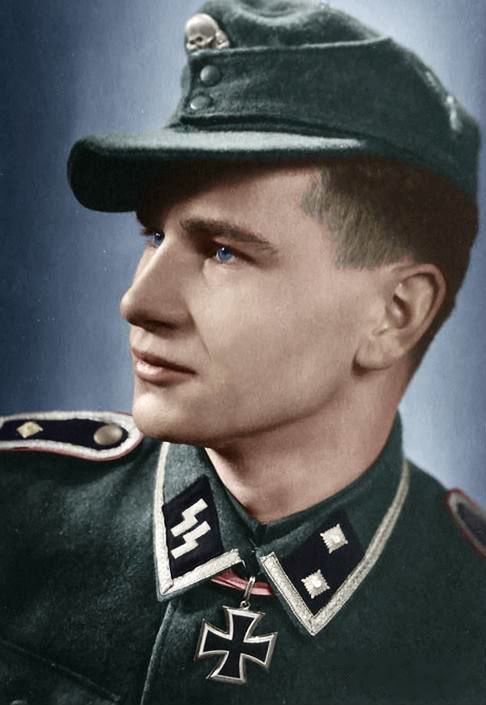
There is a widespread assumption that the men of Waffen-SS were indoctrinated political soldiers of one sort or another, with the precise meaning of this term varying with the outlook of the user. This outlook, in turn, is assumed to account for the greater proportion of war crimes attributed to the Waffen-SS. Surviving records, however, support Waffen-SS veterans´ claims that political indoctrination was at most a minor part of their training. It is essential to realize that most cases of atrocities result from some previous atrocity committed in violation of laws and customs of war and were often of an exceptionally heinous nature. In other words, they were often a part of the pernicious cycle of cruelty that stem from other, similar acts. The results are often disturbing and sometimes inexcusable, but not unique to the Waffen-SS. Each case must be examined individually and closely before any opinion on the general nature of the Waffen-SS can be considered to be well informed. Credit: Marc Rikmenspoel, Waffen-SS Encyclopedia. Left image: a portrait of SS-Oberscharführer Heinrich Gottke who served in the SS-FlaK-Abteilungs of the SS-Division Leibstandarte SS, Totenkopf and 17.Panzer-Grenadier-Division Götz von Berlichingen. Gottke was awarded the Knight's Cross for his bravery in action on December 13-14 1944. After detecting Allied troops in battalion strength supported by light tanks, he directed fire down onto the advancing forces which forced the attack back. During a second attack he directed fire onto his own position. During a third attack, he was forced to move to his secondary location from which he managed to direct fire onto the attacking force, again stopping the attack. Gottke joined the German Bundeswehr in 1958 and from 1964 he was the Envoy of the Federal Ministry of Defense. He retired on September 30 1975 as a Hauptmann, after a combined military service of 21 years. Heinrich Gottke died aged 77 on August 12 1998 in Wolfsburg, Niedersachsen. Credit: Matthias Ruf. Private Collection. FU. Right image: a formal studio portrait of East Prussian SS-Untersturmführer Alfred Schneidereit made in connection with the award of the Knight's Cross on December 20 1943. Schneidereit served as an anti tank gunner with SS-Division Leibstandarte SS. He was awarded the Knight's Cross for his actions on the Eastern Front where he participated in the battles at Lutsk, Kherson, Taganrog, Rostov, Kharkov and Kursk. Schneidereit was also promoted for bravery in the face of the enemy, and posted to the SS officer training school at Bad Tölz, which he graduated from in October 1944. He surrendered to the Soviet Red Army on May 12 1945. Alfred Schneidereit died aged 79 on February 21 1999 in Nördlingen, Bayern. Commons: Bundesarchiv.

Controversies about the Waffen-SS

SS-Oberscharführer Kurt Sametreiter
SS-Oberscharführer Friedrich Henke


The term Waffen-SS have been used interchangeably, and the actual history is often confused. Contrary to SS-Brigadeführer Paul Hausser's and SS-Standartenführer Felix Steiner's original conception, Reichsführer-SS Heinrich Himmler assigned numerous units to the Waffen-SS that had purposes other than combat. These included Einsatzgruppen murder squads and wartime concentration camp guards. These men carried Waffen-SS paybooks but had more in common with the political Allgemeine-SS than with members of combat units of the Waffen-SS. These executioners and guards were not expected to serve in a military role, and did not do so. To add to the confusion, Allgemeine-SS wore uniforms nearly identical to the Waffen-SS. This doomed the classic Waffen-SS – along with hundreds of thousands of volunteers and highly-motivated foreigners – to condemnation that extends until our days. In the minds of the Waffen-SS veterans, they and their European comrades were the Waffen-SS, the others being elements forced upon them. They saw themselves as an elite; they had fought well in many battles and had usually served honorably as soldiers. Credit: Marc Rikmenspoel, Waffen-SS Encyclopedia. Left image: the Austrian volunteer SS-Obersturmführer Kurt Sametreiter served as an Panzerjäger with SS-Division Totenkopf, Leibstandarte SS and 23.SS-Freiwilligen-Panzergrenadier-Division Nederland. Sametreiter was awarded the Knight's Cross during the Battle of Kursk in the tank Battle of Prokhorovka on July 1943. He was responsible for destroying 24 Soviet tanks in one action. Kurt Sametreiter died aged 95 on January 28 2017 in Bad Gastein, Austria. Photo: a formal studio portrait of Sametreiter by SS-Kriegsberichter Max Büschel, probably made in connection with the award of the Knight's Cross, on July 31 1943. Credit: Wehrmacht39. Commons: Bundesarchiv. Right image: SS-Oberscharführer Friedrich Fritz Henke served as a Zugführer in SS-Sturmgeschütz-Abteilung 1 of the SS-Panzer-Division Leibstandarte SS in 1943. On December 29 1943, he broke up a Soviet tank assault during the Soviet Zhitomir–Berdichev OffensiveFritz Henke knocked out the command tank from which the enemy commander escaped, only to be hit by a pistol shot by Henke. By the end of the day he had destroyed a total of 21 Soviet tanks and 11 AT guns. Henke was presented with the Knight's Cross on January 12 1944. By this time he had destroyed 38 tanks in total. SS-Untersturmführer Fritz Henke died aged 78 on November 15 1999 in Moisburg, Niedersachsen. The photo shows Henke as SS-Oscharf. in 1944. Commons: Bundesarchiv.