Showing posts with label B2: Siege of Leningrad 1943-1944. Show all posts

Siege of Leningrad, also known as the Leningrad Blockade

Focke-Wulf Fw 190A-5 fighters of Luftwaffe fighter wing JG54 Grünherz
Finnish-German Naval Detachment K during the Siege of Leningrad 1942
s.Pz.Abt.502 during the Siege of Leningrad 1943
Amid hunger and cold – Leningrad Blockade 1941 – 1944
The siege of Leningrad (Saint Petersburg) started on Sept. 8 1941, when German Heeresgruppe Nord severed the last road to the city. Finnish military forces were located north of city, at the 1939 Finnish-Soviet border, while the Wehrmacht including several European Waffen-SS formations occupied territories to the south. The blockade became one of the longest and most destructive sieges in history. Soviet deportations of Finns and Germans from the Leningrad area to inhospitable areas of the Soviet Union began in March 1942 using the city's only supply line, the Road of Life. The fighting continued around Leningrad for two-and-a-half years. In the north, the Finns stood guard along their southern border. To operate against Soviet forces around the Lake Ladoga and to close the supply line to the besieged city, the Finns formed their Ladoga Flotilla with the aim of isolating Leningrad from all directions. They were joined in summer 1942 by a German unit, the Einsatzstab Fähre Ost. Because the Soviet records during the war were incomplete, the ultimate number of casualties during the siege is disputed. The Soviet government reported about 670,000 registered deaths from 1941 to Jan. 1944. Some independent studies suggest a much higher death toll of between 700,000 and 1.3 million. Reports of cannibalism appeared in the winter of 1941-1942, after all birds, rats, and pets had been eaten by survivors. Hungry gangs attacked and ate defenceless people. Leningrad police even formed a special unit to combat cannibalism. Almost all historians regard the siege as a German operation and do not consider that the Finns effectively participated in the siege. Russian historian Nikolai Baryshnikov argues that active Finnish participation did occur, but historians have been mostly silent about it. Soon after the siege was lifted those who had led the city in its time of need were arrested by the NKVD presumably on the orders of Joseph Stalin. Their crime was that they had failed to contact Moscow frequently enough during the siege to ask for guidance. Those arrested, after 900 days of being besieged, now had to face the Soviet Gulags. Credit: Dahn A. Batchelor and Wikipedia i.a. Top image: a squadron of Focke-Wolf 190 fighter aircraft patrol of Luftwaffe fighter wing Jagdgeschwader 54 over the Eastern Front in 1943. JG54's operations in the area had a twofold objective: to keep the pressure on the Leningrad sector, and to reduce Soviet pressure on the Lake Ilmen area. It was known as the Green Hearts Wing, and it was the second highest scoring wing of all time, racking up over 9,600 kills. Photo by Kriegsberichter C. Berger. Commons: Bundesarchiv. Second image: Finnish Commander of Ladoga Coastal Brigade Colonel Eino Iisakki Järvinen and German Commander of Einsatzstab Fähre Ost Oberstleutnant d. R. Friedrich Wilhelm Siebel accompanied by two Luftwaffe officers on Lake Ladoga on Aug. 13 1942. Finnish Wartime Photo Archive. Third image: two crew members of a Panzer VI Tiger of the schwere Panzerabteilung 502 and a Kfz.31 Horch 108 'Sankra' near Lake Ladoga in the summer of 1943. Credit: Richard James Molloy. Commons: Bundesarchiv. Bottom screenshot: Leningraders collect water among the bombed-out ruins of buildings during the 872 days blockade of the city. Credit: Ryan Stennes. Leningrad Lenfilm Newsreel Studios chronicles.

Leningrad Sector: ϟϟ-Freiwilligen-Legion „Niederlande“

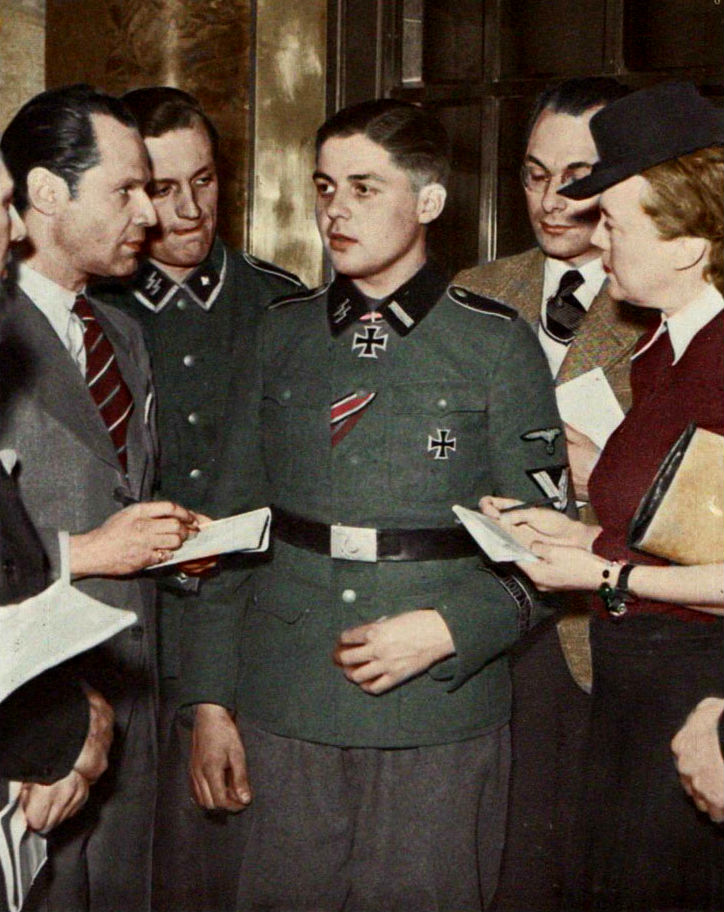
Knight's Cross holder Mooyman speaks to the press
SS Officer Candidate Gerardus Mooyman


Gerardus Mooyman from Apeldoorn in Netherlands was 19 years old when he volunteered for service in the Waffen-SS. Like many other Germanic volunteers, he started his career in SS-Freiwilligen-Standarte Nordwest, a unit consisted of volunteers from Flanders, Netherlands and other Germanic countries. After completing training for SS-Panzerjäger, he transferred to the Dutch SS-Freiwilligen-Legion-Niederlande, redesignated 4.SS-Freiwilligen-Panzergrenadier-Brigade Nederland in October 1943. During the Soviet offensive in the Leningrad sector in January 1943, the then SS-Sturmmann Mooyman, knocked out four T-34s and blocked a local Soviet advance. Shortly thereafter he was promoted to SS-Rottenführer. Another Soviet offensive came one morning in February 1943, during which Mooyman annihilated another seven T-34s. During this engagement his SS-Geschützführer was killed, requiring Mooyman to perform his duties as well. That very afternoon came another attack during which Mooyman's skill continued, allowing him to score another six Soviet tanks. For his contribution to halting the Soviet offensive, Gerardes Mooyman became the first first non-German to be awarded the Knight's Cross (February 20 1943). By the end of his service on the front he was credited with destroying 23 Soviet tanks and rose to the rank of SS-Untersturmführer. He was arrested after the war ended at Bodegraven in March 1946, put on trial in 1947 and charged with active military collaboration for his service in the Waffen-SS. Knight's Cross holder Mooyman was sentenced to six years in prison. Gerardus Mooyman died aged 63 in a car accident in Anloo in Drenthe on 21 June 1987. Credit: The Last Knight of Flanders. Left image: Mooyman in connection with the award of the Knight's Cross in February 1943. PD. Right image: Mooyman as an Officer Candidate in June 1944. Photo by SS-Kriegsberichter Erich Fabiger who covered the III. (germanisches) SS-Panzerkorps at Narva. Credit: Matthias Ruf. U.S. NARAFair use.

Leningrad Sector: Lettische ϟϟ-Freiwilligen Legion

Latvian Legion of the Waffen-SS
Latviešu leģions


The Latvian Legion was created in January 1943. It consisted of two divisions of the Waffen-SS: 15.Waffen-Grenadier-Division der SS (1st Latvian) and 19.Waffen-Grenadier-Division der SS (2nd Latvian). The first Latvian Legion unit fought its first battle in the Siege of Leningrad on March 18 1943. It continued fighting around Leningrad until the German forces retreated in January 1944. On January 27 1945, the Belgium-born commander of Latvian No.1 SS-Oberführer Adolf Ax stated: They are first and foremost Latvians. They want a sustainable Latvian nation state. Forced to choose between Germany and Russia, they have chosen Germany, because they seek co-operation with western civilization. In the years after the war, March 16 was chosen by its veterans' organisation in Western exile, as the day of the Latvian Legion. In 1998 Latvia's parliament voted this to be an official national remembrance day. Images: Latvian SS legionnaires at attention. FU.

Leningrad Sector: ϟϟ-Freiwilligen-Legion „Norwegen“

Den Norske Legion (DNL)
SS-Untersturmführer Bjørn Østring


The SS-Freiwilligen-Legion Norwegen or Den Norske Legion took part in the siege warfare around Leningrad where it suffered heavy casualties. The unit was formed from Norwegian Waffen-SS volunteers who were assured that its area of operations would be Finland. Instead, the unit was deployed to Northern Russia in the occupied Soviet Union. Initially, the Norwegian Quisling regime hoped to deploy over 30,000 Norwegian legionaries to Finnish Lapland, but this was rejected by both the Germans and the Finns. The Legion Norwegen was disbanded and withdrawn from the Leningrad sector during March 1943. Survivors who wanted to continue fighting were transferred to SS-Panzergrenadier-Regiment 23 Norge, one of the regiments of the newly formed 11.SS-Freiwilligen-Panzergrenadier-Division Nordland. Left image: Norwegian SS legionnaires swearing the oath of allegiance after months of training and preparation before being sent to the Leningrad front. The photograph was taken in Stettin. After World War II Stettin was transferred to Poland and renamed Szczecin. Credit: Jaris Almazani. Commons: Bundesarchiv. Right image: Norwegian SS-Untersturmführer Bjørn Østring of the Freiwilligen Legion Norwegen. The Leningrad veteran and member of the Norwegian Nazi party Nasjonal Samling Bjørn Østring died aged 95 on November 27 2012 in Bærum in Norway. Credit: Bekors. National Archives of Norway. 

Leningrad Sector: ϟϟ-Freiwilligen-Legion „Flandern“

SS-Freiwilligen-Legion Flandern
Flemish Waffen-SS ceremony at the Sterckshof castle


The Belgian SS-Freiwilligen-Legion Flandern was also inserted into the ring around Leningrad. The men of Flandern saw heavy fighting defeating two major Soviet attacks towards the city. On March 31 1943, the Legion was ordered back to be reformed into the 27.SS-Freiwilligen-Sturmbrigade Langemarck. The allocation of the title Langemarck, in memory of the bloody First World War battle fought at Langemarck in Belgium, was intended to represent Flemish-German camaraderie. However, the Flemings themselves didn't understand why they had been given a title which represented the losses suffered by German soldiers in 1914. Despite this, large numbers of Flemings continued to sign up for service with the Waffen-SS. The volunteers of the SS-Freiwilligen-Legion Flandern served on the Eastern front with distinction in a number of battles. Left image: a general version of a Waffen-SS recruiting poster encouraging European citizens to join the SS and fight Bolshevism. The poster was created by the niedersächsischen artist Walther Hoeck. Its based on a photograph of an unidentified SS volunteer from the Flemish Legion, one of several hundred thousand that volunteered for the Waffen-SS in order to fight against Communism and Soviet supremacy. Right image: Flemish SS ceremony marking the departure of military nurses and soldiers to the Waffen-SS at the Sterckshof castle in Deurne, near Antwerpen. Both photos in the PD.

Leningrad Sector: ϟϟ-Polizei-Division

Grenadier of the Polizei-Division on the Eastern Front
SS Grenadier disarming a Soviet Red Army soldier
SS-Polizei Division with Soviet POWs in the Leningrad area
The Polizei-Division was formed in 1939 as part of the Ordnungspolizei or uniformed national police. They were not at this time considered part of the Waffen-SS because of the manner that members of the unit were allowed to join. This status was reflected in their retention of police insignia and rank structure. The division was moved to the Volkhov River sector in January 1942 under command of Generaloberst der Polizei Alfred Wünnenberg. Finally, on February 24 1942, the Division was given official SS status and was transferred to the Waffen-SS. Its title was changed to the SS-Polizei Division. The formation was involved in heavy fighting between January and March 1942 which resulted in the destruction of the Soviet 2nd Shock Army. The remainder of the year was spent on the Leningrad front. The SS-Polizei-Division saw action south of Lake Ladoga on the Leningrad front in 1943 and was involved in a number of Soviet offensives when it was forced to withdraw to a new defensive line at Kolpino where it was successful in holding the Soviet Red Army, despite suffering heavy casualties. In May 1943, the SS-Polizei-Division were transferred to the west to retrain and upgrade to a Panzergrenadier division; leaving a small Kampfgruppe in the east. It was redesignated as 4.SS-Polizei-Panzergrenadier-Division in October 1943 under SS-Oberführer Friedrich-Wilhelm Bock. The Polizei's manpower strength was 16,081 officers and men in December 1943. Credit: Wikipedia inter alia. Top clip: a soldier of the Polizei filmed earlier in the campaign during a lull in the fighting. Middle clip: a Soviet POW being frisked for concealed weapons by a Waffen-SS soldier prior to being moved to the collection point. According to various sources, the grenadier is a member of the Polizei. In the film, you can see that he is holding a captured Russian Tokarev TT33 pistol in his right hand. Bottom clip: Grenadiers of the SS-Polizei-Division gathering Soviet Red Army POWs on the Leningrad front in 1943. All footage from Die Deutsche Wochenschau - the official Nazi German war newsreel from 1940 until production discontinued in March 1945.

Leningrad Sector: División Española de Voluntarios – División Azul

Spanish Comandante Román of  II Battalion of 269 Regiment of the Azul
Grave of Obergefreiter Marcelino Gil Martin of the División Azul
The Spanish Blaue Division or División Azul, officially designated as División Española de Voluntarios by the Spanish Army and 250.Infanterie-Division by the Germans, was composed of Spanish volunteers and officers who were given leave from the Spanish Army by dictator general Francisco Franco. Through rotation, as many as 47,000 Spanish volunteers served on the Eastern Front. División Azul faced a major Soviet attempt to break the siege of Leningrad in February 1943, when the Soviet Army 55 attacked the Spanish positions at the Battle of Krasny Bor. Despite heavy casualties, the Spaniards were able to hold their ground against a Soviet force seven times larger and supported by tanks. The assault was contained and the siege of Leningrad was maintained for a further year. The division remained on the Leningrad front where it suffered heavy casualties both due to cold and to enemy action. The Blue Division was disbanded in October 1943. Those Spaniards who wanted to continue to fight the Reds later served in the Spanische-Freiwilligen-Kompanie der SS 101 and 102. The volunteers in the Spanish Kompanie der SS 101 fought the last days of World War II in the Battle of Berlin under command of the Spanish Waffen-Hauptsturmführer der SS Miguel Ezquerra, as part of the multinational 11.SS-Freiwilligen-Panzergrenadier-Division Nordland. Top image: Andalucían Hptm. Miguel Román Garrido of División Azul. Comandante Román died aged 60 on Sept. 8 1960 in Grenada. PD. Bottom image: a comrade nails a sleeve badge of the Azul on the wooden cross grave mark of OGefr. Marcelino Gil Martin in Grigorovo at Leningrad sector. Photo taken by Lt. Angel Eustaquio Gil Martin in June 1943 when he visited his brother's grave. Credit: Doug Banks. PD.

Leningrad: 11.ϟϟ-Freiwilligen-Panzergrenadier-Division „Nordland“

SS-Sturmmann Andreas Mortensen
SS-Unterscharführer Knud Per Dahl-Nielsen


In 1943 all signs pointed to a Soviet offensive to relieve Leningrad, the German command was forced to strengthen the Oranienbaum front and transferred the newly formed 11.SS-Freiwilligen-Panzergrenadier-Division Nordland to that sector. It was billeted in the Sisak-Glina-Bosnich-Nowi area of Yugoslavia on Nov. 20 1943 when the communist partisans attacked Glina with about 5,000 men. The Danish battalion had 300 men in position and 150 in reserve, they repulsed all the daytime attacks and one nighttime assault with heavy losses to the enemy. The SS-Pionier-Battaillon 11 and SS-Panzergrenadier-Regiment 23 Norge and 24 Danmark arrived the Leningrad sector in advance of the other units of the division in early Dec. 1943. At the time the Nordland had a strength of 11,393 officers and men. Images: Danish Freikorps Danmark veterans Andreas Mortensen and Knud Per Dahl-Nielsen, both decorated for bravery with the Iron Cross during the battles of the Demyansk Pocket in 1942, had joined Nordland's Regiment 24 Danmark in 1943. Most Danish SS volunteers were sentenced to long prison terms after 1945, despite having had permission to serve in the Waffen-SS granted by the Danish government. Even the Danish Royal Guard encouraged soldiers and officers to step out of rank and sign up in Waffen-SS during the war. After the war a back dated law was signed and what at the time was legal was now illegal. Mortensen survived the war but was sentenced to five years in prison and loss of all civilian rights. Dahl-Nielsen was part of a reconnaissance unit when he was killed in action on Feb. 13 1944 north of Narva. His body has never been found. Credit: authors Jens Pank Bjerregaard and Lars Larsen; Danish Volunteers of the Waffen-SS. Private Collections: Poul Christensen and Rigborg Dahl-Nielsen. FU.

Soviet Leningrad–Novgorod Offensive and the withdrawal from Leningrad

Waffen-SS volunteer of the Nederland
German 15 cm Nebelwerfer 41 launcher while reloading
The Leningrad-Novgorod Offensive between January 14 and March 1 1944 was the Soviet strategic offensive against Heeresgruppe Nord by the Leningrad Front, the Volkhov Front and part of the 2nd Baltic Front in order to lift the almost 900-day siege of Leningrad. In all, the three Soviets fronts comprised the equivalent of 105 infantry divisions and 12 tank brigades, and the Leningrad and Volkhov Fronts alone claimed a numerical superiority of at least 6/1 in armoured fighting vehicles and aircraft over the German 18th Army. Adolf Hitler rejected all proposals for an early withdrawal into the 'Ostwall' positions, insisting that the Soviet forces had to be kept as far as possible from Germany and compelled to pay dearly for each yard of ground they took. SS-Obergruppenführer Felix Steiner's III. (germanisches) SS-Panzerkorps was able to hold off the Soviets until Jan. 26 1944 in continuous fighting while the northern wing of the 18th Army retreated to the west. The reorganization of the coastal sector was entrusted to the Danish SS-Obersturmbannführer Christian Peder Kryssing. The Soviets had finally raised the siege of Leningrad and had driven the Germans westwards into Estonia and Latvia. The Dutch 4.SS-Freiwilligen-Panzergrenadier-Brigade Nederland was involved in the 150 km fighting withdrawal to the Narva River in Estonia. In this sector of the front were to be found the bulk of the non-German volunteer divisions of the Waffen-SS. These foreign volunteers made a stand at Narva, and in an epic defence held up the Soviet Red Army for six months. Credit: Christopher Chant. Top image: an SS man of the Nederland during a break from the fierce battles. Neither heroes nor brave fighters step from the ranks of men made lonely by a hunger in their hearts for news from home. The volunteer is wearing one of many camouflage patterns used by the Waffen-SS. Photo by SS-KB Werner Mielke in 1944. U.S. NARA. Bottom image: German troops reload their 15 cm Nebelwerfer 41 multiple rocket launcher. c. Bundesarchiv.

Soviet Leningrad–Novgorod Offensive: Casualties and losses

SS-Freiwilligen Legion Flandern
4.SS-Freiwilligen-Panzergrenadier-Brigade Nederland
According to American military historian David M. Glantz and professor emeritus of military history Jonathan M. House, Soviet casualties in the Leningrad–Novgorod offensive were 313,953, including 76,686 killed and missing. According to German Statistics and Documents, Wehrmacht and Waffen-SS units suffered 71,651 casualties, including 24,739 killed and missing. The Germans were pushed back between 60 and 100 kilometers from Leningrad to the Luga River. Top image: Dutch-speaking volunteers of SS-Freiwilligen Legion Flandern deployed to the sector around Leningrad. The roughly 1,000-strong Flemish legion from German-occupied Belgium sustained heavy casualties in the fighting around Leningrad. It was later disbanded and reformed as the SS-Sturmbrigade Langemarck. Credit: Karl Mensburg. Commons: Bundesarchiv. Bottom mage: Dutch volunteers of the 4.SS-Freiwilligen-Panzergrenadier-Brigade Nederland being congratulated on the award of the Iron Cross Second Class by commander SS-Brigadeführer Jürgen Wagner. Wagner was extradited after the war by the Americans to Communist Yugoslavia where he was executed for unknown reason on June 27 1947. The man on the far left has the runic decal on the left side of the helmet, which indicates he was transferred to the Nederland brigade from the 5.SS-Panzer-Division Wiking. Photo by SS-Kriegsberichter Bruno Wisniewski. Wisniewski died on March 7 1944 near Narva in Estonia while still covering the Nederland. National Archives and Records Administration.