Showing posts with label B6: Normandy Invasion June 1944. Show all posts

Allied Operation Overlord: the Battle of Normandy, Die Schlacht um die Normandie, La bataille de Normandie (June 6 1944 – August (25) 1944)

Boeing B-17 Flying Fortress Group of USAAF over the English channel
USAAF aerial bombing of Lower Normandy
American forces arriving on Omaha Beach
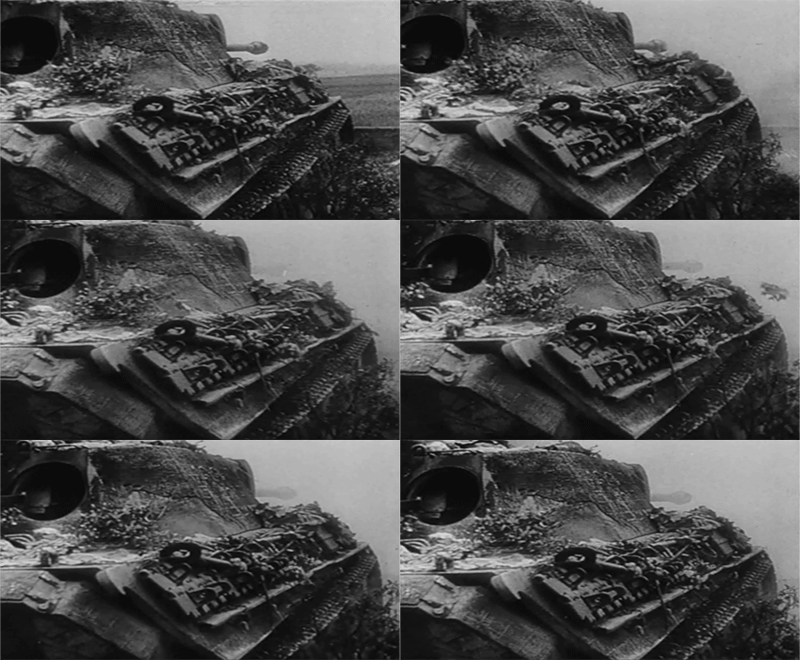
Tiger n°133 of s.SS-Pz.Abt.101 en route to the Normandy Front
Operation Overlord was
the codename for the Battle of Normandy, the Allied operation that launched the invasion of German-occupied Western Europe during World War II. The operation was launched on June 6 1944 with the Normandy landings (Operation Neptune, commonly known as D-Day). The total troops, vehicles and supplies landed over the period of the invasion were: By the end of June 11 1944, 326,547 troops, 54,186 vehicles and 104,428 tons of supplies. By June 30 1944 over 850,000 men, 148,000 vehicles, and 570,000 tons of supplies. By July 4 1944 one million men had been landed. Credit: Wikipedia. The Bombing of Normandy during the Normandy invasion was meant to destroy the German communication lines in the Norman cities and towns. However, very few Germans occupied these municipalities. German troops were mostly located outside these areas. It is estimated that the bombings in Normandy before and after D-Day caused over 50,000 civilian deaths. There was not a single Tiger formation on the scene in the beginning of the Allied invasion of Normandy. Only one formation was on its approach march, and it was still far away, in fact, east of Paris. It was the schwere SS-Panzer-Abteilung 101. Nearly a week was needed for the nearly 250 kilometers. The second Tiger formation, schwere SS-Panzer-Abteilung 102, reached the greater area of Paris a week later. The third formation was the schwere Panzer-Abteilung 503. It did not reach its area of operations east of Caen until July 7 1944. Credit: Tigers in Normandy by Wolfgang Schneider. Top image: a formation of Boeing B-17 Flying Fortresses from the 379th Bombardment Group (H) of the U.S. 8th Air Force over the English Channel. The aircraft in the immediate foreground with tail number 337677 flew around 75 missions with the 379th between June 1944 and April 1945. Credit: Nathan Howland. USAFHRA. FU. Second image from top: an Douglas A-20 G Havoc light bomber of U.S. 9th Air Force with D-Day 'invasion stripes' painted on wings. According to various sources, it bombs the surroundings of the village Le Molay-Littry in Lower Normandy on June 7 1944. U.S. NARA. Third image from top: American landing ships putting cargo ashore on Omaha Beach at low tide during the first days of the operation in June 1944. Among identifiable ships present are LST-532, USS LST-262, USS LST-310, USS LST-533 and USS LST-524. Note barrage balloons overhead and Army half-track convoy forming up on the beach. Credit: Jordan J. Lloyd. U.S. NARA. Bottom image: Panzer Tiger n°133 of schwere SS-Panzerabteilung 101 at Rue André Charpentier in Morgny when en route to the Normandy Front on June 8 1944. The elite battalion arrived on June 12 1944. It lost 15 of its 45 Tigers by July 5 1944. Tiger n°133 was commanded by SS-Oberscharführer Fritz Zahner. He survived Normandy and continued to see heavy action with the schwere SS-Panzerabteilung 503. By the Battle of the Bulge, Fritz Zahner commanded a Tiger II better known as Königstiger. Photo by Kriegsberichter Hans Scheck. Credit: Royston Leonard. Commons: Bundesarchiv.

Revenge and Vengefulness during the Battle of Normandy (I)

German Fallschirmjäger Feldgendarmerie studying the Normandy terrain
Tiger Commander Leutnant Richard Freiherr von Rosen
Panzerkampfwagen Königstiger n°301 of s.Pz.Abt.503
Both sides frequently failed to observe the Geneva Convention during the Normandy Invasion. It is not as if Allied war crimes are not known - it is just that it tends not to get talked about. The worst of these were the bombing raids on medical stations and ambulance convoys, many of which contained Allied servicemen being treated by the German Red Cross or the DRK. Historian Peter Lieb has found that many U.S. and Canadian units were ordered not to take prisoners during the D-Day landings. If this view is correct it may explain the fate of 64 German prisoners who did not make it to the POW collecting point on Omaha Beach on June 6 1944. An example is the U.S. Army General Maxwell D. Taylor who instructed the men of 101st Airborne Division to take no prisoners according to American historian and Professor Stephen Edward Ambrose. Some 30 German POWs were in fact massacred by U.S. paratroopers at the French village of Audouville-la-Hubert. A documentary made by CBC News confirmed British eyewitness Edward Ashworth's accounts of Canadian troops cutting the throats of German POWs and that Canadian tanks run over German soldiers with their arms in the air during the battle of Normandy. The rumor spread through the entire 12.SS-Panzer-Division Hitlerjugend that the Allies were killing fellow soldiers trying to surrender. In the days and weeks that followed, Canadian soldiers were executed following their capture by men of the Hitlerjugend. SS-Panzergrenadier-Regiment 25 was responsible for the killing of seven Canadian POWs at its Headquarters at L’Ancienne Abbaye Ardenne. SS-Brigadeführer Wilhelm Mohnke was implicated in the killing of another 35 Canadian POWs, all of the Royal Winnipeg Rifles, at Fontenay-le-Pesnel on June 8 1944, though he never faced a trial for any conclusion as to any query of involvement. Canadian war crimes investigators were never able to establish with certainty the units involved, much less the individuals. After WWII, Allied investigations established that separate atrocities were committed by German troops in 31 different incidents involving 134 Canadians, 3 British and 1 American. Top image: German paratroopers wearing military field police gorgets while studying the terrain of Normandy in 1944. Photo by KB Zimmermann. c. Bundesarchiv. Middle image: screenshot from a captured propaganda film showing Tiger commander and Normandy veteran the then Leutnant Baron Richard von Rosen in 1944. In his first encounter with the allied forces in Colombelles on July 11 1944, he succeeded in destroying 12 Sherman tanks and captured two Shermans intact. U.S. NARA. Bottom image: Richard von Rosen's Königstiger n°301 of schwere Panzer-Abteilung 503 getting a camouflaged paint scheme in Mailly-le-Camp in June 1944. Oberleutnant Richard v. Rosen passed away on Oct. 26 2015. Photo by KB Wagner. Credit: Paul Reynolds. c. Bundesarchiv.

Revenge and Vengefulness during the Battle of Normandy (II)

SS-Flak Abteilung of 9.SS-Pz.Div. Hohenstaufen in Normandy
Paratrooper of Fallschirmjäger-Reg.6 with a FG-42 around Carentan
Camouflaged Tiger of s.SS-Pz.Abt. 101 in Villers-Bocage
Pz.Kpfw. Tiger n°211 of s.SS-Pz.Abt.102 in the Normandy bocage
Both sides often took no quarter in tit-for-tat reprisals. According to a report by regimental adjutant Count Hauptmann Clary-Aldrigen who was captured by British troops near Hill 102 along with six senior officers and men, including regimental commander Oberst Luxenburger and battalion commander Major Zeissler of Panzer-Artillerie-Regiment 130 of the Panzer-Lehr Division on June 8 1944. The British forces were two scouting parties numbered 2 and 6A of C Squadron of the Inns of Court Regiment. According to the war diary of the Inns of Court Regiment on June 8 1944: Lieutenant Yodaiken, Lieutenant Wigram, Corporal Fowler and six other ranks. When the German officers refused to voluntarily ride on the English armored reconnaissance vehicles as shields against bullets, the one armed Luxenburger was beaten up and tied to the vehicle, covered in blood. After respective orders had been received by radio, Major Zeissler, Hauptmann Clary-Aldrigen, the NCOs and men of the group were shot by the retreating British still with Oberst Luxenberger tied to one of their vehicles. Clary-Aldrigen survived the gunshot wounds and regained consciousness and crawled, badly wounded, in the direction of the village of Le Mensil-Patry. The next day, in retaliation, three Canadian prisoners, Private Harold Angel of Cameron Highlanders and Privates Frederick Holness and Ernest Baskerville of Royal Winnipeg Rifles were ordered shot at Le Haut du Bosq on June 9 1944 by SS-Brigadeführer Wilhelm Mohnke. SS-Obersturmbannführer Bernhard Siebken opposed the summary executions and called Division HQ and spoke to divisional Chief of Staff (Ia). He was told that POWs are to be treated according to the Geneva Convention. Mohnke returned to Battalion HQ looking for Siebken, who was away at the front, he then ordered SS-Untersturmbannführer Dietrich Schnabel to execute the Canadians. At Schnabel's command the three Canadians were shot. At the end of World War II, several trials of Axis war criminals took place. However, in Europe, these tribunals were set up under the authority of the London Charter, and could only consider allegations of war crimes committed by persons who acted in the interests of the European Axis countries. Siebken and Schnabel, both of SS-Panzergrenadier-Regiment 26, were accused of the above war crime. Knight's Cross Holder Bernhard Siebken and Dietrich Schnabel were found guilty and hanged in Hameln on January 20 1949. Reference: Hubert Meyer - the official historian of 12.SS-Panzer-Division Hitlerjugend. Top image: an Anti-Aircraft Battery of 9.SS-Panzer-Division Hohenstaufen in Normandy in June 1944. Photo by Kriegsberichter Koll. c. BundesarchivSecond image: a paratrooper of Fallschirmjägerregiment 6 armed with a Fallschirmjägergewehr 42 behind an embankment in the area around Carentan in June 1944. Credit: Julius Backman. c. BundesarchivThird image: Panzer Tiger of schwere SS-Panzer-Abteilung 101 camouflaged in the undergrowth near Villers-Bocage in Normandy in June 1944. Photo by the prominent KB Arthur Grimm. Credit: Royston Leonard. c. BundesarchivBottom image: Tiger n°211 moving through the flooded low lands of Normandy for allied targets in July 1944. It was commanded by the less known Tiger Ace SS-Untersturmführer Martin Schroif, and assigned to schwere SS-Panzer-Abteilung 102. Schroif survived the war and died aged 64 on Aug. 16 1979. Credit: Vitaly Lopatin. c. Bundesarchiv.

Looting and Rape during the Normandy Campaign

"Les Assassins Reviennent Toujours sur les Lieux de Leur Crime"
Widespread looting of SS memorabilia
The theft and looting of Normandy households and farmsteads by liberating soldiers began on June 6 1944 and never stopped during the entire summer. One woman - from the town of Colombieres - is quoted saying: They are looting everything and going into houses everywhere on the pretext of looking for Germans. Even more feared, of course, was the crime of rape - and here too the true picture has arguably been expunged from popular memory. The evidence shows that sexual violence against women by Allied servicemen in liberated Normandy was common. Reference: William Hitchcock's The Bitter Road to Freedom. According to the American Professor and historian Robert Lilly, there were around 3,500 rapes by American servicemen in France between June 1944 and the end of World War II. According to an article in Der Spiegel by Klaus Wiegrefe, many personal memoirs of Allied soldiers have been willfully ignored by historians until now because they were at odds with the "Greatest Generation" mythology surrounding World War II, but this has recently started to change with books such as "The Day of Battle" by American journalist and author Rick Atkinson (winner of the Pulitzer Prize) where he describes Allied war crimes in Italy, and "D-Day: The Battle for Normandy" by British military historian Antony Beevor. References: Spiegel Online 05/04/2010. Credit: Wikipedia inter alia. Top image: a French pro-German poster of 1944 in the Norman city of Cherbourg, featuring the prayerful figure of saint Jeanne d'Arc superimposed on images of the ancient city of Rouen burning under Allied bombardment: Criminals always return to the scene of the crime. See Original Poster. PD. Bottom screenshot: American G.I.'s pose in liberated SS Panzer wrappers in France 1944. The ultimate souvenirs was no doubt various insignia and decorations of the feared Waffen-SS. PD

Allied Destruction of the Medieval Town of Caen

Handley Page Halifax of RAF Bomber Command in flight
Destruction of Caen – Caen after British Royal Air Force bombing
The British Air Marshal Arthur Harris's RAF Bomber Command bombed Caen twice, once on D-Day and again a month later on July 7 1944. There were more than 2,000 civilian casualties there on the first two days of the invasion. About 35,000 residents were made homeless after the Allied bombing. The scale of destruction is already well-established. Hundreds of tons of bombs destroyed entire cities and wiped out families. In some areas, barely a building was left standing and the liberators had to walk over banks of human corpses. Although Allied correspondence and reports state that most of the population welcomed them as liberators, civilians' feelings were often more confused. The exhibition at the Caen memorial displays the diary of Corporal LF Roker of the Highland Light Infantry: It was rather a shock to find we were not welcomed ecstatically as liberators by the local people, as we were told we should be... Another Allied serviceman, Ivor Astley of the 43rd Wessex Infantry, wrote: If we expected a welcome, we certainly failed to find it. But the suffering of civilians was for many years masked by the over-riding image, that of the French welcoming the Allies with open arms. The combination of anticipation and resentment of the Allies, noted among the French, also applied elsewhere in Europe. References: Jean-Claude Valla (La France sous les bombes américaines), Henri Amouroux, Roger Céré and Charles Rousseau, William Hitchcock and Christophe Prime. Top image: a Halifax Heavy Bomber of RAF BC over the target during a daylight raid in 1944. Credit: Nathan Howland. Imperial War Museums. Bottom image: a street shot showing the devastation after Allied carpet bombing of Caen known for its historical buildings. In the centre is the remains of the 13th century church of Saint-Pierre. The spire of the church was destroyed on July 9 1944 by a British Royal Navy shell fired from HMS Rodney. Photo by British photog. James Jarché. LIFE photo archive.

Allied Carpet Bombardment of French Cities and Towns

381st Bombardment Group of the U.S. Eighth Air Force in flight
Destruction of Saint-Lô – A martyr city of World War II
Allied Bombing during the Normandy invasion in 1944 destroyed 96% of Tilly-la-Campagne, 95% of Vire, 95% of Saint-Lô, 88% of Villers-Bocage, 82% of Le Havre, 76% of Falaise, 75% of Lisieux and 75% of Caen. The military value of these bombings was highly debatable. As for the destruction of Caen, known for its historical buildings built during the reign of William the Conqueror, it has long been admitted that it was militarily useless. According to the famous French historian and former member of the French Resistance Movement Henri Amouroux (awarded Croix de Guerre 1939-1945) 20,000 civilians were killed in Calvados department, 10,000 in Seine-Maritime, 14,800 in the Manche, 4,200 in the Orne and around 3,000 in the Eure. All together, that makes more than 50,000 French civilians killed by Allied bombings in Normandy alone, however, the Western Allies escaped all responsible for all of the death and destruction because they were 'represented as “liberators”. Top image: Boeing B-17 heavy bombers of the USAAF 381st Bombardment Group. The Group supported the Normandy invasion in June 1944 by bombing bridges and airfields and it bombed suspected positions in advance of ground forces at Saint-Lô in July 1944. USAFHRA. PD. Bottom image: American soldiers watch U.S. Army jeeps drive through the bombed-out city of Saint-Lô. The heavy damage and the high number of casualties after the American bombing of medieval Saint-Lô resulted in the city being nicknamed The Capital of Ruins. Photo by American journalist and photog. Frank Scherschel. LIFE photo archive.

Fallschirmjäger-Regiment 6 and 21.Panzer-Division in Normandy

Messerschmitt pilot Ludwig Franzisket of Jagdgeschwader 27 Afrika
Fallschirmjäger-Regiment 6 became known as The Lions of Carentan
21.Panzer-Division descended from Rommel's legendary Afrika Korps
From the first moments of the airborne invasion of France paratroopers of Major baron Friedrich von der Heydte's elite Fallschirmjägerregiment 6 was in action against American paras from the U.S. 101st Airborne Division. Scattered fire-fights continued throughout the night until about 0600 in the morning of June 6 1944 when the German paras or Fallschirmjägers was given orders to assemble and clear the region between Carentan and St. Mere-Eglise of enemy troops. The total fighting strength of the regiment at this time was 3,457 officers and men. For the first day of the Allied landings the 21.Panzer-Division operated alone on June 6 1944. It launched several counterattacks during the afternoon which effectively blocked the road to Caen. Hampered by enemy air strikes, the 21.Panzer managed to find and engage British Paratroop forces at Ranville. The division gave the British a hard fight until it received orders to withdraw. Allied air power were the decisive factor for the Allied victories in the Normandy Invasion and subsequent operations. Allied sea and air power halted every major German attack. This was to be typical of the German experience of Allied air power in Normandy and the Ardennes. After the invasion of Normandy, Allied troops found themselves unable to penetrate German defenses. Top image: Messerschmitt Bf 109 G-6 of Jagdgeschwader 27 Afrika piloted by Luftwaffe fighter ace Gruppenkommandeur Major Ludwig Zirkus Franzisket in 1944. JG 27 was among those wings rushed into Normandy to stem the invasion, but the USAAF, RCAF and RAF and subordinated foreign elements had already achieved air supremacy over Western Europe by June 1944. Zirkus Franzisket was credited with 39 aerial victories, plus four further unconfirmed claims. All of his victories were claimed on the Western Front and include three U.S. B-17 four-engined bombers. Franzisket survived the war and became a Professor and director of the Westfälisches Museum für Naturkunde and died aged 71 on November 23 1988 in Münster. Credit: Rui Manuel Candeias. c. Bundesarchiv. Middle image: German paras wearing the Feldgendarmerie gorget review battle plans with their commanding Luftwaffe officer in Normandy 1944. Credit: Ghermán Mihály. c. Bundesarchiv. Bottom image: battle-hardened members of Panzer-Regiment 22 of the 21.Panzer-Division. The young Leutnant wears a fallschirmjäger tunic with Heer eagle and panzer collar tabs applied. Photo taken by KB Karl Müller. Credit: Slyhoogus. c. Bundesarchiv.

ϟϟ-Panzeraufklärungsabteilung – The Eyes of the Division

Volunteer of 12.SS-Panzer-Division Hitlerjugend
Radio Operator of SS-Panzer-Aufklärungs-Abteilung 12


The Aufklärungs-Abteilung was the eyes and ears of the parent division. As with all German combat formations, the composition of the Waffen-SS Aufklärungs-Abteilung varied from division to division, and from one period of the war to another. Panzer Aufklärungs-Abteilungen were attached to Panzer divisions, and were generally equipped with amphibious Schwimmwagens and armoured vehicles, with all troops transported by halftrack, and an anti-tank gun (PaK) component was included, light tanks were also included in the detachment as the theory of reconnaissance in force was practiced. The Abteilung had to be able to move quickly, and as its mission was reconnaissance, it was not equipped to deal with enemy medium or heavy armour, although these engagements did happen quite frequently. Left image: a young volunteer of the 12.SS-Panzer-Division Hitlerjugend wearing a disruptively Erbsentarn patterned jacket on the outskirts of Caen in June 1944. Photo by South Tyrol-born SS-Obersturmführer and KB Friedrich Zschäckel. Credit: Karl Mensburg. c. Bundesarchiv. Right image: another unidentified young SS-Panzergrenadier photographed in the Caen area in July 1944. According to some sources, a member of the SS-Panzer-Aufklärungs-Abteilung 12 Hitlerjugend. Credit: Doug Banks. c. Bundesarchiv.

12.ϟϟ-Panzerdivision „Hitlerjugend“ (I)

Feldm. Gerd v. Rundstedt observing exercises conducted by Hitlerjugend
Pz.Kpfw. V Panther n°314 at Mailly-le-Camp training center
Pz.Kpfw. IV n°635 of SS-Pz.Reg.12 Hitlerjugend en route to Normandy
Pz.Kpfw. IV n°615 of SS-Pz.Reg.12 Hitlerjugend en route to Normandy
The 12.SS-Panzer-Division Hitlerjugend, with 20,540 personnel, first saw action on June 7 1944. It was the first Waffen-SS division into action in the Normandy Campaign, blocking the Anglo-Canadian advance toward the strategically vital town of Caen during the first couple of days of the Allied invasion. The division was unique because the majority of its junior enlisted men were drawn from members of the German youth organization Hitlerjugend born as late as in 1926, while the officers were generally veterans of the Eastern Front. About 1,000 experienced Waffen-SS officers and NCOs had been transferred from the 1.SS-Panzer-Division Leibstandarte SS during its formation and training in 1943. SS-Panzer-Regiment 12 of the Hitlerjugend trained at Mailly-le-Camp in France until it was transferred to the Beverloo Camp in Belgium where it joined the rest of the division in January 1944. In early April 1944, the Hitlerjugend was ordered to move to Normandy in France. It continued training exercises in the peaceful area around Caen, familiarizing itself with the terrain. This proved invaluable in the months that followed. Although its training had not been completed and some units of the division were still on exercises, upon being alerted to the Allied landings the Hitlerjugend division and its panzer regiment were among the first German armoured units to be thrown into battle. SS-Panzer-Regiment 12 arrived on the morning of June 7 1944 to spearhead the division's counterattack. Their Panzers proved bulwarks of the German defence in Normandy. However, they were not immune to Allied bombing. Top image: Prussian Generalfeldmarschall und Oberbefehlshaber West Gerd von Rundstedt standing on a Sd.Kfz.7 half-track while observing exercises conducted by SS-Panzer-Regiment 12 at the Beverloo Camp in March 1944. From left to right: Regimental Commander Kurt Meyer, Divisional Commander Fritz Witt, Corps Commander Josef Sepp Dietrich and Commander-in-Chief West Gerd von Rundstedt. c. Bundesarchiv. Second image: Panther n°314 at the shooting range at Mailly-le-Camp training center in France. Credit: Rui Manuel Candeias. c. Bundesarchiv. Third image: Panzer IV n°635 commanded by SS-Oscharf. Johann Terdenge was captured by the British around Caen during Op. Epsom in late June 1944. It ended up being sent back to the U.K. for technical evaluation at STT. A notable feature of the newly formed SS-Panzer-Regiment 12 panzer uniform was the wearing of leather surplus from Germany's U-boat arm. Credit: Royston Leonard. c. Bundesarchiv. Bottom image: members of this young tank crew have painted their girlfriends´and mothers´names on their tank. Information based on original photographs of wrecked vehicles: Panzer IV n°615 was later captured at the Battle of Buron where the Canadians had been badly mauled in the fierce fighting on June 8 1944. By 1944 the Panzer IV was in widespread use within the Waffen-SS. It was fitted with armoured skirts to provide protection from Allied antitank rockets. Photos by KB Bernhard Kurth. c. Bundesarchiv.

12.ϟϟ-Panzerdivision „Hitlerjugend“ (II)

Pz.Kpfw. IV n°536 of SS-Pz.Reg.12 Hitlerjugend
Pz.Kpfw. Panther n°128 of SS-Pz.Reg.12 Hitlerjugend
Although fanatical in their determination and tenacity to fight to the death, it did not take long for the 12.SS-Panzer-Division Hitlerjugend to suffer horrendous casualties. In their first engagement with the Canadians, the division destroyed 28 Canadian tanks while losing only six soldiers for their efforts. They fought with a very high degree of determination. However, the odds were against them in the long run. In slightly over one month of combat, the Hitlerjugend Division had lost over 60 percent of its forces due to combat actions. The main tanks fielded by the Hitlerjugend Division were the Panzer IV, deployed in 1.Bataillon of the division's armoured regiment and the Panzer V Panther tank. The Panther weighed 44.1 tons, mounted a 70-calibres long 7.5cm gun and possesed well-sloped armour protection. It outperformed Allied tanks in terms of combined lethality and survivability. In addition to these two tank types, the division also deployed Jagdpanzer IV's tank destroyers. Top image: Panzer IV n°536 commanded by Hitlerjugend panzer ace SS-Unterscharführer Willy Kretzschmar of the 5th Company of SS-Panzer-Regiment 12. This photo is taken after an artillery round blew off the tanks' track immobilizing it in Buron about 6 kilometres north-west of Caen in June 1944. Willy Kretzschmar and his SS panzer crew is accounted for at least 15 Allied tanks during the desperate defensive battles that the Hitlerjugend conducted in Normandy but the exact number is unknown. Commons: Bundesarchiv. Bottom clips: Panther n°128 of the division's most potent combat unit fires on British-Canadian positions north of Caen during the Normandy campaign in June 1944. Footage from Die Deutsche Wochenschau - the official Nazi German war newsreel from 1940 until production discontinued in March 1945. It received film stock from special Waffen-SS and Wehrmacht war reporting units. Fair use.

„Hitlerjugend“ counterattack from Caen towards the beaches

Pz.Kpfw. IV of SS-Pz.Reg.12 Hitlerjugend
SS-Pz.Grenadiers of SS-Pz.Gren.Reg. 25 Hitlerjugend
After much confusion, the 12.SS-Panzer-Division Hitlerjugend got moving at about 14:30 hours on June 6 1944, over twelve hours after the first reports of the Allied landings had been received. The divisions advance to the areas near the British–Canadian landing beaches of Sword and Juno Beaches proceeded slowly due to Allied air attacks. Experienced Waffen-SS veterans understood what was coming. They also knew how much would depend upon the fresh-faced teenagers assembling around them. At 10:00 hours on June 7 1944, the SS-Panzergrenadier-Regiment 25, along with 50 Panzer IV tanks of the SS-Panzer-Regiment 12, moved into position north-west of Caen. They were ordered to break through to the beach but were halted by naval and anti-tank fire and Allied air interdiction. Regiment commander SS-Obersturmbannführer Kurt Meyer countermanded the divisional commander's order on his own initiative, feeling that objective unrealistic, and hoped merely to stop the flow of Canadian units inland until the situation could be stabilized. Late on June 7 1944, the divisions sister regiment, the SS-Panzergrenadier-Regiment 26 arrived on the battlefield. It crossed behind Kurt Meyer's regiment and took post to the west. The 1.Bataillon launched an attack towards Norrey-en-Bessin, defended by the Regina Rifle Regiment of 7th Canadian Infantry Brigade, orders were to overrun the Canadians and force a deep wedge between them and the British to the west. No reconnaissance of the Canadian positions was done. Bessin was well-defended by the Regina Rifles, with firmly established positions and with artillery support, and the attack failed. The attack at 03:30 hours on June 8 1944 had little initial success. The 1.Bataillon managed to break into the village of Putot-en-Bessin and surround several companies, pushing the Canadian Royal Winnipeg Rifles out of the village by 13:00 hours and inflicting 256 casualties – of which 175 were taken prisoner. Later that day, a counter-attack by the Canadian Scottish Regiment, with artillery, tank and tank-destroyer support, re-took Putot. A company of Panther tanks finally appeared on June 8 1944, and Kurt Meyer personally led a night attack toward the village of Rots, which they reached at midnight. Credt: Welsh historian Jon Latimer inter alia. Top clips: Panzer IVs of the Hitlerjugend en route to the Normandy Front on June 6 1944. Footages from Die Deutsche Wochenschau. FU. Bottom image: Hitlerjugend regrouping after the failed attack in Norrey-en-Bessin near the town of Rots on June 9 1944. The wounded officer with the back to the camera is SS-Obersturmbannführer Max Wünsche, commanding officer of SS-Panzer-Regiment 12. The officer to the very right is the diplomat's son SS-Hauptsturmführer Rudolf von Ribbentrop of the same regiment. Photo by SS-KB Wilfried Woscidlo. Credit: David W. Stradal. Commons: Bundesarchiv.

ϟϟ-Panzergrenadier-Regiment 25 (Norrey-en-Bessin)

SS-Panzergrenadiers of SS-Panzergrenadier-Regiment 25 Hitlerjugend
Commanding officer of SS-Panzer-Regiment 12 Hitlerjugend
These famous photographs of the 12.SS-Panzer-Division Hitlerjugend were taken by the eminent SS-Kriegsberichter Wilfried Woscidlo. They were taken just before these young volunteers of SS-Panzergrenadier-Regiment 25 were moving out from Rots on June 9 1944. In the 1.Bataillon 65 percent were under 18 years old. Only three percent were over 25. Top image: in the foreground stands the 18-year-old SS-Sturmmann Otto Funk in a Italian pattern camouflage smock. He was involved in heavy fighting in and around the French town of Caen in the summer 1944. A total of 2,600 British tons of bombs reduced Caen to rubble and caused many civilian casualties. In the summer of 1944 there was extremely violent fighting in these ruins. Funk was the ammo-carrier of MG gunner SS-Schütze Klaus Schuh. The pressure of combat, battle fatigue, is shown on the faces of these young SS volunteers. Many of these World War II photos capture something special. It may be calm before the storm, it may be a moment of horror, or it may show a simple humanity often lost in the fray of battle. Credit: Whitedeath. c. Bundesarchiv. Bottom image: SS-Hauptsturmführer Rudolf von Ribbentrop, son of the Nazi diplomat and Foreign Minister Joachim von Ribbentrop, sits in the sidecar of a motorcycle after paying a visit to survivors of SS-Hauptscharführer Wilhelm Boigk's 3rd platoon of the 15th company. The motorcycle is driven by the commanding officer of SS-Panzer-Regiment 12 SS-Obersturmbannführer Max Wünsche. Rudolf von Ribbentrop is born on May 10 1921 in Wiesbaden and is still alive in 2011. Stuttgarter Illustrierte Nr 25. c. Bundesarchiv.

ϟϟ-Panzergrenadier-Regiment 25 (Norrey-en-Bessin)

12.SS-Panzerdivision Hitlerjugend


At the late morning on June 9 1944 an combined arms attack was planned together with the panzers of SS-Panzer-Regiment 12 to seize La Villeneuve, as a starting point for a future offensive up north of the 12.SS-Panzerdivision Hitlerjugend. After hours of confused fighting, the 15.Kompanie of SS-Panzergrenadier-Regiment 25 were forced to withdrawThese photos are taken in the village of Rots in the Calvados region just after the failed attack on Norrey-en-Bessin. Photos show exhausted volunteers of SS-Hauptscharführer Wilhelm Boigk's III. Zug before grimly carry on their battleWilly Boigk himself was killed in action on July 4 1944 and is buried at the Soldatenfriedhöf Reyes-Bazenville. Left image: MG 42 gunner Klaus Schuh, KIA on June 26 1944, and squad leader Peter Koslowski, KIA on July 25 1944. Right image: a soldier of SS-Panzergrenadier-Regiment 25 taking a quick nap in full camouflage kit carrying the indestructible Zeiss field glasses. Both photos by SS-Kriegsberichter Wilfried Woscidlo. Scan: Stuttgarter Illustrierte Nr 25 (1944). Commons: Bundesarchiv.

ϟϟ-Sturmmann der Waffen-SS Funk and the Stuttgarter Illustrierte

Magazine Stuttgarter Illustrierte Nr 25 1944

Magazine Stuttgarter Illustrierte Nr 2 1941


The photograph of SS-Sturmmann Otto Funk taken in Rots in the Calvados department in Normandy is making the cover page of the Magazine Stuttgarter Illustrierte, on June 21 1944. Another one, also pictured in France, who made the cover of the Stuttgarter Illustrierte back in 1941 was the then SS-Hauptsturmführer Joachim Peiper. In a personal conversation with the author and historian Herbert Walter, Jochen Peiper told how he was embarrassed when he found the magazine in kiosks of Berlin – So it came to nationwide fame… The young Hitlerjugend volunteer Otto Funk got wounded near Cheux in the Calvados department just a few days after the magazine was released, on June 26 1944. Still he will continue fight till the bitter end. On May 8 1945, the survivors of 12.SS-Panzer-Division Hitlerjugend surrendered to the U.S. 65th Infantry Division of the 7th Army, near Enns in Austria. In a final act of defiance, the division refused to drape their vehicles with white flags, as the Americans had ordered. Otto Funk survived the war and is still alive in 2011. Left image: Scan: Stuttgarter Illustrierte - June 21 1944. Right image: Scan: Stuttgarter Illustrierte - January 8 1941. Private Collection, with permission.