Showing posts with label 6. Soviet Union/Operation Barbarossa June-Dec 1941. Show all posts

Nazi German Reich – Communist Soviet Union Relations 1941

Pan-German Nazi dictator Adolf Hitler in the Reichstag 1941
German advance party on the Eastern Front during Barbarossa 1941
Soviets taken prisoner by Waffen-SS during Barbarossa 1941
Soviet soldier captured in a foxhole in Ukraine during Barbarossa 1941
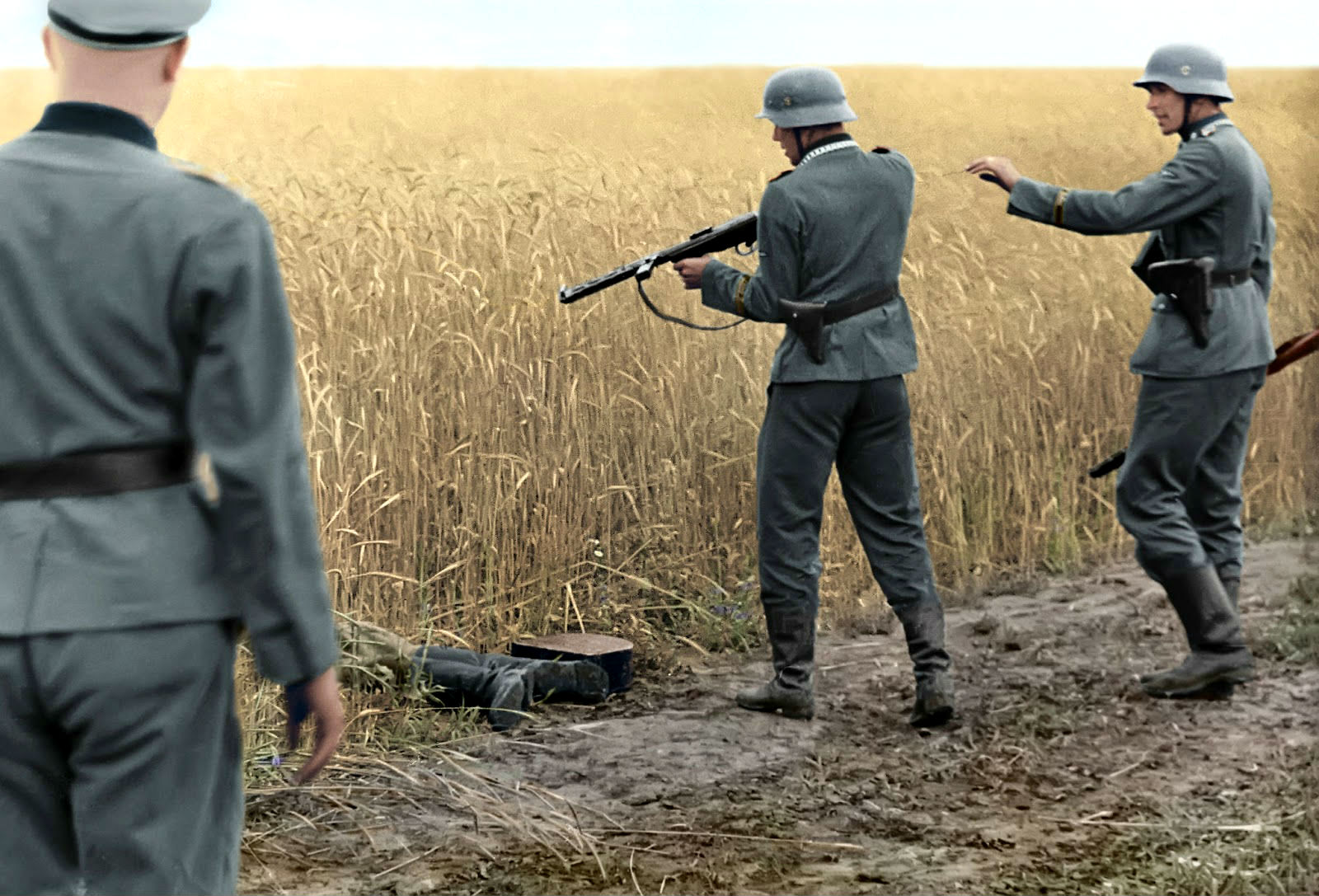
Summary execution of a partisan by the so-called Kettenhunden 1941
In the 1930s Soviet production of military equipment grew steadily, and in the pre-war years the economy became progressively more oriented toward military production. The Soviet numerical advantage in heavy equipment was also more than offset by the greatly superior training and readiness of German forces. The Soviet officer corps and high command had been massacred in Communist dictator Joseph Stalin's Great Purge in 1936-1938. In total, some 30,000 Red Army personnel were executed, while more were deported to Siberia and replaced with officers deemed more politically reliable. In Sept. 1939, only a month after the Ribbentrop-Molotov non-aggression pact was signed between Germany and the USSR, Stalin ordered the Soviet invasion of eastern Poland, stating concern for ethnic Ukrainians and Belarusians in Poland. The Red Army then occupied Estonia, Latvia, and Lithuania and the Romanian territories of Bessarabia and northern Bukovina in June 1940. Only Finland resisted Stalin's program of expansion. On May 5 1941, Stalin gave a speech to graduates of military academies in Moscow declaring: War with Germany is inevitable. If comrade Molotov can manage to postpone the war for two or three years that will be our good fortuneImmediately after the German invasion of the Soviet Union in June 1941, Nazi dictator Adolf Hitler put forward a thesis that the Red Army made extensive preparations for an offensive war in Europe, thus justifying the German invasion as a pre-emptive strike. After the war this view was brought forward by Wehrmacht leaders, like Feldmarschall Wilhelm Keitel. This thesis was reiterated in the 1980s based on the analysis of circumstantial evidence. Thus, it has been found that a proposal was drawn up by Marshal Georgy Zhukov and signed by General Aleksandr Vasilevsky and Lieutenant General Nikolai Vatutin suggesting secret mobilization and deploying Soviet Red Army troops on the western border. The proposed operation's objective was to cut Germany off from its allies, especially Romania with its oilfields that Germany needed to conduct the war. According to former Soviet GRU officer Viktor Suvorov, Stalin planned to use Germany as a proxy against the West. With the complete annihilation of the encircled German Army thus made inevitable, a Red Army offensive into the rest of Europe would follow. Suvorov argued that Barbarossa was actually a pre-emptive strike that capitalized on the Soviet troop concentrations immediately on the 1941 borders. Some others who support the idea that Stalin prepared to attack, like Russian military historian Mikhail Meltyukhov, reject this part of Suvorov's theory, arguing that both sides prepared for an attack on their own, not in response to the other side's preparations. Credit: Wikipedia i.a. Top image: Nazi dictator Adolf Hitler addressing the Reichstag in 1941. Photo taken by Hitler's personal colour photographer Hugo Jäger. Credit: Mads Madsen. LIFE photo archive. Fair use. Second image: German infantry move through a burning Soviet village in 1941. Credit: Julius Backman Jääskeläinen. Commons: Bundesarchiv. Third image: Soviet soldiers surrender to elements of the Waffen-SS division Leibstandarte SS in July 1941. Commons: Bundesarchiv. Fourth image: Soviet soldier taken prisoner in the swamp area near Dnieper River in central Ukraine in Sept. 1941. Millions of Soviets taken prisoner by the Germans perished in captivity. Many of those who survived to return were sent straight to the gulags - the Soviet labor camps. Commons: Bundesarchiv. Bottom image: an SS-Feldgendarmerie operating behind the eastern front line in 1941. Varied German military police units combed the villages looking for partisans and weapons. In the first photo of a series of pictures the alleged partisan is seen handing over a cassette box with disc-shaped magazines to a Soviet Degtyaryov infantry machine gun before he is summarily executed. Credit: Olga Shirnina. Commons: Bundesarchiv.

Unternehmen Barbarossa - German Invasion of Soviet Union

Nazi Luftwaffe and fascist Regia Aeronautica during Barbarossa
18.Panzer-Division crossing the River Bug during Barbarossa
SS soldier painting a road sign on a shot down wreck of a Soviet aircraft
SS-Totenkopf convoy in Leningrad Oblast during the Barbarossa
After a five week delay while operations in Greece and Yugoslavia were completed, Operation Barbarossa was launched on June 22 1941. Over 3,000,000 men, more than 3,000 tanks, and over 2,000 aircraft and approximately 100,000 men belonged to the Waffen-SS advanced east to begin the Nazi Party's crusade to destroy Bolshevism and carve out living space for the Western Europeans, the Lebensraum programme. While the Waffen-SS represented a small percentage of troops, their role was proportionally greater than their numbers foreshadowed. Indeed, because of their power, the Leibstandarte, Reich, Totenkopf and Wiking divisions were employed within Panzergruppen, spearheads of the German offensive. During the first few weeks of the invasion, the Germans achieved staggering results, as whole Soviet armies were annihilated, thousands of aircraft were destroyed on the ground, and hundreds of thousands of enemy soldiers were captured. For the Waffen-SS the campaign in the communist Soviet Union was to be a crusade. The war would bring spectacular victories, but would also bring a new kind of war, one which both sides gave and received no quarter. Finally, one cannot ignore the actions of cleansing carried on the rear of the German armies by troops under the direct command of Reichsführer-SS Heinrich Himmler, namely the notorious SS paramilitary Einsatzgruppen. The vast majority of these mobile killing squads on the Eastern Front were made up of Balts, Ukrainians and other East European volunteers. Already by the end of 1942 there was only one German for every ten local auxiliaries. Their crimes were forever marked by the seal of infamy. Unlike the Wehrmacht and the Waffen-SS these SS death squads were not subordinated to the German Army High Command (OKW). Credit: French author Charles Tran. Top image: a Junker Ju 87 Stuka dive-bomber wing of Sturzkampfgeschwader 2 Immelmann with squadron sign 'Der Bamberger Reiter' being escorted by Italian Macchi C200 fighters of Benito Mussolini's Regia Aeronautica during Barbarossa in 1941. Credit: Alan Lathan. Commons: Bundesarchiv. Second image: a submersible Panzerbefehlswagen Panzer III Tauchpanzer of the 18.Panzer-Division part of Heeresgruppe Mitte fords the Bug River on June 22 1941 during the opening of Barbarossa. Private collection of Reinhard Schultz. FU. Third screenshot: a Waffen-SS man drawing two sig-runes on the wreck of a Soviet military aircraft pointing the direction of the troops movement. The film was shot in the opening phase of the Russian campaign. Footage from Die Deutsche Wochenschau. FU. Bottom image: elements of the SS motorized infantry division Totenkopf part of Heeresgruppe Nord pictured in September 1941 by the Totenkopf war correspondent SS-Kriegsberichter Wiegand. At the end of September 1941, the Totenkopf division was at the center of a major Soviet counter-attack near Lushno. The attacks were ultimately defeated, leaving behind a victorious, if shattered Totenkopf. Commons: Bundesarchiv.

ϟϟ marschiert in Feindesland - Blitzkrieg Against the Soviet Union

Artillery observers of SS-Division Wiking
Panzer IV Commander of SS-Division Leibstandarte SS


The Nazi German forces were split into three army groups during the Barbarossa campaign, each with a specific objective. Army Group North was to head through the Baltic States of Latvia, Lithuania and Estonia and take Leningrad. Army Group South would attack into Ukraine towards Kiev and the Donbas industrial region. Between them, Army Group Centre's objective was Minsk, Smolensk and then Moscow itself. The Waffen-SS divisions were divided among the different army groups and placed under the command of the Wehrmacht. In the North, the SS-Division Totenkopf was operating with Generaloberst Erich Hoepner's 4th Panzer Group. In the center Reich was part of Generaloberst Heinz Guderian's 2nd Panzer Group. In the South Wiking and Leibstandarte were deployed alongside the tanks of Generaloberst Ewald von Kleist's 1st Panzer Group. The Germans got off to a good start, with the panzer groups quickly pushing towards their objectives and Russian forces falling apart in confusion. The armored columns advanced deep into Soviet territory with the Leibstandarte and Wiking impressing their Army counterparts with their aggression and skill in attack, and the Reich distinguished itself on numerous occasions. The soldiers of the Waffen-SS were living in a cruel remorseless world, forever removed from the ideological verbiage of the political SS. While the Waffen-SS divisions were fighting in the front line, behind the lines it was a different story. The 1st and 2nd SS-Infanterie-Brigades, formed from former SS concentration camp guards of the SS-Totenkopfverbände for service behind the front line and the SS-Kavallerie-Brigade created for occupation duties and anti-partisan operations moved into the Soviet Union behind the advancing armies. They and the paramilitary death squads of the Einsatzgruppen were assigned to the Reich Main Security Office (RSHA) and used for rear area security and policing, and were not under Army or Waffen-SS command. Left image: SS forward observers using periscope binoculars designed as stereoscopic rangefinders. According to the book Panzergrenadiere der 5. SS-Panzerdivision Wiking im Bild, the photo shows Generalstabsoffizier (Ia) of the Wiking SS-Sturmbannführer Günther Ecke during the opening days of Barbarossa. Günther Ecke was KIA on Aug. 6 1941, near the city of Smila. c. Bundesarchiv. Right image: tanker of the LSSAH scanning the horizon for the next target. Photo taken at the Kursk salient later on in the war by SS-KB Max Büschel. U.S. NARA.

ϟϟ-Division „Totenkopf“ in Heeresgruppe Nord

SS-Kriegsberichter Ernst Baumann
Motorized soldiers of the Totenkopf
SS-Kradschützen of the Totenkopf
After the older men were replaced in the Totenkopf with young wartime volunteers, and the division was thoroughly trained, it fought during Barbarossa with Army Group North under Generalfeldmarschall Wilhelm Ritter von Leeb, plunged towards Leningrad. Russian forces in this sector were thinly spread and the panzers covered 800 km in three weeks. It's manpower strength was 18,754 men in June 1941. By mid-July they were only 95 km from their objective. The SS-Division Totenkopf had used its time wisely to train for the challenges of fighting in the Soviet Union. The main emphasis in the new training was on mobile warfare over much broader and more open expanses of territory. Special drills included assaulting fortified positions, fighting in villages and heavily wooded areas, and the practice in developing camouflage techniques for long distance moves through open country. The tank-destroyer battalion concentrated on the tactics for fighting large formations of tanks at close range. As part of Army Group North, the Totenkopf fought desperate engagements south of Leningrad in 1941 and was trapped in the Demyansk Pocket from January 1942. When they pulled out in October 1942 they had the combat strength of a battalion. Credit: Charles W. Sydnor. Top image: photo of the talented photographer and war correspondent SS-Kriegsberichter Ernst Baumann, who was assigned to the Totenkopf during the opening days of the invasion of the Soviet Union. In the late autumn of 1941, Baumann was reassigned to the Obersalzberg near Berchtesgaden. Here Baumann became friends with Nazi dictator Adolf Hitler's mistress, Eva Braun. At her request, Baumann became Eva's private photographer taking photos of her and her sister Gretl often modeling clothing outfits, including bathing suits. On October 1 1942, he found himself transferred back to the Eastern Front where he was assigned to the SS-Division Wiking in the Caucasus as a 36-year old infantryman. Credit: Richard James Molloy. U.S. NARA. Middle image: soldiers of the Totenkopf in a Volkswagen Kübelwagen near Lake Ilmen in the Novgorod Oblast 1941. Photo by Ernst Baumann. c. Bundesarchiv. Bottom image: a motorcycle trooper of the Totenkopf mourns by the fresh graves of his fallen comrades during the first phase of Barbarossa. Photo by Ernst Baumann. U.S. NARA.

Fritz Christen, the First Enlisted Totenkopf to Win the Knight's Cross

Postkarte Unsere Waffen-SS
Anti-Tank Crew of the Totenkopf in the Novgorod Oblast
In the morning of September 24 1941, the then SS-Sturmmann Fritz Christen and his Anti-Tank Battery of the SS-Division Totenkopf were fighting Russian forces north of the village of Lushno north of Demyansk. They knocked out 6 of 15 attacking tanks. The next day Soviets repeated the attack, and Christen's gun took hit. All crew members were killed and Christen wounded. Moreover, gun's sight was destroyed. Christen, alone manning the 50mm Anti-tank gun without a sight, destroyed 7 incoming T-34 and holding the line. At night, he would sneak from his firing pit out to other gun sites and retrieve ammunition to continue his fight. When a counterattack by other Totenkopf troops three days later recaptured Lushno, they found Christen manning the Anti-tank gun alone. In front of his lone position 13 destroyed tanks and about 100 killed Red Army soldiers were found. Fritz Christen was awarded with the Knight's Cross of the Iron Cross by Nazi dictator Adolf Hitler himself in Wolfsschanze, making him the first enlisted man in the Totenkopf to be given the honor. SS-Oberscharführer Fritz Christen was captured in May 1945 by American forces. The Americans turned the severely diminished 3.SS-Panzer-Division Totenkopf over to the Soviet Red Army. The senior officers were executed on the spot by the NKVD. The surviving remnants of the Totenkopf later died in Soviet Siberia. Only few of them survived captivity to return to Europe. Fritz Christen survived ten years in the Gulags and was released to return home in 1955. He died on September 23 1995 at his home in Neusorg in Bavaria. Top image: an original Nazi era propaganda postcard of the Unsere Waffen-SS series. According to various sources, it shows Fritz Christen when posing for SS-Kriegsberichter Ernst Baumann after his Knight's Cross recommendation in 1941. U.S. National Archives. Bottom image: Totenkopf soldiers in camouflage smocks firing from an anti-tank gun 37mm Pak.35/36 near Lake Ilmen in the Novgorod region. Photo by SS-KB Ernst Baumann during the Barbarossa campaign in 1941. Credit: Karl Mensburg. Commons: Bundesarchiv.

Polizei-Division and ϟϟ-Kampfgruppe „Nord“ in Heeresgruppe Nord

Soldier of the Polizei-Division at rest in Soviet Union
Men of SS-Division Nord in the Kiestinki area
Members of the Nord during a lull in the fighting in the Karelia region
The Polizei Division were attached to Army Group North, together with SS-Division Totenkopf, and formed the northern wing of Barbarossa under Generalfeldmarschall Wilhelm Ritter von Leeb, and tasked with the mission to advance through the Baltic states and on to Leningrad. The Polizei was initially part of the reserve in the advance. During heavy fighting for the Luga bridgehead in August 1941 the division lost over 2,000 soldiers including its commander SS-Gruppenführer Artur Mülverstedt. After a series of failed attacks in swampy and wooded terrain, the division, along with army formations, fought its way into the northern part of Luga, encircling and destroying the Soviet defenders. In January 1942, the division was moved to the Volkhov River sector and in February it was assigned to the Waffen-SS, though most of division did not hold SS membership. Prior to the Barbarossa the SS-Kampfgruppe Nord had crossed the Norwegian-Finnish border and were ready at Salla on June 22 1941. The Nord was at the time mostly made up of conscripts from Hungary, Romania, and a few Norwegians. The commander of OKH Norwegen Generaloberst Nikolaus von Falkenhorst did, however, not trust their fighting ability, because even if the formation were well equipped, the men were poorly trained and lacked proper leadership. Nord's combat performance at Markajärvi-Salla was disappointing to say the least. At the time, just like with the Polizei and Totenkopf, the Nord was not made up of regular Waffen-SS troops. The Nord would receive German and Austrian replacements from the general élite pool of Waffen-SS thoroughly trained recruits in the winter of 1941-42, and the Totenkopf in the fall of 1942. From September 1941 the unit was officially designated SS-Division Nord. Top screenshot: soldier of the Polizei carrying an MG34 tripod and a belt of 7.92 cartridges in 1941. Die Deutsche Wochenschau. Middle image: an SS-Hstuf. of the Nord congratulates his men after a successful mission in the Kiestinki area. c. Bundesarchiv. Bottom image: a snapshot taken during an occasion in North Karelia when sisters of the Finnish voluntary auxiliary paramilitary organization Lotta Svärd had baked cakes for the soldiers of the Nord. Photo by SS-KB Blaurock. U.S. NARA.

ϟϟ-Division „Reich“ in Heeresgruppe Mitte

SKG 210 tasked to support Heeresgruppe Mitte on its drive on Moscow
SS-Untersturmführer of Regiment Der Führer during Barbarossa
Grenadiers of the motorized infantry SS-Division Reich in Belarus
Volunteers honoring fallen comrade of the Reich during Barbarossa
The SS-Division Reich was with Army Group Center under Feldmarschall Fedor von Bock during the Barbarossa. It fought with Panzergruppe Guderian as part of Generaloberst Heinz Guderian's Eastern Front Elite, first in the drive on Moscow, then toward Kiev, then Moscow again. It was the first Waffen-SS division created, though the title “1st” was reserved for Adolf Hitler's elite bodyguard, the Leibstandarte SS. The Reich's manpower strength was 19,021 officers and men in June 1941. By June 28 1941 Panzergruppe 2, led by Guderian, and Generaloberst Hermann Hoth's Panzergruppe 3 had encircled three Soviet armies and captured over 320,000 men in the Białystok-Minsk pockets. The two panzer groups then pressed ahead, linking up on the far side of Smolensk on July 27 in another double envelopment. Two more Soviet armies were trapped and destroyed, and another 300,000 troops taken prisoner. Reich suffered heavy losses defending the Yelna position as the Kiev Pocket was formed and closed. It then broke through the Moscow defences south of Borodino and came within a few kilometers of the Soviet capital. Soon, German troops found themselves suffering from the winter cold. Then, when the Soviets launched their first major counter-attack late in 1941, the Reich provided an unparalleled example of tenacity. Hammered by Stalin's organs, the Katyusha multiple rocket launcher, tanks and massed infantry supported by fresh well equipped Siberian divisions, the Waffen-SS more than justified their reputation as the eastern army's fire brigade. The men of the SS-Division Reich, the title became Das Reich in May 1942, fought from the first to the last day of the war on almost every front, they rushed from one battle crises to another, filled with absolute consciousness of their duty, many thousands of them sacrificing their young lives. Top image: Messerschmitt Bf 110 E-2s belonging to Luftwaffe unit Schnellkampfgeschwader 210 over Belarus or Russia in 1941. The SKG 210 flew over the Central part of the front supporting the German army's encirclement and overrunning of Soviet land forces in the Białystok and Minsk areas in the early phase of the campaign, and flew in support of the advancing Army Group Centre advance to Moscow. Credit: Alan Lathan. Second image: volunteers of the German-Austrian SS-Regiment Der Führer of the Reich. The photo is believed to have been taken while the Reich was subordinate to Gen.Oberst Heinz Guderian's command in 1941. c. Bundesarchiv. Third image: men of the Reich with a Sd.Kfz 10 half-track passing a Belarusian village during Barbarossa. The half-track bears the white divisional insignia, the Wolfsangel rune, flanked by the tactical sign on the left front mudguard. Reich's vehicles also carried a white 'G', standing for Panzergruppe Guderian. Photo by SS-Oscharf. and SS-KB Wolfgang Wiesebach. The war correspondent Wiesebach was reported as MIA on June 9 1944 in North Bosnia. c. Bundesarchiv. Bottom image: the screenshot captures a solemn moment as a bunch of flowers is tenderly placed on the grave of a fallen comrade of the Reich. Note the variety of camouflage patterns used in the Waffen-SS. Credit: Karl Mensburg. Die Deutsche Wochenschau.

Many Ukrainians Welcomed German Troops as Liberators

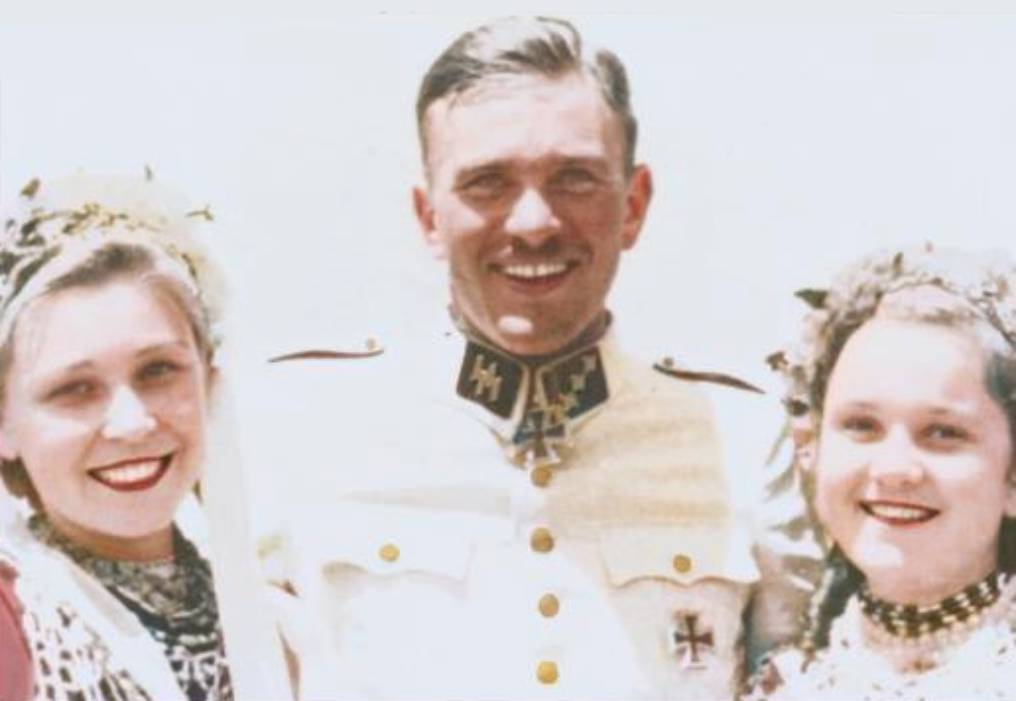
SS-Ostuf. Bremer pose with Ukrainian women in traditional dress
Leibstandarte SS troops greeted as liberators by the Ukrainian populace
Men of the Leibstandarte SS on the Azov Sea in Ukraine
The launch of Operation Barbarossa - the invasion of the Soviet Union - surprised the Soviet secret police NKVD, whose jails and prisons in territories annexed by the Soviet Union were crowded with political prisoners. Immediately after the start of the German invasion, the NKVD and the Red Army commenced the execution of large numbers of prisoners in most of their prisons in Western Ukraine, Belarus, Estonia, and Lithuania. Approx. two thirds of the total number of 150,000 prisoners were murdered. 70 percent of the victims were Ukrainian, 20 percent Polish, and the remainder consisted of Jews and other nationalities. The NKVD undertook mass extrajudicial executions of untold numbers of citizens, and conceived, populated and administered the Gulag system of forced labor camps. During their hasty retreat the Soviets dismantled and removed industrial plants, conducted a scorched-earth policy - blowing up buildings and installations, destroying crops and food reserves and flooding mines. Almost four million people were evacuated east of the Urals for the duration of the war. The Soviets immediately began to execute German prisoners-of-war right after capture or a short interrogation. Numerous high level orders to this effect are on record. The Germans moved swiftly, however, and by the end of November 1941 virtually all of Ukraine was under their control. Initially the German soldiers were welcomed as liberators by jubilant Ukrainian villages. In Galicia especially, there had long been a widespread belief that Germany was the Ukrainians’ natural ally for the attainment of their independence from the yoke of Soviet Russian Bolshevism. Credit: PhD. Jennifer Popowycz. Top image: the barely 24-year-old Knight's Cross holder SS-Obersturmführer Gerhard Bremer in the SS white summer service tunic somewhere on the Azov Sea coast during the first year of the Barbarossa campaign. Middle image: girls in national costume greet arriving Leibstandarte SS troops with bread and salt at the entrance in a Ukrainian village. Bottom image: soldiers and officers of the Leibstandarte SS poses with Ukrainian women in traditional costumes at the summer festival near the Azov Sea. c. Bundesarchiv.

Heeresgruppe Süd

Leibstandarte SS with a captured communist flag
SS-Division Leibstandarte SS in Ukraine
Wehrmacht continue their advance further east
Army Group South, under Feldmarschall Gerd von Rundstedt, had the furthest to go and his attack also faced the stiffest Soviet resistance during the Barbarossa offensive. Most of the Russian armour was on this front. On August 8 1941 the Germans surrounded two Soviet armies, capturing 100,000 men in the Uman pocket, and reached the Dnieper River. The naval port of Odessa on the Black Sea was also besieged. Up to this point all seemed to be going well, the only major problem being the time needed for the infantry to catch up with the panzers and mop up pockets of Russian defence. But Soviet resistance was now stiffening, despite catastrophic losses. A German salient around Yelnya, south-east of Smolensk, was recaptured in a costly but successful counterattack. The Soviets were completely fooled by German moves. Five Soviet armies were trapped in a vast salient around Kiev. By the end of September Kiev had fallen and over 650,000 Russian troops killed or captured. The Germans pushed along the Black Sea coast and into the Crimea, laying siege to Sevastapol. In October Kharkov fell, but by now the Germans were exhausted. The fighting had severely depleted their ranks and supply lines were stretched to the limit. For now, the southern front stayed where it was. In the north too, Waffen-SS and the German forces had reached their limit. Credit: author Ian Carter. Top image: a group of Waffen-SS men in late summer of 1941 secure the services of a local translator to explain the legend on this recently captured Soviet flag which reads: Fight for Lenin and Stalin – be prepared! The soldiers have been positively identified as members of SS-Hauptsturmführer Hugo Kraas Kradschützenkompanie of the Leibstandarte SS. Commons: Bundesarchiv. Middle image: an original Nazi era propaganda postcard showing men of the Leibstandarte SS with a MG 34 mounted on a tripod in a Ukrainian village. Photo by SS-Kriegsberichter Franz Roth on September 15 1941. Commons: Bundesarchiv. Bottom screenshot: Wehrmacht soldiers part of Army Group South during the beginning of Barbarossa campaign. Credit: Julia Kotterias. Die Deutsche Wochenschau - the official German war newsreel.

ϟϟ-Division „Leibstandarte ϟϟ“ in Heeresgruppe Süd

SS-Unterscharführer of the Leibstandarte SS
Soviet POWs were expendable and considered subhuman
The Leibstandarte SS and the Wiking Division went to Generalfeldmarschall Gerd von Rundstedt's Army Group South during the Barbarossa campaign of 1941. They were drawn up one behind the other under the command of Generaloberst Ewald von Kleist's first Panzer group and they would soon spearhead the German armies. The Leibstandarte seized a bridgehead over the Dnieper, it broke through the Soviet defences of the Crimea at Pereskop and stormed Taganrog and Rostov. After battles in the beginning of the operation the Leibstandarte turned south in order to close the Uman cauldron at Novo Arkhangelsk at the beginning of Aug. 1941. Then after fighting in at Sasselje and Novo Danzig, it took the town of Kherson and took up defensive position on the River Dnieper at Berislav. It then advanced on Pereskop on the neck of the Crimean Peninsular and attacked the fortifications defending the Crimea. The Leibstandarte then engaged in pursuit of the enemy interchanged with defence against enemy counter attacks, between the Sea of Azov and the lower Dnieper. The Leibstandarte subsequently aimed for Rostov. On Oct. 17 it took Taganrog and it took Rostov on Nov. 21 but withdrew because of the danger of encirclement threatened. Up to beginning of December, there was fighting east of the River Mius before settling into winter positions along the Ssambek River. Top image: photo of unknown origin claiming to show an NCO of the Leibstandarte in Ukraine. Source: LSSAH in Photos 1933-1945. FU. Bottom image: Soviet Red Army soldiers captured by the Leibstandarte during Barbarossa. Nazi Germany engaged in a policy of deliberate maltreatment of Soviet POWs, in contrast to their treatment of Western POWs. They deliberately starved to death Soviet prisoners in staggering numbers. In the eyes of the Nazis, the war against the Soviets would be a war of annihilation. Photo by Paul Augustin who served as a SS-Kriegsberichter with the Leibstandarte SS from at least 1940 until March 1943. During that period, he took many hundreds of photographs of his unit, and a collection of those photos is maintained by U.S. National Archives. Augustin was promoted to SS-Hschaf on March 1 1943 and KIA eight days later. Credit: Mensburg. U.S. NARA.

ϟϟ-Division „Wiking“ in Heeresgruppe Süd

East Prussian Commander of the Wiking Felix Steiner
Wiking consisted partly of men from the Low Countries and Scandinavia
NKVD troops overrun by Heeresgruppe Süd the first day of 'Barbarossa
The
SS-Division Wiking was formed under SS-Brigadeführer und Generalmajor der Waffen-SS
Felix Steiner on November 11 1940, from the Germania Regiment. Besides Germania, it contained the Nordland and the Westland Regiments and consisted of up to fifty percent Scandinavians, Dutchmen, Flemish and Finns. It was the first troop of European Waffen-SS volunteers. After making preparation for the Barbarossa against the Soviet Union in the same area as the Leibstandarte SS, the Wiking started off with a 
manpower strength at 19,377 officers and men at Rava-Ruska when it swept into western Ukraine in June 1941. It advanced with Generalfeldmarschall Gerd von Rundstedt's Heeresgruppe Süd over Tarnopol, broke through the Stalin Line at Satanov and reached Proskurov. In the area south-east of Zhytomyr, there was fighting on both sides of the River Ross. The division fought at Smele, at Chyhyryn on the River Dnieper and captured Dniepropetrovsk on August 25 1941. In the battle of the Sea of Azov and in the Donez Rearguard Action, the Wiking engaged battle north of the Leibstandarte SS. It fought in the Ignatiefka-Marienfeld area, crossed the rivers Krinka and Mius and fought off enemy counter-attacks at Biryutschi and Daryevka. On November 1941 it fought a delaying action east of the River Mius in the Tusloff sector and took a defensive position on the Mius from December 1941. During this time, several parts of the division were sent to defend critical points on the Heeresgruppe Süd's front, especially to the west and north of Stalino, now Donetsk. Top image: Divisional Commander of the Wiking SS-Brigadeführer Felix Steiner stated about the infamous and illegal Commissar Order (which stated that captured Soviet political commissars should be summarily shot) that "No rational unit commander could comply with such an Order" in a discussion with his superior the Wehrmacht General der Infanterie Gustav von Wietersheim on July 4 1941. The order was formally rescinded on May 6 1942. Middle image: Danish volunteer SS-Hauptsturmführer Christian Frederik von Schalburg surrounded by some of his men in Ukraine. He had joined the Waffen-SS and the Wiking in 1940. C.F. von Schalburg was killed in action aged 36 on June 2 1942 in the Demyansk PocketBottom image: SS troops under Heeresgruppe Süd escort captured Soviet NKVD border troops across the bridge over the San River in the Polish border town of Przemyśl. The city was one of the first to be captured by German troops on the Sunday of June 22 1941. At that time, the San River was the border between German and Soviet-occupied Poland. All photos: Commons: Bundesarchiv.

Volunteers of the ϟϟ-Division „Wiking“

German Wiking Volunteer Hans-Jörg Hartmann
Swedish Wiking Volunteer Hans Waldemar Lindén


The Wiking Division was the only SS armored division exclusively to fight on the Eastern Front. It was composed of Scandinavians, Dutchmen and Flemish whose primary motivation - most of them - was to fight against Bolshevism. The Division stormed through the steppes, marshes and forest of Ukraine during the Barbarossa campaign in 1941. They pursued the enemy to the shores of the Sea of Azov. The volunteers won for themselves a select place in the annals of war. Whether in the south, the centre or the north, wherever the Soviets launched a counter-attack and tore gaps in the German attacking front, orders went out for the Waffen-SS formations. When taken prisoner in autumn 1941 the Russian Major-General Pavel Danilovich Artemenko, commanding officer of the XXVII Rifle Corps, said that the Wiking had shown greater fortitude than any other formation on either side; the Russians had breathed a sigh of relief, he said, when the division was relieved by army units. Left image: Hans-Jörg Hartmann with his adopted daughter before leaving for the Eastern Front to take part in the Barbarossa. He was born in Berlin-Lichterfelde and volunteered for the SS-Verfügungstruppe in 1935 and served as company commader in regiment Nordland of the Wiking. The holder of the Iron Cross First Class SS-Hauptsturmführer Hartmann was killed aged 28 on November 20 1941 at Agrafenovka north of Rostov. He kept a photo diary of the weeks following the opening of operation Barbarossa which can be seen here. Hans-Jörg Hartmann's first born son was born 10 days after his death. It was not likely that his wife had yet received the news. She named the child after his father. Credit: Eric Airlangga. Fair use. Right image: Swedish volunteer Hans Waldemar Lindén wearing Waffen-SS camouflage smock and helmet cover in the first months of the Barbarossa. He was born in Stockholm and came as a volunteer to fight in the Russo-Finnish Winter War at age 17, where he served in the Finnish artillery. After the hostilities have ceased he volunteered for the Waffen-SS and was sent to Graz and Heuberg for intensive combat training. Lindén then served with SS-Flak-Abteilung 5 of the Wiking. He was wounded at the Mius-Front during the winter and taken to a field hospital in Jusovka in Donetsk Oblast. SS-Sturmmann Hans Lindén died aged 19 on December 30 1941 and was one of the first Swedish SS volunteers to fall on the Eastern battlefields. He was posthumously awarded the Iron Cross Second Class. Lennart Westberg Archives. Fair use.

Nordic Volunteers: Frikorps Danmark

SS-Freiwilligen-Verband Dänemark
Danish SS recruits leaving for further combat training in Austria
That SS-Division Wiking performed so well during its first campaign suggested that troops drawn from outside the Reich's borders might be an effective way of fulfilling the Waffen-SS manpower requirements. SS-Brigadeführer und Generalmajor der Waffen-SS Felix Steiner, the innovator who brought his tactical insights to the Waffen-SS embraced the Germanic volunteer movement and helped to make it a success. Certainly, the invasion of the Soviet Union marked the beginning of a vast expansion of foreign recruitment. Frikorps Danmark was a Danish volunteer free corps. At the outset of the German invasion of the Soviet Union in June 1941, Germany asked Denmark to form a military corps to fight with the Germans against the Soviets. Its formation was subsequently sanctioned by the democratically elected Danish government which authorized officers of the Danish Army to join the unit. Of 13,000 volunteers, the Waffen-SS was able to select 7,000 of the best, including 77 officers of the Royal Danish Army. At least three of them won the Knight's Cross during the war. Approx. 3,500 of them were killed in action. On June 6 1943, the corps was disbanded. Most soldiers were transferred to the SS-Panzergrenadier-Regiment 24 Dänemark, one of the three regiments of the then newly formed 11.SS-Freiwilligen-Panzergrenadier-Division Nordland. The bottom picture was taken at the railway station of Hellerup in København on July 19 1941. Photo: F. Aggersbo. National Museum of Denmark. PD.

Nordic Volunteers: Finnish Battalion and Norwegian Legion

Finnisches Freiwilligen-Bataillon der Waffen-SS
SS-Freiwilligen-Legion Norwegen (DNL)
The Finnish SS-Freiwilligen Bataillon Nordost was formed in June 1941. It was a motorized infantry battalion of the Waffen-SS. The Finnish Government recruited men for service with the Waffen-SS for a two-year term in early 1941. For most of its existence it was attached to SS-Regiment Nordland of the SS-Division Wiking. While many Finns were already serving with Wiking, the battalion differed in that it was staffed with Finnish officers and NCOs. The battalion was praised by many Waffen-SS commanders. The mathematician Rolf Nevanlinna was chairman of the Committee for the Finnish Volunteer Battalion of the Waffen-SS. Top image: Credit: Julius Backman Jääskeläinen. Finnish Wartime Photograph Archive. PD. The Norwegian collaborationist formation SS-Freiwilligen-Legion Norwegen was formed by the Waffen-SS in June 1941 in German-occupied Norway. The Legion was initiated by the Minister President of Norway Vidkun Quisling and Reichskommisar Joseph Terboven. The volunteers were deployed to Russia taking part in the fighting on the Leningrad front. The Norwegian Legion was disbanded in March 1943. Most survivors who wanted to continue fighting the Soviets were transferred to SS-Panzergrenadier-Regiment 23 Norge of the predominantly Nordic and Volksdeutsche 11.SS-Freiwilligen-Panzergrenadier-Division Nordland. Bottom image: Den Norske Legion. National Archives of Norway. PD.

ϟϟ-Division „Reich“ and Casualties and losses in Operation Barbarossa

Waffen-SS prior to the winter season in communist Soviet Union
Volunteers of the SS-Division Reich
Unidentified fallen Stabsfeldwebel
The Germans forces were the best-trained troops in the world for the rapid, blitzkrieg-style warfare that encompassed the Eastern Front, but they were unready to deal with harsh weather and the poor road network of the Soviet Union. The gravity of the beleaguered German army's situation towards the end of 1941 was due to the Red Army's increasing strength and factors that in the short run severely restricted the German forces' effectiveness. Chief among these were their overstretched deployment, a serious transport crisis and the eroded strength of most divisions. Parallels have been drawn with Napoleon's invasion of Russia. By December of 1941, SS-Division Reich and other German troops were within sight of Moscow. But, when the notorious Russian winter set in, German advances came to a halt. The Reich had lost 60 percent of its strength and was still to take part in the Battle of Moscow, and was decimated in the following Soviet offensive; the SS-Regiment Der Führer was reduced to 35 men out of the 2,000 that had started the campaign in June 1941. During the bitter fighting outside of Moscow against the Soviet counteroffensive, the Reich was virtually destroyed. By the end of this, one of the largest, deadliest military operations in history, Germany had suffered some 775,000 overall casualties. More than 800,000 Soviets had been killed, and an additional 6 million Soviet soldiers had been wounded or captured. Despite massive advances, Adolf Hitler's plan to conquer the Soviet Union before winter had failed. On December 24, 1941, Admiral Wilhelm Franz Canaris wrote in his personal diary: In the retreat from Moscow we had to abandon German field hospitals as well. The Russians dragged out the sick and injured, hanged them upside down, poured gasoline over them, and set them on fire. On another occasion German prisoners were beheaded and their heads laid out to form the SS symbol. Top image: two soldiers of the Waffen-SS scanning the horizon in the Soviet Union. Photo by SS-KB Paul Augustin. Credit: Karl Mensburg. c. Bundesarchiv. Middle image: two soldiers of the Reich Division. Serving on the Eastern Front in winter time required camouflage. Before the introduction of purpose-made-special winter clothing camouflage was improvised from plain white cloth. The harsh Soviet winter of 1941 saw temperatures drop below -40 °C. The SS-Unterscharführer to the right appears on the cover of the book Loyalty Is My Honor by Gordon Williamson. c. Bundesarchiv. Bottom image: USSR propaganda photo; a Soviet T-34/76 tank crosses a snow-covered wasteland near the corpse of a fallen Stabsfeldwebel. PD.