Showing posts with label A2: Northeast Caucasus/Operation Edelweiß Sept-Dec 1942. Show all posts

ϟϟ-Division „Wiking“ in the Checheno-Ingush ASSR (Нохч-ГІалгІайн ACCP)

Nazi dictator Adolf Hitler - determined to command personally
Marder II of SS-Panzerjäger-Abteilung 5 Wiking in the Caucasus
German intelligence estimated that about 70 percent of Soviet oil production was centred in the Caucasus region. If the German Reich could seize the Caucasus oilfields, the Wehrmacht would no longer be constrained to fight a pauper's war with inadequate fuel reserves. Furthermore, the Red Army would also suffer from the loss of the Caucasian oilfields and Adolf Hitler hoped that fuel shortages would constrain Soviet offensive capabilities. He maintained a profound distrust of his senior command, despite the unflagging loyalty that most of them displayed right to the end. Hitler wanted to be the Feldherr, the generalissimo, exercising direct control of the armies himself. His commanders tried, both directly and indirectly, to persuade him to adopt a more realistic plan, without success. This was the major breakdown in personal relations between Hitler and his High Command. Teletype message to the SS-Division Wiking on September 28 1942:
Wiking's march route through East Europe and Soviet Union 1941-1945
TO: Commander, SS-Division Wiking. The entire field army is looking to your division. You have the task of paving the way for the field army toward Grozny. /signed/ Generaloberst Ewald von Kleist. It was intended for the division to eject the enemy ensconced at Malgobek, which was on the demarcation line between Europe and Asia. Blocking any German advance to Grozny was the Malgobek ridge. SS-Gruppenführer und Generalleutnant der Waffen-SS Felix Steiner was ordered to launch a flanking maneuver along the valley of the River Kurp that ran behind the ridge. Wiking's first objective was the fortified town of Sagopshin or Ssagopschin, several kilometers farther up the valley, which was crisscrossed with steep-sided gorges and antitank ditches. Credit: Military historians Adrian Gilbert and Robert Forczyk. Top image: photo taken by Hitler's personal photographer Hugo Jäger, specialised in colour photography. LIFE photo archive. Fair use. Middle image: a tank destroyer Marder II of the SS-Panzerjägerabteilung 5 of the Wiking in the Caucasus during Operation Edelweiß. The Marders were not assault vehicles or tank substitutes; they were best employed in defensive or overwatch roles. During combat, the Marders often used to flank enemy tanks and destroy them from the side or rear. Credit: Julius Backman Jääskeläinen. c. Bundesarchiv. Bottom image: K.G. Klietmann, Die Waffen-SS.

ϟϟ-Division „Wiking“ Advance to Spearhead the Attack on Grozny

SS-Panzer-Abteilung 5 Wiking
Volunteers of the SS-Division Wiking
The Commander of the 1.Panzer-Armee Generaloberst Ewald von Kleist ordered the SS-Division Wiking to spearhead the attack on Grozny. Working in cooperation with General der Panzertruppen Traugott Herr's 13.Panzer-Division, a plan was arranged to capture the vital Chechen city. On September 26 1942, the last German effort north of the Terek river in the Caucasus began. The Wiking was in a position to launch its attack southward. As they reached the Terek River, the Soviet defences solidified. They had to break through several obstacle belts, constructed by the Soviets south of Mozdok, and through Malgobek and Sagopshin to reach the Georgian Road, over which the Soviets were receiving American war materials from Iran. Malgobek was the key to an assault on Grozny. Realizing the difficult situation, SS-Gruppenführer Felix Steiner divided Wiking into four columns, each with separate objectives, but all aimed at breaching the Soviet defences and opening a road to the Caspian Sea. Top image: SS-Panzer-Abteilung 5 Wiking in the Caucasus. U.S. National Archives Records Administration. Bottom image: Austrians, Danes, Dutch, Flemings, Finns, Germans, Norwegians and Swedes in the multinational Wiking Division in Caucasous in 1942. Both photos taken by Waffen-SS war correspondent SS-Kriegsberichter Willi Altstadt. U.S. National Archives.

ϟϟ-Division „Wiking“ Assault Planned Against Sagopshin and Malgobek

SS-Division Wiking
SS-Panzer-Abteilung 5 Wiking


Several days before the planned assault on Sagopshin and Malgobek the SS-Division Wiking conducted final attack preparations and rehearsals. The SS-Infanterie-Regiment Nordland was to attack along the Kurp River to Malgobek. The SS-Panzer Battalion Wiking, with elements of the Germania, was to breach the main line of defence and establish a bridgehead. The Westland was to capture the town of Sagopshin, and the division's engineer component, along with the rest of the Germania was to advance along the Kurp River. In the evening of Sept. 25 1942 all units were in their designated areas for their final preparations for the upcoming attack. Left image: a young volunteer of the Wiking collecting eggs at a local farm during Operation Edelweiß. Right image: tankers of SS-Panzer-Abteilung 5 Wiking watching the Luftwaffe bringing in supplies and equipment in Caucasous 1942. Both photos taken by SS-Kriegsberichter Willi Altstadt. U.S. National Archives.

ϟϟ-Division „Wiking“ Fighting for Sagopshin and Malgobek

SS Panzer Commander Johannes Mühlenkamp
Volunteers of the SS-Division Wiking


The attack got underway on the night of September 25-26 1942. SS-Infanterie-Regiment Nordland's assault soon bogged down, as they realized that not only were they outnumbered by the Soviet Red Army, but the latter were also well entrenched in prepared positions. Within thirty minutes, almost half of the men of the regiment had fallen. Despite this, they still captured the hill, and its commander SS-Oberführer Fritz von Scholz was awarded the Knight's Cross for his actions during the battle. On September 28 1942, Wiking reached the outskirts of Sagopshin and a fierce tank battle ensued. SS-Sturmbannführer and commander of the SS-Panzer-Abteilung 5 Wiking Johannes Mühlenkamp rode in three different tanks that day and was shot three times. New attack plans were made and Westland made a frontal attack on Sagopshin. The Soviet strongholds were defeated after heavy and fierce resistance the following day. On September 29 1942, the aerial reconnaissance in the west and southwest of Malgobek identified 50 Soviet T-34's and Mark IIIs. During the afternoon, it was further reported that additional troop elements and 400-500 motorized vehicles and approximately 25 tanks were observed in the area. Nevertheless, the Wiking continued its attack towards Malgobek for another week. On October 5 1942, SS-Untersturmführer d. R. Karl Nicolussi-Leck destroyed three enemy tanks which approached the advancing men of the Germania from the open flank. Three more were knocked out by SS-Obersturmführer d. R. Hans Flügel and his tank commanders. It was later discovered that they were all British-built Mark IIIs and Valentines. In preparation for the final assault, a large-scale Stuka attack was laid on against Malgobek. SS-Infanterie-Regiment Germania took the town of Malgobek and its surrounding hills on Oct. 6 1942. Left image: SS-Stubaf. Johannes Mühlenkamp scanning the Caucasian horizon with his binoculars. Photo by SS-KB Willi Altstadt. U.S. NARA. Right image: Wiking volunteers. c. Bundesarchiv.

ϟϟ-Division Wiking: The Capture of Malgobek – Reference point 701

Finnisches Freiwilligen-Bataillon der Waffen-SS
SS-Unterscharführer Markus Ledin
The Soviets were continuously being reinforced. An enemy column consisting of approximately 1,000 men and numerous motorized vehicles was identified five kilometres east of the forward lines around noon on October 6 1942. The SS-Division Wiking finally captured Malgobek the very same day, however the objective of seizing the capital and opening a road to the Caspian Sea was not achieved. The closest point to Grozny, Reference Point 701, was captured at 1730 hours by the Finnish Freiwilligen-Bataillon der Waffen-SS of SS-Infanterie-Regiment Nordland after two hours of hard fighting. In vain, the Soviets ran up against the newly won positions of the third battalion of Nordland for three days without breaking into the main line of resistance. All attacks were turned back by the tanks of the SS-Panzer-Abteilung 5 Wiking. On October 12 1942, 18 Soviet bombers, escorted by fighters, conducted four bombing runs on the positions on high ground. According to various sources the SS-Division Wiking lost over 1,500 men during the fighting for Sagopshin and Malgobek. Several combat units were reduced to only dozens of men, and as a Waffen-SS veteran later wrote: Casualties weren't counted any more, just men left alive. Note: It should be pointed out that Reference Point 701 was not Hill 701, which is indicated in some writings. It was a target reference point for artillery purposes. There was no high ground of 701 meters between Malgobek and Wosnessenskaja. Credit: Viking Panzers. Top image: SS volunteers of the Finnisches Freiwilligen-Bataillon der Waffen-SS. Public domain. Bottom image: Swedish SS-Unterscharführer Markus Ledin from Stockholm volunteered for the Waffen-SS in January 1942 and served with the Wiking until he got wounded during the fierce fighting in Sagopshin. After recovering, he was transferred to the then newly created 11.SS-Freiwilligen-Panzergrenadier-Division Nordland. Courtesy of Joakim Munter.

ϟϟ-Division „Wiking“ Leaves the Sagopshin and Malgobek area

SS-Panzer-Abteilung 5 Wiking in the North Caucasus
SS-Division Wiking in defensive positions in North Caucasus
After the capture of Malgobek, the SS-Division Wiking were drawn into severe defensive battles. For four consecutive days Soviet forces tried to recapture Reference point 701 without results. Sagopshin or Ssagopschin and Malgobek were turning points in the events of the southernmost front of the German armed forces. With the fighting on October 17 1942, the Wiking's offensive efforts in the Sagopshin-Malgobek came to an end. There were enormous logistical difficulties – the Wiking and the Wehrmacht was at the very end of a supply chain already stretched to breaking point. It was no longer possible to force the Soviets over the mountain chain and into the sea. After the Soviet breakthroughs in the region around Stalingrad, the German forces in the Caucasus were put on the defensive. The Wiking Division transitioned to the defense in the positions it had won. Positions they had paid a high price for. Many Wikinger had spilled their blood for Malgobek. On October 21 1942 the SS-Divison Wiking leaves the Sagopshin-Malgobek area and takes positions around the Werch-Kurp area. Top image: tankers of SS-Panzer-Abteilung 5 Wiking in Caucasous. Bottom image: Wiking Grenadiers in forward defensive positions in Northeastern Caucasus in 1942. The dug-in forces complemented in-depth defence features, such as minefields, and other trench and bunker warfare. Both photos taken by Waffen-SS Kriegsberichter Willi Altstadt. U.S. National Archives and Records Administration. Fair use.

„Wiking“ Division Redesignated as ϟϟ-Panzergrenadier-Division „Wiking“

Soviet tankers taken prisoner by the Wiking Division
Panzer III of SS-Panzer-Abteilung 5 Wiking


On November 9 1942, the division was redesignated from SS-Division Wiking to SS-Panzergrenadier-Division Wiking. The infantrymen of SS-Regiments Germania, Nordland and Westland had become Panzergrenadiers. The front of the division seemed secure but on the flanks there was bitterly hard fighting. The Soviets tried to break through the front with strong forces. Tanks and infantry attacked relentlessly day in, day out without success. On November 19 1942, the Wiking ended its attachment relationship to the 23.Panzer-Division which was withdrawn from the front to be sent to Stalingrad to participate in the upcoming relief effort. Left image: according to various sources, a Soviet tank crew being taken prisoners by the Wiking. The Wikinger has his Schmeißer MP40 slung behind his back. The photo appeared in Signal magazine in October 1943 edition published by the Wehrmacht. Commons Bundesarchiv. Right image: Panzergrenadiers riding on a Panzer III of SS-Panzer-Abteilung 5 Wiking. The Soviet T-34 was generally invulnerable in frontal combat engagements with the Panzer III until the 50 mm tank gun was introduced on the tank beginning in the spring of 1942. Production of the Panzer III ceased in 1943 and was replaced as the main German medium tank by the Panzer IV and the Panzer V Panther. Nevertheless, the Panzer III's capable chassis provided hulls for the Sturmgeschütz III assault gun until the end of the war. Photo by war correspondent SS-Kriegsberichter Willi Altstadt. Credit: Julius Backman Jääskeläinen. U.S. National Archives. Fair use.

III.Panzerkorps in the North Caucasus October 19 – November 12 1942

SS-Panzergrenadier-Divison Wiking in North Caucasus
SS-Hauptsturmführer Hans Dorr in North Caucasus
Waffen-SS 15 cm NbW 41
The nature of the difficult fighting against a vastly superior enemy at the foot of the Caucasus, under the Kasbek, which was glittering in snow and ice, is confirmed by figures supplied by the III.Panzerkorps. During the operations conducted from October 25 to November 12 1942, the three divisions attached to the corps, the 13.Panzer-Division, 2nd Rumanian Mounted Division and SS-Panzergrenadier-Divison Wiking, had made contact with 30 enemy formations. The corps took 16,000 prisoners, knocked out 188 tanks and four armored trains and captured 249 artillery pieces. The losses of the III.Panzerkorps consisted of 1,257 killed, 273 missing and 5,008 wounded during the operations conducted from October 19 to November 12 1942. 
The men of the Wiking improved the dugouts that they had been assigned. It goes without saying that the men were thinking of spending the winter in the Caucasus and wanted to be prepared for it. Credit: Peter Straßner, European Volunteers and Ewald Klapdor, Viking Panzers. Top image: European comrades of the Wiking side by side in the Northeastern Caucasus in 1942. Photo by SS-Kriegsberichter Willi Altstadt. U.S. National Archives. Middle image: battle fatigue etched into his face, this tough-looking SS officer and Wiking veteran Hans Dorr prepare for renewed close-quarters fighting in the North Caucasus in the fall of 1942. Hans Dorr had joined the SS-Verfügungstruppe at 21 back in April 1933 and would rise to the rank of Obersturmbannführer within the Waffen-SS and became the Commander of SS-Panzergrenadier-Regiment 9 Germania in May 1944. He would be one of the few to be awarded the prestigious Knight's Cross of the Iron Cross with Oakleaves and Swords. Dorr also received the Close-Combat Clasp in Silver but was probably also awarded it in Gold, however, no confirmation of this has yet been found. In total he was injured 16 times during the war and carried the Wound Badge in Gold. SS-Obersturmbannführer Hans Dorr died at a Field hospital near Judenburg in Austria on April 17 1945 at age 33, only weeks before the war's end. Note: Although Dorr is wearing the collar patch of an SS-Obersturmführer, he had already made SS-Hauptsturmführer before Edelweiß. Photo by SS-KB Willi Altstadt. U.S. National Archives. Bottom image: Waffen-SS 15 cm Nebelwerfer 41 multiple rocket launcher of SS Nebeltruppen. c. Bundesarchiv.

ϟϟ-Panzergrenadier-Division „Wiking“ pulled back from Caucasus

Unidentified Waffen-SS Volunteer


There was no longer any doubt that the Caucasus offensive, which had yielded such impressive successes, had to be characterized as a failure with the start of the events in December 1942. The tables started to be turned, and the German forces in the field were pressed hard. With the deterioration of the situation on the Stalingrad front, the German forces in the Caucasus were forced to withdraw rapidly to avoid being trapped themselves. On Dec. 12 1942 the III.Panzerkorps front was shortened; SS-Panzergrenadier-Division Wiking was taken out of the front and fights it way back to the west. It's manpower strength was 15,928 officers and men in December 1942. New assignment, a relieving attack in the direction of Stalingrad! The division was involved in a terrible winter retreat, characterized by bitter fighting against the enemy and against glacial cold. Left image: an unidentified volunteer, one of several hundred thousand that volunteered for the Waffen-SS in order to fight against Bolshevism and Soviet supremacy. In his belt he stored two Stielhandgranate 24. Right image: an SS-Scharführer of the Wiking wearing the Close Combat Clasp in Silver. Those were awarded for taking part in at least 25 close combat engagements. He also wears the Iron Cross 1st Class, the Infantry Assault and Wound Badge. c. Bundesarchiv.

Knight's Cross Holders of the „Wiking“ in the Caucasus

SS-Gruf. Steiner surrounded by officers and divisional staff of Wiking
SS-Obersturmführer Pförtner & SS-Sturmbannführer Dieckmann
Top image: the charismatic Felix Steiner as commander of the Wiking Division in the beginning of the Russian campaign. He would become the guiding figure in the foreign Waffen-SS and a much-celebrated figure among veterans after the war. Steiner won the 159th Oakleaves to the Knight's Cross during the Caucasus campaign on December 23 1942 as SS-Gruppenführer und Generalleutnant der Waffen-SS. The officer standing behind on Steiner's right side is the then SS-Hauptsturmführer Otto Paetsch, Generalstabsoffizier of the Wiking. He would win the Knight's Cross on August 23 1944 and was awarded a posthumous award of the Oakleaves on April 5 1945 as commander of SS-Panzer-Regiment 10 of the 10.SS-Panzer-Division Frundsberg. The Wiking veteran Paetsch is said to have been a shining example to his officers, NCOs and men. He was fatally wounded aged 35 on March 16 1945 in Pommern. c. Bundesarchiv. Bottom image: two other Knight's Cross holders of SS-Panzergrenadier-Division Wiking: to the left is SS-Obersturmführer Helmut Pförtner who was the first soldier in SS-Regiment Germania of the Wiking to be honored with the Knight's Cross. He had won the Knight's Cross as SS-Untersturmführer and platoon leader on January 18 1942. Pförtner was born in Beverungen in Westfalen and was killed in action aged 29 on February 28 1943 as SS-Hauptsturmführer near Izjum south-east of Kharkov. To the right is SS-Sturmbannführer August Dieckmann, Commander of SS-Infanterie-Regiment Germania. He was later to be promoted SS-Obersturmbannführer and awarded the 233rd Oakleaves to the Knight's Cross on April 16 1943. Dieckmann was born on May 29 1912 in Cadenberge near Hannover and was killed in action aged 31 on October 10 1943 while leading his men against Soviet fortifications around the Dnieper River in Ukraine. Photo by SS-KB Willi Altstadt. The war correspondent Altstadt himself was awarded the Iron Cross First Class in August 1942 and promoted to SS-Untersturmführer d. R. on March 20 1943. U.S. NARA.

ϟϟ-Division „Wiking“ Gained a Combat Reputation Second to None

SS-Sturmbannführer Hajo von Hadeln
Volunteers of the Wiking Division
The Wikinger were fast attaining an elite status to equal the best of the original Waffen-SS Divisions. Not only did SS-Division Wiking earn an esteemed combat reputation but it also served as a spearhead for major operations and later in the war it served as a defensive 'fire brigade'. In the Caucasus and during the long and difficult fighting retreat, the European volunteers had lost three battle-proven commanders with promising futures; SS-Sturmbannführer Fritz Steinert, SS-Obersturmführer Harry Polewacz and SS-Sturmbannführer Dr. phil., Freiherr Hans Joachim von Hadeln, all young commanders of the SS-Panzergrenadier-Regiment Westland. All three had established their battalions and stamped them with their personalities. Polewacz and von Hadeln were both killed at the same location in the Rostov Oblast on January 12 1943. They were buried at the division's military Ehrenfriedhof in Uspenka, a well-known 'landmark' for the men of the Wiking. Hajo von Hadeln was born in 1910 in Berlin and graduated at SS-Junkerschule Bad Tölz in 1935. He was one of the first to receive the Deutsche Kreuz in Gold in the Wiking in 1941. Source: former SS-Obersturmbannführer Franz Hack: Der Panzerdivision Wiking im Bild. Left image: Wiking commander SS-Sturmbannführer Hajo von Hadeln in 1942. Credit: Matthias Ruf. FU. Right image: according to various sources, Dutch Wiking replacements for the combat losses at target practice with their P.08 Luger pistols in 1942, possibly in the Khevenhüller-Kaserne in Klagenfurt-Lendorf in Austria. They had to be integrated into the division while it was engaged in combat, a division that had earned a tough but fair reputation, or as fair a reputation as any unit on the Eastern Front could have. Credit: Jakob Lagerweij. Commons: Bundesarchiv.

Anglo-Soviet Invasion of Persia and American Aid to the Soviet Union

Tehran Conference codenamed Eureka: Stalin, Roosevelt and Churchill
SS-Division Wiking in Caucasus
Caucasus Waffen-SS Veterans of Finland
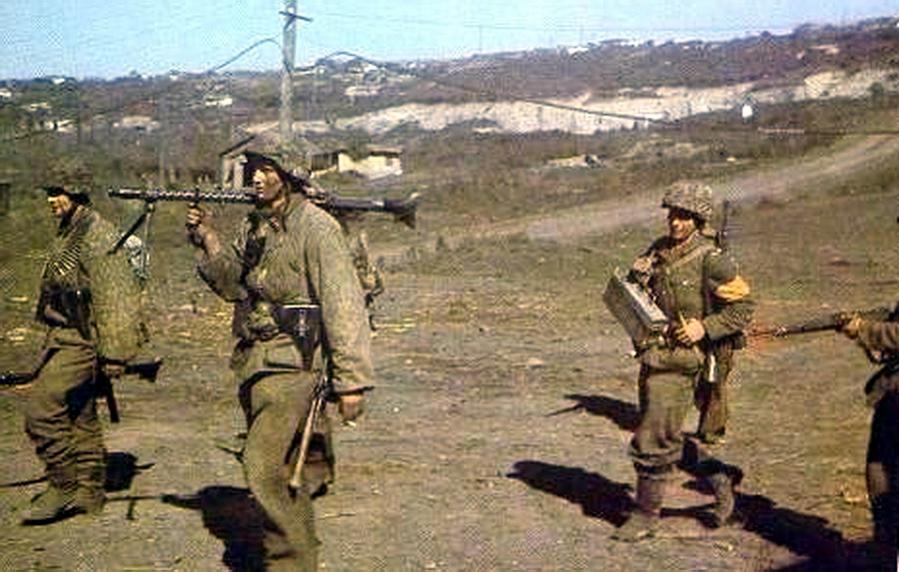
The Anglo-Soviet invasion of Iran was the joint invasion of Iran by the United Kingdom and the Soviet Union in August 1941. The invasion's strategic purpose was to ensure the safety of Allied supply lines to the USSR, the Persian Corridor, secure Iranian oil fields and limit German influence in Iran that was considered friendly to the German Reich. On March 11 1941 American President Franklin D. Roosevelt signed the Lend-Lease bill, which permitted the U.S. to supply its anti-Hitler coalition allies with materiel. The first convoys with American goods were sent to the USSR in August 1941. During the war German submarines and torpedoes sank about 80 cargo ships destined for the Soviets. More than 14,000 U.S. airplanes were given to the Soviet Union in the course of the war. The Soviets received a total of 44,000 American jeeps, 375,883 cargo trucks, 8,071 tractors and 12,700 tanks. Additionally, 1,541,590 blankets, 331,066 liters of alcohol, 15,417,000 pairs of army boots, 106,893 tons of cotton, 2,670,000 tons of petroleum products and 4,478,000 tons of food supplies made their way into the Soviet Union. Credit: Wikipedia inter alia. The English military history, Basil Liddell Hart, wrote the following concerning the German failure in the Caucasus: An important factor in the failure was that the Russians had hundreds of bombers stationed at the airfields in the vicinity of Grozny. American help through the Persian Gulf, which reached the southern portion of the desperate fighting conducted by the Soviets, also became appreciable for the first time. The commander of the Wiking tank battalion, later wrote: It was during the fighting down in the Caucasus that American weapons appeared in large numbers for the first time. Some Russian tank units were equipped entirely with Shermans, American Dodge trucks and jeeps. Even the uniforms that the Russian soldiers wore, especially the equipment issued to the Russian alpine forces, were of American origin. Even the rations that we pulled out of the rations containers on knocked-out fighting vehicles were American. The only thing left on the Russian soldier that was Russian was the soldier himself. Everything else was of American origin. Credit: the Wiking and Frundsberg veteran SS-Stubaf. Ewald Klapdor, Viking Panzers. Top image: Soviet Communist dictator Joseph Stalin, U.S. President Franklin D Roosevelt and British Prime Minister Winston Churchill during the Tehran Conference after the Anglo-Soviet invasion of Iran in August 1941. FDR Presidential Library. FU. Middle image: a battle-weary MG team of the Wiking in the Caucasus 1942. The man carrying the ammo crate with a yellow brassard is a Soviet Hiwi (voluntary helper). The Waffen-SS trained and deployed Soviet collaborationists from Sept. 1941. PD. Bottom image: Finnish SS company and battalion non-commissioned officers pictured before their service with the Wiking in Caucasus in 1942. Credit: Jussi Luostarinen. PD.