Showing posts with label A1: Northwest Caucasus/Operation Edelweiß July-Sept 1942. Show all posts

Unternehmen Edelweiß: ϟϟ-Division „Wiking“ Advances into the Caucasus

Wikinger out in the Caucasian sunflower fields
German light armoured half-tracks entering North Caucasus
Operation Edelweiß was a German plan to gain control over the Caucasus and capture the oilfields of Maykop, Grozny and ultimately Baku and end Soviet's ability to sustain itself. The operation started very well for the German forces, and the Soviet Armies defending below the Don River quickly melted away. To defend the oil fields from destruction by retreating Soviet units, the Brandenburgers special forces supported by local nationalist Cossacks infiltrated deep behind enemy lines, often dressed as the dreaded Soviet secret police, the NKVD. These troops were tasked with capturing bridges and roadways ahead of advances and holding them until relieved. The Brandenburgers helped clear the way in many sectors, penetrating further into the Soviet Union than any unit before it. Meanwhile, the SS-Division Wiking penetrated deeply into the Caucasus, facing thousands of ambushes and encounters against an enemy that was impossible to pin down. The divisions tank commander SS-Sturmbannführer Johannes Mühlenkamp's SS-Panzer-Abteilung 5 attacked between the Don and the Kuban in July and August of 1942, hitting the constantly withdrawing enemy and breaking all resistance. However, a long and difficult way still lay in front of the Wiking: over 500 kilometres of steppes, interlaced with little rivers gave the enemy the opportunity again to escape into the vastness of the area and to appear again unexpectedly in another position and to attack. Even in peacetime, a march by a large motorized division with its approximately 2,000 heavy vehicles and numerous other trucks and motorcycles on the Caucasian steppe would have been a tiresome effort with many difficulties. March route of the division: Maykop-Labinskaja-Armavir-Georgijevsk. Top image: a young Wiking volunteer in the Caucasian sunflower fields during the German "oil campaign" in Aug. 1942. Photo by SS-KB Willi Altstadt. Credit: Karl Mensburg. U.S. NARA. Bottom image: German SPW Sd.Kfz. recon half-tracks advancing into the Caucasus during the opening phase of Edelweiß in Aug. 1942. Photo by KB Scherl. Credit: Facundo Filipe. c. Bundesarchiv.

Wiking Veteran SS-Sturmbannführer der Waffen-SS Kepplinger

Ludwig Kepplinger as SS-Hauptsturmführer
Ludwig Kepplinger as SS-Hauptscharführer

The Austrian Ludwig Kepplinger was the first NCO in the Waffen-SS to be awarded the Knight's Cross of the Iron Cross. At the time he served as a SS-Hauptscharführer in SS-Standarte Der Führer. He is reported to have been an exceedingly brave death-defying soldier. SS-Untersturmführer Ludwig Kepplinger was wounded in the Caucasus when serving as Company Commander of the 10th Company of SS-Infanterie-Regiment Westland of the SS-Division Wiking. After recovering from his wounds Kepplinger was given command of SS-Panzer-Abteilung 17 of the then newly created German-Latin Waffen-SS division Götz von Berlichingen with the majority of its original cadre coming from replacement units and conscripts. These were predominantly Panzer soldiers, like Kepplinger, whose vehicles had been knocked out. The Wiking veteran SS-Sturmbannführer Ludwig Kepplinger was murdered by French partisans southeast of Laval in August 1944. His body was found in 1980 west of Villiers-Charlemagne. Left image: Ludwig Kepplinger as SS-Hauptsturmführer. Credit: Bill Treseler. Commons: Bundesarchiv. Right image: a Wolfgang Willrich portrait of Kepplinger, showing him in the combat clothing worn at the time of his Knight's Cross winning action, with camouflage smock and steel helmet. He is armed with the MP28, a popular submachine gun and forerunner of the mass-produced MP38/40. Credit: Gordon Williamson and Josef Charita. FU.

ϟϟ-Division „Wiking“ in the North Caucasus

Patrik Mineur as SS-Sturmmann
SS-Regiment Germania


The German invasion of the Caucasus was intended to be an all-out effort to inflict a crippling blow upon the Soviet Union before the Western Allies could mount any large-scale operations in the West: a main effort into the Caucasus to seize the oil and cut Lend Lease routes. The SS-Division Wiking was at the forefront of the German drive toward the Caucasus Mountains. In the coming month, the division was to operate in this terrain, a terrain that was so completely different to the European volunteers. Many of the Wiking photos in this thread are photographed by SS-Kriegsberichter Willi Altstadt. He served with SS-Kampfgruppe Dieckmann of the Germania Regiment from the days leading up to the attack on Rostov, through the fighting for the city, and then for the advance into the Caucasus. Willi Altstadt then started photographing the Finnisches Freiwilligen-Bataillon der Waffen-SS in the high country of the West Caucasus. Left image: SS-Rottenführer Patrik Mineur from Haparanda in North Sweden volunteered for the Waffen-SS in 1942 and served with SS-Regiment Germania of the Wiking in the Caucasus. Mineur was killed in action aged 26 on October 13 1944 in Nieporęt north of Warszawa. His brother had died four years before in the Russo-Finnish Winter War while fighting in the Swedish Volunteer Corps. PD. Right image: an SS-Hauptscharführer and SS-Unterscharführer from SS-Regiment Germania proudly posing with their catch. Note the unregimental use of the SS aluminum cap skull on the SS-Unterscharführer's M41 field cap. FU.

ϟϟ-Division „Wiking“ in Pursuit Across the North Caucasus

Commander of the Wiking SS-Gruppenführer Felix Steiner
Waffen-SS volunteers of the Wiking Division
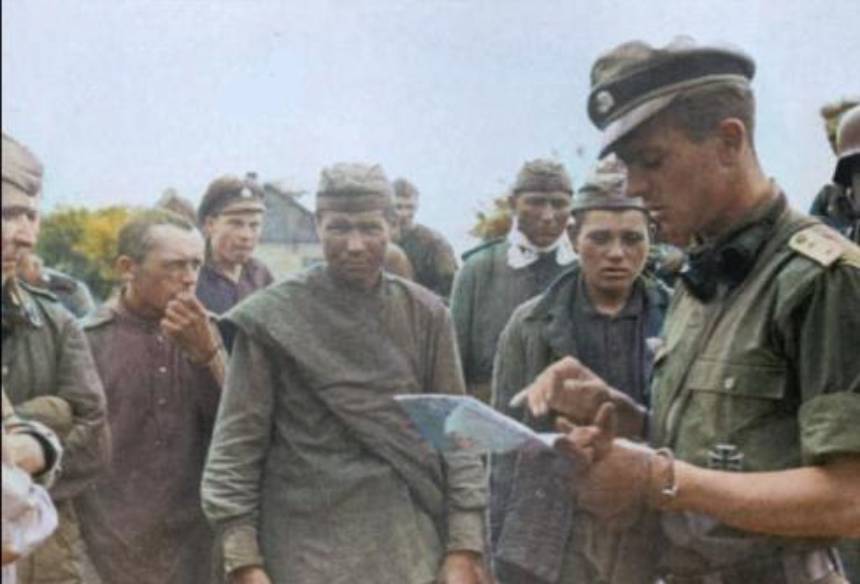
Waffen-SS officer question Soviet POWs
Under the leadership of SS-Gruppenführer Felix Steiner, the SS-Division Wiking pushed its tanks and self-propelled guns south towards the Caucasus. The steppe country of the northern Caucasus offered the Soviets excellent opportunities for conducting a fighting delay. The countless large and small rivers which flow from the Caucasus watershed into both the Black and Caspian Seas were obstacles that the enemy could hold with comparatively weak forces. The Wiking was on its own in its pursuit of the retreating Soviets toward the Kuban River. They pushed hard and deep into the Caucasus against a much stiffer Soviet defense than the previous year. The enemy withdraw and regroup further west. It was very hot and dusty; so dusty that the only features recognizable through the thick layer of dust on the faces of the young European volunteers were their eyes. Despite this, that type of maneuver warfare appealed to them. Speed was the answer. Enveloping movements, outmaneuvering the Soviets; that is how the days passed. Top image: Waffen-SS commander Felix Steiner somewhere between the Kuban steppes and the Caucasus Mountains in 1942. Commons: Bundesarchiv. Middle image: youthful combat-ready SS volunteers of the Wiking, draped with ammunition belts and stick grenades Model 24 Stielhandgranate in the North Caucasus. Photo by war correspondent SS-Kriegsberichter Willi Altstadt. U.S. National Archives. Bottom image: a Waffen-SS officer interrogate recently captured Soviet soldiers. The information obtained was used on the battlefield, defining strategy and saving lives. The war against the Soviet Union fused ideological aggression with racial impetus and colonial aspirations that resulted in a conflict of unsurpassed brutality. The head of the Prisoner of War Office at OKW, General der Infanterie Edwin Reinecke told his audience: ‘The war between Germany and Russia is not a war between two states or two armies, but between two ideologies. The Red Army [soldier] must be looked upon not as a soldier in the sense of the word applying to our western opponents, but as an ideological enemy. Public domain.

ϟϟ-Division „Wiking“ Crossing the Kuban in the North Caucasus

Luftwaffe Jagdgeschwader 52 supported the invasion of the Caucasus
Waffen-SS Commanders of the Wiking Division in the Caucasus
SS-Division Wiking crossing the Kuban in the Caucasus
The Soviet rearguards were unable to occupy one position for long or mount any effective resistance. The SS-Division Wiking forced them to be constantly on the retreat. During the pursuit, the Luftwaffe commander, Major Diering continually reported that the Wiking was moving within a flood of Russians that was rolling toward the south. The Stukas of Fliegerkorps IV had paved the way for the Wiking and 13.Panzer Division when they had pushed through heavy anti-tank defences near Rostov, and continued to support the drive to the oil fields in the Northern Caucasus. Although the Wehrmacht Daily Report of Aug. 4 1942 reported that mechanized formations of the Waffen-SS had reached the Kuban River on a broad front, the Wiking Division initially halted a suitable distance from the river. The Wiking were welcomed by two elderly Cossacks in Czarist uniforms complete with decorations. Following the Russian custom, the SS-volunteers were given bread and salt. On Aug. 6 1942, the Wiking was standing on the river's west bank. Top image: Messerschmitt Bf 109 of Jagdgeschwader 52 undergoing maintenance by its ground crew on an airfield Northeast of Anapa on the Black Sea coast of the Caucasus. JG 52 was used during the push towards the Caucasian oil fields during Aug. and Sept. 1942. The wing scored its 4,000th victory on Dec. 10 1942. Commons: Bundesarchiv. Middle image: Commander of SS-Panzer-Abteilung 5 SS-Sturmbannführer Johannes Mühlenkamp in the cupola of his Befehlspanzerwagen IV and Commander of SS-Infanterie-Regiment Germania SS-Sturmbannführer August Dieckmann taking a brief rest from the rigors of battle with determined expressions into the wide vista. U.S. National Archives. Bottom image: combat-hardened soldiers of the Wiking paddle furiously towards the west bank of the Kuban River. The middle and the bottom photo was taken by war correspondent SS-Kriegsberichter Willi Altstadt. Altstadt commanded SS-Kriegsberichter-Zug 5 with the Wiking division during the advance into the Caucasus in 1942. U.S. National Archives.

ϟϟ-Division „Wiking“ Advance Toward Maykop in the North Caucasus

The Prussian Wiking Commander Felix Steiner
SS-Division Wiking
SS-Division Wiking moved off to the Southwest in the direction of Adygea's capital Maykop at the head of the LVII.Panzerkorps. Under the command of the East Prussian officer SS-Gruppenführer und Generalleutnant der Waffen-SS Felix Steiner, the Dutch, Scandinavian and German SS volunteers assembled in the division penetrated to the Northwest and Southwest parts of the Maykop oil region. The enemy offered resistance wherever he could. Top clip: the commander of the Wiking Division, Felix Steiner, talks to his men in the summer of 1942. Before the end of the war he had been awarded the Knight's Cross of the Iron Cross with Oakleaves and Swords. Together with SS-Oberst-Gruppenführer und Generaloberst der Waffen-SS Paul Hausser, he contributed significantly to the development and transformation of the Waffen-SS into a combat force made up of volunteers and conscripts from both occupied and un-occupied lands. By nature of that act alone, he became one with his men. Die Deutsche Wochenschau - the official Nazi German war newsreel from 1940 until production discontinued in March 1945. It received film stock from special Waffen-SS and Wehrmacht war reporting units. Bottom image: SS-Panzergrenadiers and Kradschützen of the Wiking in the Caucasus in 1942. Photo by war correspondent SS-Kriegsberichter Willi Altstadt. U.S. National Archives. 

Award Ceremony for ϟϟ-Kampfgruppe Dieckmann of ϟϟ-Regiment „Germania“

SS-Sturmbannführer August Dieckmann
SS-Kampfgruppe Dieckmann of the Germania
The German advance south towards the oilfields of the Caucasus was making good progress. On August 8 1942 the Wiking reached the first of the oil towns, Maykop. If they could continue this progress and seize the bulk of the oilfields they would deprive Soviet Union of the life blood needed to continue the war. Images: 
European Volunteers of SS-Infanterie-Regiment Germania of the Wiking Division being congratulated on the award of the Iron Cross Second Class by Knight's Cross Holder SS-Sturmbannführer August Dieckmann, Commander of Germania; SS-Sturmmann Harry Langjahr of SS-Artillerie-Regiment 5 of the Wiking was presented the Iron Cross Second Class. He went to the forward observation post as a wire troubleshooter and discovered the Assistant forward Observer and his radio operator dead. Alone, with only a rudimentary knowledge of artillery firing and under enemy pressure, he immediately started directing fire for the battery. Through this courageous decision, which was made on his own initiative, an enemy attack was halted. SS-Stubaf. Dieckmann himself was always to be found at the spearhead of the advance. He was personally involved in close combat amongst the lead riflemen and tanks in the Caucasian oilfields. Dieckmann stormed forward as the point man, encouraging his men to follow him. Photos by SS-Kriegsberichter Willi Altstadt in August 1942. Willi Altstadt himself was awarded the Iron Cross First Class the very same month. c. Bundesarchiv.

ϟϟ-Hauptsturmführer der Waffen-SS Juchem

Hans Juchem as SS-Obersturmführer
SS-Division Wiking
Hans Juchem had just turned 17 when he 
entered the ranks of the SS-Verfügungstruppe in 1934 and was posted to the SS-Standarte Deutschland. He became an officer cadidate and graduated from SS-Junkerschule Bad Tölz in 1938. After the Western campaign in 1940 were he proved himself, he was given command of the 5th Company of Wiking's regiment Germania and took part in Operation BarbarossaSS-Obersturmführer Hans Juchem gained a reputation as a good commander and a man to turn to for difficult missions and his company was selected more and more to lead the Wiking Division's advance, or as a counterattacking force. Germania assaulted trench lines in close combat that was fought using handgrenades, submachine guns and even entrenching tools, turned back attacks by numerically superior enemy forces and launched innumerable immediate counterattacks. Juchem was awarded the German Cross in Gold in September 1942 for his achievements in the Caucasus, and the Close Combat Clasp in Gold on August 10 1943, only three days before he fell in battle aged 26 near the Izium River in Ukraine. SS-Hauptsturmführer Hans Juchem was posthumously awarded the Knight's Cross for his action in 1943. He was one of only 98 German soldiers that received both the Knight's Cross and the Close Combat Clasp in Gold. Top image: Juchem wearing a Heer splinter camouflage jacket during the Caucasus Campaign in September 1942. Bottom image: Wikinger relaxing in a Sunflower field. c. Bundesarchiv.

ϟϟ-Panzer-Abteilung 5 „Wiking“ in the Maykop area in North Caucasus

Finnish SS-Untersturmführer during the Battle of the Caucasus
SS-Panzer-Abteilung 5 Wiking
The battle of the Caucasus lacked the sweeping manoeuvres which annihilated the Soviet forces during the 1941 summer campaign. This time, the Soviet commanders and soldiers learned to withdraw and regroup their forces in order to launch ferocious counterattacks. In the first week of August in 1942, the SS-Division Wiking's spearheads were in the foothills of the Caucasus mountains and resistance started to stiffen in the huge sunflower fields that were all over region. They moved through shoulder-high tobacco fields in full bloom, through sunflower fields and past waving grain. SS-Sturmbannführer Johannes Mühlenkamp wrote after the war: After a march, there was suddenly a large open area in the middle of a forest. Lineinaja was on the western edge of the clearing. My tanks moved out in battle order and then took off for the city. Between the tanks were the Finnish volunteers. The Finns took part in the tank attack by double timing. Our attack broke over Lineinaja like a storm. The Finns could no longer be controlled. They frequently lunged at the enemy soldiers, swinging their typical Finnish knives. With the fighting around Linejuaja, Wiking's offensive operations for the Maykop oil region had ended. They had been dramatic enough, and a tense time for the troops and command alike. The last offensive action in this region was fought on August 14 1942. Top image: a Finnish SS-Untersturmführer of the Finnisches Freiwilligen-Bataillon der Waffen-SS in the Caucasus 1942, armed with a Luger and a traditional Finnish Puukko knife. Credit: Johannes Dorn. PD. Bottom image: a Panzer III of SS-Panzer-Abteilung 5 Wiking in Maykop area in August 1942. The tanker crews were subject to the most claustrophobic conditions. Panzer III was a medium tank developed in the 1930s. It was intended to fight other armoured fighting vehicles and serve alongside and support similar Panzer IV which was originally designed for infantry support. However, as the Germans faced the formidable Soviet T-34, more powerful anti-tank guns were needed. Credit: Facundo Filipe. Commons: Bundesarchiv.

Légion Wallonie Subordinated to ϟϟ-Division „Wiking“ in North Caucasus

Belgian officers Lucien Lippert and Léon Degrelle of the Légion Wallonie
German infantry armed with PaK anti-tank guns in the Caucasus oil fields 
After Linejuaja was taken, it was imperative to take possession of the oilfields and organize the SS-Division Wiking for the defense of this large area. For the rest of August and into September 1942 Wiking took part in Anti-Partisan operations against Soviet forces hiding in the hills. During this period the Wehrmacht-organized volunteer Légion Wallonie consisting of French-speaking Belgians briefly came under Wiking control. As the Nazis considered Walloons an inferior people to the Flemish, Walloon and Flemish volunteers were segregated into different units. Walloons were only able to enlist in the regular armed forces. Among the Legion's soldiers was Belgian nationalist politician Lieutenant Léon DegrelleDegrelle had met Waffen-SS General Felix Steiner and had understood that in the long run it would be more advantageous for the Legion to disengage itself from the reactionary Wehrmacht and join the more dynamic, revolutionary-minded Waffen-SS. The Wiking soon left the Walloons behind. It was soon to encounter new terrain consisting of mountains and dense forests when the division moved southwest to the forest area of the western Caucasian Mountains. When the German mountain troops of 97.Jäger-Divison arrived, they joined the Walloons to drive through the mountains and capture the Black Sea port of Tuapse. The Legion's battlefield performance was of great value to Degrelle, who came to be appreciated by German officers. The Légion Wallonie was later incorporated into the Waffen-SS on June 1 1943 as the SS-Sturmbrigade Wallonien. Its Caucasus frontline veterans were granted the privilege to wear the German Gebirgsjäger Abzeichen Edelweiß. Credit: British military historian Adrian Gilbert. Top image: Belgian Commander of Legion Wallonie Hauptmann Lucien Lippert with his second-in-command Leutnant Léon Degrelle before the Legion was incorporated into the Waffen-SS. The later SS-Sturmbannführer d.R. Lippert was killed in action at the village of Novo-Buda in the Korsun-Cherkassy pocket in central Ukraine on February 13 1944 and was succeeded by Degrelle. Credit: Régis Klimenko. PD. Bottom image: a German anti-tank unit advancing through the Maykop oil fields during Operation Edelweiß in August 1942. Credit: Facundo Filipe. Commons Bundesarchiv.

ϟϟ-Division Wiking: Caucasian Forests to Northeast Caucasus

Wiking pushing forward deep into enemy territory in NE Caucasus
Award Ceremony of Regiment Germania of the Wiking
Burning oil wells around the city of Maikop
The SS-Division Wiking was soon far ahead of the other mechanized formations that had remained in the south of Maykop. The Wiking was all by itself in the Caucasus forest and had to secure the Maykop oilfields until the expected arrival of the mountain forces, the 97.Jäger-Divison. Naturally, only strongpoints could be held. Ambushes and attacks by enemy formations were the order of the day. Orders from the OKH for Wiking's redeployment to the Chechen-Ingush region were instigated on Sept. 16 1942. The Wiking was needed badly in the Northeast Caucasus where the offensive of Generaloberst Ewald von Kleist's 1.Panzer-Armee in the direction of Grozny, the capital city of the Chechen Republic, was bogged down in the Terek Valley around Mozdok. When the chief of staff of the 1.Panzer-Armee explained the objectives to Wiking Commander Felix Steiner - a march on Grozny to be followed by a crossing of the Caucasus Mountains to strike Baku - the SS general was openly skeptical of the whole enterprise. The chief of staff agreed with Steiner's misgivings but emphasized that these were orders from OKH and were to be obeyed. This disjuncture between Hitler and his staff and the generals at the front would become ever greater, directly contributing to the failure of the campaign. Corps order-of-the-day: Effective Sept. 19 1942, SS-Division Wiking leaves my area of command. I would like at this time to express my thanks and recognition for their first-rate accomplishments and brave operations during the advance on Rostov and the Caucasus. My best wishes go with the division for the future. /signed/ General der Panzertruppe Friedrich Kirchner. The transfer to the Chechen-Ingush region took four days. The Soviet accounts of war concerning the transfer are quite laconic: Despite their losses of the past three weeks, the Fascists had achieved no decisive success and saw themselves forced to pull one of their best divisions, SS-Division Wiking, out of the Tuapse sector and direct it to the Mozdok area of operations. Credit: Wiking veteran Peter Straßner. Top image: young SS-Scharf. of the Wiking during a brief lull in the fighting in North Caucasus. Volunteers from all over Europe were forming the southernmost vanguard of the German Heeresgruppe Süd. Photo by SS-KB Willi Altstadt. Credit: Karl Mensburg. U.S. NARA. Middle image: SS-Ustuf. awarding Iron Crosses 2nd Class and Merit Crosses to Germania. Photo by unofficial SS-KB Ernst Baumann. Credit: Jakob Lagerweij. c. Bundesarchiv. Bottom image: soldiers of Heeresgruppe Süd around the city of Maykop in Adygea. Credit: Facundo Filipe. c. Bundesarchiv.