|
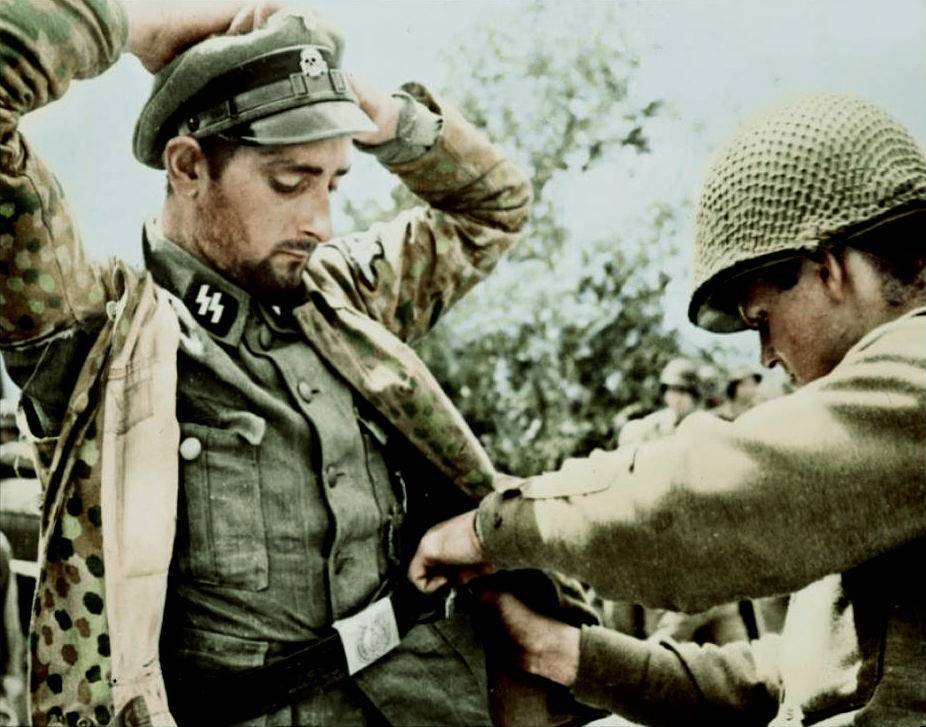
| Waffen-SS taken POWs during the counter-offensive Operation Lüttich |
Following the successful advance of the U.S.
Operation Cobra on July 25 1944 Nazi dictator Adolf Hitler personally ordered a German counter-attack code named Operation
Lüttich. It was to cut into the side of the 'neck' of the corridor through which American troops were now pouring into central France. Instead of eight Panzer Divisions, only four - one of them incomplete - could be relieved from their defensive tasks and assembled in time; the 2.SS-Panzer-Division Das Reich,
Wiener 2.Panzer-Division, 116.Panzer-Division
Windhund and part of the Leibstandarte SS, with a total of about 300 tanks. The Luftwaffe were unable to reach the battlefield and the Allies had complete air control. Allied aircraft inflicted severe losses on the attacking troops. In the open ground the Panzers became exposed targets and the counter offensive soon halted. Over 150 tanks involved in the counter attack were lost to Allied air strikes. Nevertheless, the offensive continued around Mortain for several more days. The Germans were soon outflanked to their south and the front to their east collapsed, resulting in many of the troops in Normandy being trapped in the
Falaise Pocket. Top image: U.S. B-24 Liberator long range heavy bombers just hitting the West-European continental coast on August 3 1944. Photo by
U.S. Air Force photographer sergeant Lew Funk. Credit: Nathan Howland. Private Collection. Second image: Sergeant Jack Stollery is filming when a Captain of the 2.Panzer-Division, known as the
Wiener Panzer-Division, is surrendering to Canadian Major David Vivian Currie of the South Alberta Regiment and Sergeant Major George Mitchell of the Argyll & Sutherland Highlanders of Canada in Saint-Lambert-sur-Dives. CSM Mitchell later told that the surrendering officer commonly referred to as Hauptmann Siegfried Rauch was arrogant and demanded that his surrender be taken by an officer. Mitchell responded with his rifle butt. The German officer never made it to a POW cage and it was reported that he was killed soon after the photo was taken. Private Jake Leyland of the same company of the Argylls' said about his fellow countryman:
This guy had thirteen prisoners and next day they never reached the compound - he said that they all tried to escape... Credit: Doug Banks. Library and Archives Canada. Bottom images showing captured battle-hardened SS troops of the elite Das Reich during the Lüttich near Mortain on Aug. 7-13 1944. Their facial expressions clearly reflect what's going on in their hearts. Das Reich's manpower strength was 20,184 officers and men during the early days of the
Normandy invasion, and in Sept. 1944 it reported having 12,357 men. During the war Das Reich was honored with 69 Knight's Crosses, 151 German Crosses in Gold and 29 Honor Roll Clasp recipients. It also boasted three Swords and 10 Oakleaves to the Knight's Cross holders. Its Panzer-Regiment collected 20 Knight's Crosses and 17 German Cross in Gold during 111 weeks of combat, destroying 1,730 tanks and assault guns. Already on Nov. 1 1943, the division was credited with 2,000 tank kills. Das Reich had more high award winners served in its ranks than any other division in World War II. The tactical marking of the division was a
Wolfsangel rune, normally painted in white or yellow. A temporary insignia in the shape of a horizontal bar with two vertical bars was in use prior to the
Battle of Kursk. Credit: Christian Zentner and Friedemann Bedürftig. Photos in the PD.