Showing posts with label B8: Knights at Normandy 1944. Show all posts

ϟϟ-Brigadeführer und Generalmajor der Waffen-SS Meyer – the Abbaye Ardenne Case, Canadian Military Court 10-28 December 1945

Kurt Meyer as SS-Standartenführer
SS soldiers of Kurt Meyer taken POW in Calvados
Kurt Meyer always led from the front and was wounded numerous times and several of his drivers were killed fighting alongside him. On June 14 1944, a British naval barrage hit the command post of 12.SS-Panzer-Division Hitlerjugend in Venoix, southwest of Caen, killing SS-Brigadeführer Fritz Witt leaving the division without a commander. The High Command appointed SS-Obersturmbannführer Kurt Meyer. He took command on June 17 1944 at the age of 33, thereby becoming the youngest divisional commander on either side during World War II. The Abbaye Ardenne Case: On December 10 – 28 1945, a Canadian Military Court in occupied Germany accused Kurt Meyer of having, as Commander of SS-Panzergrenadier-Regiment 25 of the Hitlerjugend, incited and counselled his men to deny quarter to allied troops. The Canadian court had not found him guilty of directly ordering the killings, but merely of tacitly condoning them - the court sentenced Kurt Meyer to death. In Meyer's closing statement before sentencing, he chose not to ask for clemency, but instead defended the record of his unit and the innocence of his soldiers. Meyer was probably saved by a petition written on his behalf by Cardinal Clemens August Graf von Galen, the archbishop of Münster, and shortly before the sentence was to be carried out, the commander of Canadian forces in Europe, Christopher Vokes had second thoughts. Vokes' main concern was the degree to which a commander should be held responsible for the actions of his men, feeling that it was not simply enough for a commander to fail to prevent such killings. Discussing the case, Vokes conceded that: there isn't a general or colonel on the Allied side that I know of who hasn't said, 'Well, this time we don't want any prisoners; indeed, he himself had ordered the shooting of prisoners in 1943. Even Canadian Army officers and journalists confirmed this in their attempts to overturn what was probably an unjust decision. Vokes commuted the sentence to life imprisonment. Meyer petitioned for clemency in late 1950 - somewhat surprisingly including an offer to serve in the Canadian military force if released. He was released from prison in 1954. Later Canadian troops found themselves accused of having killed captured German soldiers on the June 1944 invasion of Normandy. It was claimed that forces of the 3rd Canadian Infantry Division were ordered to take no German prisoners of war during the Normandy campaign, but a decision was taken not to prosecute and perpetrators have never faced justice. On June 7 1944 notes were found by Waffen-SS Grenadiers on captured Canadian prisoners saying German soldiers who had surrendered during the campaign would be shot, information later confirmed by Canadian infantry under interrogation; that prisoners were ordered not to be taken if they hindered operations. Former SS-Obersturmbannführer and author Hubert Meyer also confirmed this story; he stated that on June 8 1944 a Canadian notebook was found that contained orders to not take prisoners if they impeded the attacking force. Bitterness between Canadians and soldiers of the Hitlerjugend became a vicious circle throughout the battle for Normandy. Left image: Kurt Meyer as SS-Standartenführer in Normandy, France 1944. Credit: Ghermán Mihály. Commons: Bundesarchiv. Right image: an SS-Obersturmführer and an SS-Unterscharführer of SS-Panzergrenadier-Regiment 26 taken prisoners near Secqueville-en-Bessin on June 26 1944. PD.

ϟϟ-Brigadeführer und Generalmajor der Waffen-SS Witt

SS-Brigadeführer Fritz Witt
12.SS-Panzerdivision Hitlerjugend
In 1931, Fritz Witt from Nordrhein-Westfalen joined the SS and was one of the original 120 men picked for the special SS guard unit, known as the SS-Stabswache Berlin. This unit was the nucleus of the later Waffen-SS division Leibstandarte SS. He commanded units in both the SS-Standarte Deutschland and the Leibstandarte SS. For his leadership and bravery in a number of actions, both in Greece and in Ukraine, he won the Oakleaves to the Knight's Cross, at the age of 34. Witt received the award as SS-Standartenführer from Nazi dictator Adolf Hitler in the Führerhauptquartier Werwolf north of Vinnytsia in Ukraine on March 1 1943. After the ceremony, he went straight back to the still ongoing battle. Witt assumed his last command in the summer of 1943, when he was chosen to organize, train and lead the 12.SS-Panzergrenadier-Division Hitlerjugend. Shortly before the invasion of Normandy in early June of 1944, he was promoted to SS-Brigadeführer. Witt was the second youngest German officer to reach a General rank at only 35 years of age. On June 6 1944, the Allied invasion of France began and SS-Brigadeführer Witt led his new division of old veterans and teenage soldiers into combat for the first time. Led by its aggressive commanders, such as Kurt Meyer and Max Wünsche, the division fought extremely well and bloodied several Allied divisions during the Normandy fighting. Fritz Witt was killed aged 36 when a Royal Navy naval artillery barrage fired by HMS Rodney hit his divisional headquarters on June 14 1944 at Venoix. He was initially buried at Venoix and later reinterred at Champigny-Saint-André-de-l'Eure in France, plot 8, grave 1027. His youthful SS-Panzergrenadiers grieved openly when they found out about his death, many in tears at the loss of their beloved and highly esteemed commander. Top image: Knight's Cross with Oakleaves holder SS-Brigadeführer Fritz Witt in 1944. Credit: Bekors. c. Bundesarchiv. Bottom image: a still showing volunteers of Witt's division at the Ardenne Abbey near Caen. The film was shot on June 12 1944, two days prior to his death. The pictured soldiers are Günther Hamel and Peter Koslowski, both of 15./SS-Panzergrenadier-Regiment 25. Koslowski was killed in action aged 23 on July 25 1944. Credit: Karl Mensburg. Die Deutsche Wochenschau.

ϟϟ-Hauptsturmführer der Waffen-SS Kling

Heinz Kling as SS-Hauptsturmführer
Tiger n°331 of s.SS-Pz.Abt.101 part of 1.SS-Pz.Korps in France
Heinrich Kling from Kassel joined the SS in 1932 just short of his 19th birthday. Kling started to climb through the non-commissioned ranks in the SS-Standarte Germania of the SS-Verfügungstruppe and was identified as a potential officer candidate and took his place at the SS-Junkerschule Bad Tölz in 1938. On Nov. 9 1938 he had graduated and obtained his commission. Having initially been assigned to the Germania, he was assigned to the SS-Totenkopfstandarte 12 in Litzmannstadt in 1939. The unit was involved in so called anti-partisan duties in occupied Poland in early 1940, though there is little information on what Kling's involvement actually was. These Totenkopf-Standarten were never part of the military SS-VT or the Allgemeine SS. They belonged to the SS-Totenkopfverbände, an independent unit within the SS. Kling was then assigned to the expanding elite formation Leibstandarte SS of the Waffen-SS in time for the invasion of the Soviet Union in 1941, and had moved to the Panzers by 1942. As company commander, Kling was assigned the lead Tiger n°405. He proved his worth as a leader time after time and was always to be found at the centre of the fighting having the desire to drive forward as the lead vehicle. The campaign of 1943 saw him wounded twice. Having returned to the front at the end of 1943, he personally destroyed his 46th enemy tank on Dec. 20 1943. In 14 weeks of operational fighting his company destroyed 343 tanks, eight assault guns, 255 heavy anti-tank guns and 20 guns of heavy and medium caliber, and in Jan. 1944 he was recommended for the Knight's Cross. He was presented with the award on Feb. 23 1944, a month after his company comrade the panzer ace Michael Wittmann had received his. Part of Kling's Knight's Cross recommendation signed by Rgt. Kdr. Joachim Peiper reads as follows: [Kling] has performed excellently in all of his battles as commander of the Tiger-Kompanie. He is responsible to a major extent for the successes of the SS-Panzer-Regiment 1 LSSAH... Kling is a proven, crisis-proof, natural fighter and he is fully worthy of this proposed award. The recommendation was endorsed by Div. Kdr. Theodor Wisch and approved by Korps Kdr. Gen. Sepp Dietrich. Kling was heavily involved in the reformation of 13.(schwere) Kompanie of SS-Panzer-Regiment 1 of the Leibstandarte SS and its upgrading to battalion strength during the spring of 1944. The men of the stalwart commander Kling's elite 13th Company had more Knights Cross recipients than any other tank company. The new formation under the command of SS-Oberführer Heinz von Westernhagen was designated the schwere SS-Panzerabteilung 101. It was transferred to France in March 1944, where it fought in the Battle of Normandy. By the end of June 1944 Kling was promoted to SS-Sturmbannführer, but was severely wounded in July 1944. Following Westernhagen's removal from command and subsequent death in March 1945, Kling was appointed formally commander of the schwere SS-Panzerabteilung 101. By then, the 101st had been redesignated as the schwere SS-Panzerabteilung 501. He surrendered to the Western Allies in Steyr in Austria on May 8 1945. Bat. Kdr. Kling ended the war with a total of 51 confirmed tank kills to his credit. After the war, he worked low-paying jobs and is said to have become an alcoholic. Heinz Kling died at the age of 38 on Sept. 30 1951, having drowned at Lake Bodensee. Awards AO: Knight's Cross, German Cross in Gold and Wound Badge in Gold. Credit: The Waffen-SS Knight's Cross Holders Vol 4: 1944 by author Peter Mooney and panzerace.net. Top image: Heinrich Kling as SS-Hstuf. in 1944. U.S. NARA. Bottom image: Tiger of the s.SS-Pz.Abt.101 in France on March 21 1944. Tiger n°331 was commanded by SS-Ustuf. d. R. Thomas Amselgruber. The tank was knocked out after eliminating two Shermans at Granville in Normandy on June 28 1944. Photo by KB Hans Scheck. c. Bundesarchiv.

ϟϟ-Sturmbannführer der Waffen-SS Schreiber

Helmut Schreiber as SS-Hauptsturmführer
Original SS-Regiment Deutschland Officer's Cuff Title
Helmut Schreiber from Gießen volunteered for the SS-VT at age 21. He was assigned to SS-Standarte Deutschland, where he underwent tough physical and military training and participated in the Anschluss of Austria and the occupation of the Sudetenland in 1938. Following his training at SS-Junkerschule Bad Tölz and additional specialized training in Wien in Austria, he was assigned back to his former division, SS-Division Reich, as a platoon leader in SS-Infanterie-Regiment Deutschland. Schreiber distinguished himself in the fighting on the Eastern Front. The young officer learned all facets of the infantry war: Conducting assaults while covered by friendly mortar fire; fighting in trenches for enemy positions; combat patrols with attached flamethrower teams or snipers; house-to-house fighting in nameless villages; to name just a few aspects. Schreiber's company often experienced several days of intense fighting without a break. It demonstrated itself to be a tough unit. The regiment experienced great success in the fighting to retake Kharkov at the beginning of 1943. When SS-Obersturmführer Schreiber and his company of daredevils were victorious against a numerically superior Soviet combat formation, he personally received the German Cross in Gold from SS-Obersturmbannführer Heinz Harmel's hand. Schreiber was promoted to SS-Hauptsturmführer on June 21 1943. On July 8 1943, during the Battle of Kursk, the Soviets attacked the positions of SS-Hauptsturmführer Schreiber's battalion, supported by strong tank forces. In the sector of Regiment Deutschland, 83 enemy tanks were destroyed. Shortly after 16:00 hours the enemy broke through the open left flank. Schreiber immediately recognized the danger threatening the battalion. He mustered together a platoon of his company and conduted a textbook assault into the flank of the enemy. After a bitterly hard battle the enemy was thrown out of his positions. Taking advantage of the initial success, Schreiber began a further attack on his own initiative and advanced  through no-man's-land. In a sweeping attack the enemy positions were overrun and captured. Schreiber's actions closed the enemy's essential escape route. For those actions, he was awarded the covered Knight's Cross on July 30 1943. On April 1944, Schreiber was promoted to SS-Sturmbannführer and given command of III./SS-Panzergrenadier-Regiment Deutschland. After an urgently needed reconstitution in France, the experience and combat power of 2.SS-Panzer.Division Das Reich were brought to bear on the Invasion Front in May 1944. But against the material superiority of the British and the Americans, even the battle-scarred Waffen-SS veterans were powerless. Despite it all, however, Schreiber had some success during the defensive fighting at Caen and Falaise. SS-Sturmbannführer Helmut Schreiber and the equally highly decorated SS-Brigadeführer Sylvester Stadler surrendered to the Americans in Austria on May 4 1945. Before the proud SS veteran took this final difficult step, he had the presence of mind to save his awards from the greedy hands of the victors. The Knight's Cross and the Close Combat Clasp in Gold lasted through the months of captivity in the hollow wooden leg of an officer comrade. As a result, the deserving warrior had those awards until his last day of life. Schreiber was one of only 98 German soldiers that received both the Knight's Cross and the Close Combat Clasp in Gold. After the war, he was wanted by the French authorities for suspected involvement in the Oradour massacre. Therefore, Schreiber lived under the false name Helmut Kraus. In 1957, he was recruited by the West German Federal Intelligence Service (BDN) from which he retired in 1980. Schreiber died aged 91 on Dec. 6 2008 in München. Source: Florian Berger: The Face of Courage. Images: Fair use.

ϟϟ-Obersturmbannführer der Waffen-SS Weidinger

Otto Weidinger as SS-Sturmbannführer
Original SS-Regiment Der Führer Officer's Cuff Title
Otto Weidinger from Würzburg in Bayern enlisted in the SS-Verfügungstruppe in April 1934. 
He volunteered for officer training and entered the SS-Junkerschule in Braunschweig in May 1935. Weidinger first saw combat with
 the SS-Standarte Deutschland during the 
invasion of Poland in 1939. After subjugating Poland, his unit participated in the Battle of the Netherlands, where he distinguished himself, earning the Iron Cross First Class. During Operation Barbarossa, Weidinger served on the divisional staff of SS-Division Reich. In June 1943, he saw significant combat action at the Battle of Kursk where he received a serious head wound while serving in SS-Regiment Germania. In April 1944, Weidinger was awarded the Knight's Cross and the assumption of command of SS-Panzergrenadier-Regiment 4 Der Führer of the 2.SS-Panzer-Division Das Reich at the Normandy coastline. After two months of heavy fighting following the D-Day invasion, Weidinger's unit, along with 80,000 other German troops, were surrounded in what would be known as the Falaise Gap. Faced with the prospect of surrender or annihilation, Weidinger had his unit constantly probe the enemy line for weaknesses, which he then exploited by using his remaining Panzers. Ten thousand German troops were able to escape the collapsing pocket. For his actions in the face of near-certain defeat, Weidinger was awarded Oakleaves to his Knight's Cross in December 1944. One of the last things Weidinger did before surrendering to U.S. forces was to use his men to save as many ethnic German civilians and conscripts as possible from imminent massacre in Prague. He did so by leading a convoy of several hundreds of cars and trucks in all thinkable shapes and sizes out of Prague just a few days before wars' end. After the end of WWII, Weidinger was imprisoned by the Americans, along with thousands of other Waffen-SS men who were automatically considered war criminals by virtue of being volunteers in the Waffen-SS, which was designated as a criminal organization by the Allies. After 6 and 1/2 years in prison, he was finally put on trial as a war criminal, along with 50 other Waffen-SS soldiers. All were charged with a war crime for being volunteers in the Waffen-SS. He was acquitted by a military court in Bordeaux in France on June 19 1951 and released on June 23 1951. Upon his release, Weidinger worked as a pharmacist until his retirement. From 1967 to 1982, he wrote Comrades to the End - the complete regimental history of the German-Austrian SS-Regiment Der Führer as well as a 6 volume history of SS-Division Das Reich consisting of five text volumes and a photo compilation. In 1984, he published a controversial account of the Tulle massacre: Tulle and Oradour. A German-French tragedy. SS-Ostubaf. Otto Weidinger died aged 75 on Jan. 10 1990 in Baden-Württemberg. Awards i.a.: Knight's Cross with Oakleaves and Swords, Wound Badge in Silver, Close Combat Clasp in Bronze and Tank Destruction Badge. Top image: Private collection. Fair use.

ϟϟ-Obersturmbannführer der Waffen-SS Wünsche

Formal studio portrait of Max Wünsche
Battlefield portrait of Max Wünsche
In June 1943, SS-Sturmbannführer Max Wünsche was transferred from the SS-Panzergrenadier-Division Leibstandarte SS to 12.SS-Panzer-Division Hitlerjugend, and took command of SS-Panzer-Regiment 12 when the Allied landed in Normandy. Wünsche led his young SS-Panzergrenadiers through hard and costly fighting during the days after the invasion, experiencing particularly bitter combat at Caen during which he was wounded. In the following battles Wünsche's regiment was credited with the destruction of 219 Allied tanks up to the beginning of July 1944, which gained Wünsche the award of the Oakleaves to his Knight's Cross. By early August 1944, his regiment was reduced to a handful of still operational panzers and was encircled in the Falaise Pocket along with the rest of 12.SS-Panzer-Division Hitlerjugend, which had lost over 8,000 men by the time. Wünsche, his adjutant SS-Hauptsturmführer Georg Isecke, SS-Untersturmführer Fritz Freitag and a wounded medical officer, escaped out of the pocket on foot. During the escape Wünsche was wounded in the calf and was later captured by the British. Wünsche spent the rest of the war as a Prisoner of War in camp 165 at Caithness in Scotland which was a special camp for high ranking German officers. He was released in 1948 and returned to Germany and became a manager of an industrial plant in Wuppertal until his retirement in 1980. Max Wünsche died aged 80 on April 17 1995. He was known for his outstanding bravery and leadership. Awards i.a.: Knight's Cross with Oakleaves, German Cross in Gold and Wound Badge in Silver. Images: Max Wünsche as SS-Stubaf. in Feb. resp. March 1943. Credit: Bekors. c. Bundesarchiv.

ϟϟ-Hauptsturmführer der Waffen-SS Wittmann

Michael Wittmann as SS-Obersturmführer during the Normandy campaign
Tiger ace Michael Wittmann in the cupola of Tiger n°231
Schwere SS-Panzerabteilung 101
During SS-Hauptsturmführer Michael Wittmann's many campaigns both on the Eastern front and in the West, Wittmann was to make a name for himself with his exceptional skill and bravery, and was highly respected both by friend and foe alike. While his skill had been recognised on the harsh battlefields on the Eastern Front, his exploits during the Normandy Campaign of 1944 - and the famous assault of elements of the British 7th Armoured Division, during the Battle of Villers-Bocage on June 13 1944 - were to elevate him to the status of a legend. While in command of a single Panzerkampfwagen VI Tiger, Wittmann destroyed up to 14 enemy tanks including Cromwells, Sherman Fireflys and M3 Stuart tanks and two 6-pounder anti-tank guns and several armoured Universal and Loyd Carriers and half-tracks in a very short time in and around Villers-Bocage. Michael Wittmann, nicknamed 'The Black Baron, is credited with the destruction of 138 tanks and 132 anti-tank guns, along with an unknown number of other armoured vehicles making him one of the worlds top scoring Panzer aces, together with Hauptmann Johannes Bölter (schwere Panzer-Abteilung 502), SS-Oberscharführer Ernst Barkmann (2.SS-Panzer-Division Das Reich), Lieutenant Otto Carius (schwere Panzer-Abteilung 502) and Feldwebel Kurt Knispel (12.Panzer-Division) who was the top scoring ace of World War II with 168, possibly as high as 195, tank kills. Michael Wittmann was killed aged 30 on August 8 1944 while taking part in a counterattack ordered by SS-Brigadeführer Kurt Meyer of the 12.SS-Panzer-Division Hitlerjugend to retake tactically important high ground near the town of Saint-Aignan-de-Cramesnil. There is however considerable conflict surrounding the exact details of Wittmann's death. The unmarked field grave of Tiger n°007's crew was discovered in 1983. It was possible to identify the remains by Wittmann's dental records and his driver SS-Unterscharführer Heinrich Reimers identification tag. They were then reinterred together at the German war cemetery of La Cambe in France. Units: 1.SS-Panzer-Division Leibstandarte SS Adolf Hitler and schwere SS-Panzer-Abteilung 101. Awards among others: Knight's Cross of the Iron Cross with Oakleaves and Swords. Here's a link to an interview with Michael Wittmann recorded by KB SS-Hschaf. Dieter Menninger shortly after the Villers-Bocage action on June 13 1944Clip and stills: Michael Wittmann as SS-Obersturmführer shortly after the award of the Swords. The film was shot only a few weeks before he met his end in a fiery ambush in the Calvados in Normandy. Die Deutsche Wochenschau.

ϟϟ-Untersturmführer der Waffen-SS Günther

Alfred Günther as SS-Hauptscharführer
Alfred Günther from Magdeburg in Sachsen joined the SS-Verfügungstruppe in 1937 and commanded 3.Kompanie of SS-Sturmgeschütz-Abteilung 1 of the Leibstandarte SS until 1943. Günther distinguished himself through his extraordinary bravery and ruthless devotion to duty throughout the war. He became the first member of the Assault Gun Battery to be awarded the Knight's Cross of the Iron Cross. Günther then joined the schwere SS-Panzer-Abteilung 101 where he later came to command Tiger n°311. Each Panzerkampfwagen Tiger was given a three-figure turret number – the first signified the company, the second the platoon, and the third the individual vehicle number. Alfred Günther was killed aged 27 in Évrecy in Normandy when his tank received a direct hit by an aircraft bomb on June 15 1944. Most sources give his final rank as SS-Hauptscharführer, however he was posthumously promoted to SS-Untersturmführer. John P. Moore also gives his final rank as SS-Untersturmführer in the publication Führerliste der Waffen-SSAlfred Günther is buried at the German war cemetery of La Cambe in France: Block 30 Row 8 grave 303. Image: Alfred Günther pictured here as a SS-Hauptscharführer after receiving the Knight's Cross of the Iron Cross on March 3 1943Photo by SS-KB Johan KingCredit: Bekors. c. Bundesarchiv.

ϟϟ-Hauptsturmführer der Waffen-SS von Ribbentrop

Rudolf von Ribbentrop as SS-Obersturmführer
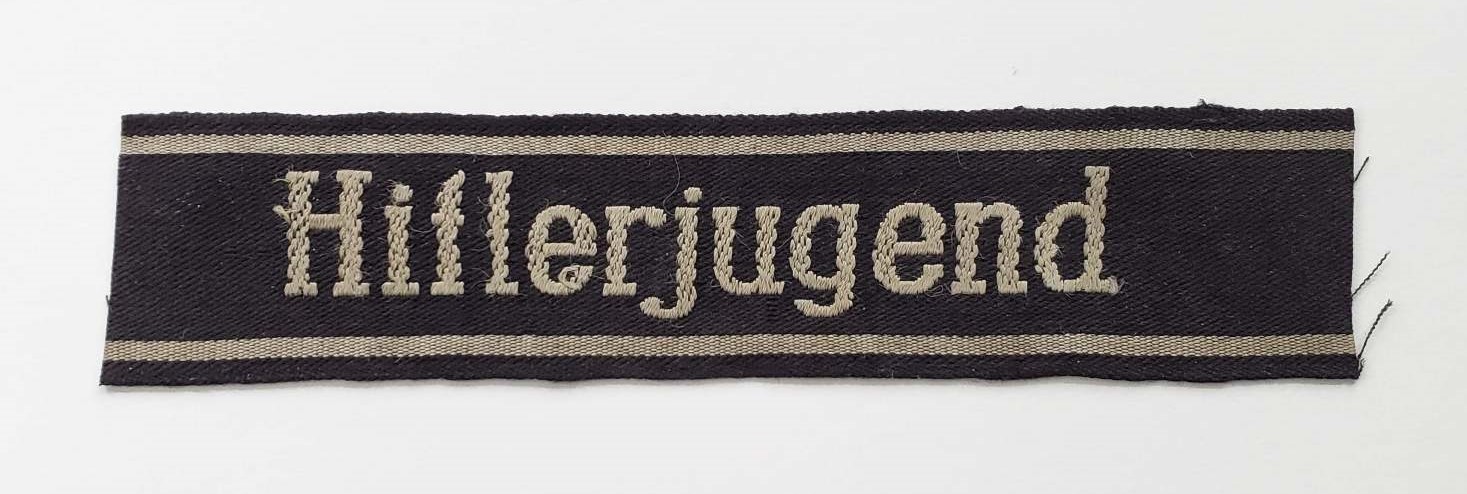
Original SS-Division Hitlerjugend Cuff Title
At the start of World War II Rudolf von Ribbentrop, son of the German diplomat and Foreign Minister Joachim von Ribbentrop, enlisted as a recruit in SS-Standarte Deutschland. After the invasion of Poland 
and the Western Campaign von Ribbentrop was sent to SS-Junkerschule in Braunschweig. He was commissioned on April 20 1941 as a SS-Untersturmführer and given command of a platoon in SS Nord Reconnaissance Battalion. Upon the invasion of Soviet Union, SS-Kampfgruppe Nord was sent to Finland where von Ribbentrop was to distinguish himself and was awarded the Finnish Order of the Cross of Liberty. 
After being wounded he was reassigned to the newly formed Panzerregiment of the Leibstandarte SS. During the retreat from Kharkov in Feb. 1943 von Ribbentrop was shot in the right shoulder blade and left shoulder.
During the action, Soviet sniper wounded Ribbentrop through lung. He refused to be pulled back to a hospital, but instead went to rescue wounded soldiers. von Ribbetrop was awarded the Iron Cross First Class for his personal bravery in these battles. He then took command of 7.Kompanie (II./SS-PzRgt 1) during the recapture of Kharkov in March 1943. One month later he was awarded the Knight's Cross. von Ribbentrop was later transferred to the newly formed 12.SS-Panzer-Division Hitlerjugend and appointed commander of 3.Kompanie (I./SS-PzRgt 12). On June 3 1944 on the way to Le Neubourg, his car was attacked by a Spitfire, and von Ribbentrop was wounded for the fourth time. By June 9 1943, he was back in command of his company. During the defensive battles in Normandy, von Ribbentrop was awarded the German Cross in Gold and the Panzer Assault Badge. Following the breakout from the Falaise Gap, von Ribbentrop was made Regimental Adjutant to SS-Panzer-Regiment 12. It was in this capacity that he saw action during 
Op. Wacht Am Rhein. On Dec. 20 1944 he was wounded for the fifth time with a shell fragment in his mouth. He was awarded the Wound Badge in Gold, and was given command of SS-Panzer-Regiment 12, which he commanded until the Hitlerjugend surrendered to the Americans on May 8 1945. Rudolf von Ribbentrop is born on May 10 1921 in Wiesbaden and is still alive in 2011. Top image: Credit: Julia Kotterias. Private Collection. Fair use.

ϟϟ-Obersturmbannführer der Waffen-SS Bremer

Gerd Bremer as SS-Obersturmführer
During the Normandy Invasion the Leibstandarte veteran SS-Sturmbannführer Gerhard Bremer from Saarbrücken was trapped with his Battalion of the SS-Panzergrenadier-Regiment 26 of the 12.SS-Panzer Division Hitlerjugend in the Falaise Gap, but was finally able to withdraw to the Maas river covering the retreat of the 5.Panzer Army for which he was awarded the Oakleaves to the Knight's Cross. He was next involved in the Ardennes Offensive in December 1944 and Operation Spring Awakening in March 1945 in Hungary and ended WWII in the area of St. Pölten in Lower Austria. Bremer was kept as a prisoner of war by the French Government from July 1948 to 1954. After his release Bremer moved to Dénia on the Costa Blanca in the Alicante province of Spain. SS-Obersturmbannführer Gerhard Bremer died on October 29 1989 in Alicante in Spain. Awards among others: Knight's Cross of the Iron Cross with Oakleaves and the German Cross in Gold. Image: Gerd Bremer pictured in the SS white summer jacket carrying the Knight's Cross in 1942. This photo was taken in Ukraine by Paul Augustin who served as a SS-Kriegsberichter with the Leibstandarte SS from at least 1940 until his death on March 9 1943. During that period, Augustin took many hundreds of photographs of his unit, and a collection of those photographs is maintained by the U.S. National Archives. Another photo of Bremer taken by Adolf Hitler's personal photographer Heinrich Hoffmann appears on the front cover of Waffen-SS Knights and their Battles: The Waffen-SS Knight's Cross Holders Vol 1: 1939-1942 by Irish-born author Peter Mooney. U.S. NARA.

ϟϟ-Obersturmbannführer der Waffen-SS Tychsen

Christian Tychsen as SS-Sturmbannführer
Christian Tychsen first joined the 50.SS-Standarte in 1931 before being transferred to the newly formed SS-Verfügungstruppe and SS-Standarte Germania in 1934. During the war he commanded various units within the Waffen-SS before he became commander of SS-Panzer-Regiment 2 of the 2.SS-Panzer-Division Das Reich in November 1943. After being wounded more than nine times in total, Tychsen was severely wounded in Normandy on the afternoon of July 28 1944 while his VW Kübelwagen was ambushed and fired upon by an American M-4 tank of the 67th Armored Regiment. He died as temporary commander of Das Reich aged 33 of his wounds in American captivity, and was stripped of all his decorations and all other types of identification for souvenirs - as a result SS-Obersturmbannführer Tychsen was buried as an unknown soldier. Tychsen was finally identified in the 1970's and rebuired with full honors. Awards among others: Knight's Cross with Oakleaves, German Cross in Gold and Wound Badge in Gold. Image: a formal studio portrait of the Reich veteran Christian Tychsen. He was awarded the Knight's Cross after the recapture of Kharkov on March 31 1943 and the Oakleaves on December 10 the same year. The photograph was taken by the South Tyrol-born war correspondent SS-Kriegsberichter Friedrich Zschäckel. Commons: Bundesarchiv.

ϟϟ-Sturmbannführer der Waffen-SS Waldmüller

SS-Sturmbannführer Hans Waldmüller
SS-Sturmbannführer Johann Hans Waldmüller joined the SS-Verfügungstruppe at 22 years old in 1934 and was assigned to the SS-Standarte Deutschland. He was transferred to the motorized infantry regiment Leibstandarte SS in the summer of 1940 for the Battle of France. He then took part in the Balkans Campaign and Operation Barbarossa in 1941. Waldmüller was one of the many Leibstandarte SS officers selected for transfer to the newly formed 12.SS-Panzer Division Hitlerjugend in 1943. Here he became the commander the 1.Battalion of SS-Panzergrenadier-Regiment 25. Waldmüller held the right flank position of the Hitlerjugend for weeks against the hardest attacks, under constant naval artillery. He was awarded the Knight’s Cross on August 27 1944 for his unit’s defensive achievements during the fierce battles around Caen in Normandy. Waldmüller stood in the midst of his men, the very soul of resistance, according to SS-Brigadeführer Kurt Meyer. During the German retreat through Belgium, Waldmüller, age 31, was lured into an ambush by Belgian communist partisans near Basse-Bodeux between Werbomont and Stavelot on September 8 1944. When Waldmüller's mutilated body was recovered by his troops it was slashed open, the genitals were cut off and his body was dumped into a drainage pipe. He had fought bravely for five years and was known for his adventurous and daring acts. Hans Waldmüller – along with SS-Untersturmführer Karl Markart who was murdered by headshot in the same incident – rests at the German military cemetery at Düren-Rölsdorf near Aachen in Germany. Awards among others: Knight's Cross of the Iron Cross, German Cross in Gold and Wound Badge in Silver. Image: Knight's Cross holder SS-Sturmbannführer Hans Waldmüller wearing an Italian M29 Telo Mimetico camo smock. Photo taken only a few days before he got murdered. PD.